About this blog

This blog is all about fly fishing for native trout. On it I cover trip reports, fishing tactics, conservation, the latest news about native trout species and much more. This site provides a companion to my web page Nativetroutflyfishing.com.

Gary
Showing posts with label John Day Westslope Cutthroat. Show all posts

Wednesday, July 13, 2022

High Desert Angling: Part 3 - Ending on a Good Note

Day 4: Monday July 4th 2022: After a good night sleep, we got on the road early headed for the Santa Rosa Mountains in pursuit of the Quinn River Cutthroat Trout. For years the Quinn River Cutthroat had been either lumped in with Humboldt or Lahontan Cutthroat, but recent genetics work had indicated that they are distinct enough to warrant subspecies status. Back in September of 2019, I had made a trip down to the Santa Rosa Mountains to look for Quinn River Cutthroat only to be foiled by a freak snowstorm that made access to the small streams draining the mountains impossible. This time it was a beautiful bluebird day and the weather couldn’t have been further from that first trip. 

Turning off the highway and heading for the Mountains, we hit another genuinely awful dusty and deeply rutted dirt road, that was swarming with 3” Mormon Crickets. Luckily my car was up to another rough road and we made it to the trailhead at the mouth of the canyon with no issues. The first thing that struck me when we got out of the car was the noise, which was a cacophony of thousands of Crickets and Cicadas, both of which appeared to be having population booms. We quickly geared up and hit the trail headed for a waterfall, that served as a barrier to nonnative Brook Trout, blocking them from the native Quinn River Cutthroat upstream. As we followed the canyon towards the falls, the creek remained completely obscured by an impenetrable wall of vegetation, somehow the thickest of any of the creeks we had visited so far. Mormon Crickets were everywhere, making so much noise that I was worried we might stumble upon a rattlesnake without hearing it. With that very real threat, we took the cautious slow and steady approach, but it didn't take long for us to reach the falls, above which we would hopefully find some native trout.

The falls 
So many Mormon Crickets!

As we had to go by the falls to get to the upper valley, I figured we might as well stop on the way and see if any fish had washed over. The waterfall was beautiful, but the biggest thing of note was the smell. With the cricket boom, thousands had fallen into the stream and many of these had collected along the edges of the waterfall pool.

Lots of dead crickets

Usually one of the wonderful traits of native trout in small streams is their refusal to pass up food, resulting in quick rises. However, with all of the crickets falling in the stream, the fish in this creek were not as accommodating and cast after cast produced no results. Finally, on a near perfect drift my dry fly disappeared below the surface indicating a grab on my nymph. The battle was quick and luckily for me Derek was on hand to net my first Quinn River Cutthroat. The Cutthroat was a small, exceptionally fat fish, lightly spotted across its body, with a beautiful rose color across its sides.

An exceptionally fat little Quinn River Cutthroat

After I got my Cutthroat, Derek took point for a bit but we didn’t find any other fish in the waterfall hole or the creek right below it. This prompted us to head upstream, where we hoped fishing would improve. The few promising pools directly above the falls showed no signs of life and the dense vegetation made continuing upstream impossible, so we decided to hit the trail. We worked our way up the canyon looking for an opening in the vegetation or some promising looking water, but it was hard to come by. We did find some slightly open water over a mile upstream and fished the area hard but there was no sign of fish. The morning was already wearing on and we decided to start working down the canyon and pop into the stream wherever we could find access. Again no fish.

The upper valley... No fish...

When we got back to the falls we tried that area again, but didn't find any additional fish. We did find a few more spots to access the stream as we worked our way toward the trailhead, however it wasn’t until we reached the trailhead that Derek managed to hook another fish. Unfortunately, this turned out to be a Brook Trout instead of a Cutthroat. After another fishless half hour downstream of the trailhead, the day was wearing on and if we wanted to reach our next stop at a reasonable time, so we had to get on the road.
Time to hit the road again

After leaving the stream in the Santa Rosa range, we started the last leg of our trip. It was a five hour drive to our next stream in the upper John Day drainage, which felt particularly long after so many miles on the road. After several days driving through sage brush desert, coming over a rise just north of Burns Oregon and find ourselves in driving through towering pine trees signally our exit from the interal desert basins. 

We reached the upper John Day watershed around 5pm, opting for fishing over dinner. Like our attept to catch the Humboldt Cutthroat the previous day, the John Day Westslope Cutthroat was not a new fish for me, having caught one in 2019. However, I prefer to represent as many fish as possible on my website to show phenotypic diversity, so we were back to see if we could find more this time. Acting on a tip from Steve we were targeting a very small headwater stream, which was report to only hold Cutthroat. Arriving at the stream it looked like we could jump across it in most places and flowed through a meadow upstream of the road and spruce and fir forest downstream of the road. I decided to start downstream of the road, while Derek went upstream. Upon reaching the waters edge, I was immediately met with a good sign, as handful of trout were clearly visible holding in the middle of the pool below the culvert. My first cast wasn't ideal, with my flies making the water but my line hanging up on a branch over the stream. However, the drift was good and the largest of trout made a slow and deliberate rise to my dry fly. The hookset pulled my line free of the branch and even with my 1wt I was quickly able to pull the trout away from the others and land it in the tailout of the pool. Given the challenges provided by the rest of the trip, this was a very welcome change.. 

A beautiful darkly colored John Day Westslope Cutthroat

While the light wasn't ideal at this point of the day,  I managed to get a few decent photos then turned the fish loose. The photography time allowed the hole to rest and a few more casts resulted in another fish, this time on my dropper. After I hooked a third, which I lost, effectively putting off the rest of the hole. I worked downstream a ways hooking and losing a few more fish, but also finding the stream to be quite brushy, prompting me to head upstream and see how Derek was doing. 

The creek above the road was much more open than downstream and Derek was also getting into cutthroat, with every likely and many of the unlikely lies holding trout. We worked the productive little stream for a couple of hours catching a number of Cutthroat before the need to set up camp and make dinner finally pulled us away.

Derek working the stream for Cutthroat

Another Westslope Cutthroat

With our mission for the day complete and having just experienced the best fishing of the entire trip, we settled into camp for the evening, ready to turn our path towards home the next day.

Day 5: Tuesday July 5th 2022: We awoke early on the last day of our trip, although we had a long ways to go still with a roughly eight hour drive for me to reach home, we didn't feel the need to rush. As such, we took our time breaking down camp, enjoying a slower pace before hitting the road. While we had no directed plans to fish on the way back, we found ourselves driving along a beautiful little meadow stream that was too tempting to pass by and decided we could spare a few minutes to wet a fly.

Our last stop on the trip

Fishing at this stream proved to be just as fast paced as the stream from the previous evening and within a few casts we each had caught ourselves a Redband Trout. With the fish abundant and the stream open, we only spent about 30 minutes on the water, long enough to catch 3 or 4 Redbands apiece before hitting the road.

A small but beautiful Columbia Basin Redband Trout

The rest of the drive was as rather uneventful, putting back at Derek's house around lunchtime and myself home in time for dinner. This was one of the faster paced and more challenging trips that I have been on, but with with use managing to catching five varieties of native trout and three additional nonnatives, it certainly was a success. Likely this will be my only major out of state native trout road trip this year, pushing my thoughts towards next years plans of a trip to Colorado to round out my remaining Cutthroat subspecies.

Monday, October 14, 2019

Back on the Road Again: Native Redbands and Cutthroat of Eastern Oregon

With all of the changes that life has thrown my way over the last few years. For the first time in years I headed out on the road (along with my cousin Derek, who has joined me on several other past trips) with some new native trout to target as well as some old ones to revisit. This trip was all revolving around the American Fisheries Society in Reno, Nevada at which I was presenting, but I was able to add a couple of days on each side of the conference to target some native trout.  The main targets of the trip were the White River Redband, John Day Westslope Cutthroat, Willow-Whitehorse Basin Cutthroat, Quinn River Cutthroat, Eagle Lake Rainbow Trout and possibly some McCloud River Redband Trout.

Day 1: Friday September 27th 2019: Derek and I hit the road bright and early, heading south from my home in Olympia, Washington towards the White River watershed in north-central Oregon. The White River flows from the glaciers of Mt. Hood into the of the Deschutes River just downstream of Maupin, OR.  While the Deschutes River holds Columbia Basin Redband Trout, the Redband Trout found above a series of waterfalls on the White River are genetically distinct from the fish in the Deschutes and identify more closely related to Fort Rock Redbands in the Great Basin, with recent studies indicating that they likely warrant a subspecies designation. As the White River is glacially fed, it has very poor visibility so I selected a couple of tributary streams to fish for these trout. Unfortunately, when we arrived the first of these streams had no public access on the lower end and the flows on the second stream were so low that we could not find any holding water and only managed to rise one small fish. Luckily we were able to find a small irrigation impoundment on the second stream that offered some great looking holding water.

The irrigation pond

This spot called for beaver pond tactics, so Derek and I tied on some Zug Bugs and started fishing. Letting the Zug Bugs sink for several seconds and retrieving them with short twitches proved quite effective and in short order I had caught a a few beautiful Redbands including a 10" beauty.

A White River Redband Trout

While we were successful on our first fish of the day, it took much longer than planned and we still had a long drive to the upper John Day River to look for Westslope Cutthroat and it looked like with the shorter days of fall every minute of daylight was going to count.

The middle John Day River from the road

We arrived at the stream with about an hour of daylight to spare and got to fishing with a dry dropper rig right away. We were able to locate a good piece of holding water almost right away, and on one of the first cast I hooked a fish. Could it be that easy? Unfortunately not, it turned out the fish was a small Columbia Basin Redband - likely a juvenile steelhead and the next fish out of the hole also turned out to be a Redband too.

A small Redband from the stream

After the second fish, the hole shut down so we started heading downstream. Unfortunately it seemed that this stream was lacking in good holding water and while we found a couple more small Redbands and a juvenile Chinook, there was no sign of any Cutthroat nor any water that was likely to hold them. After trudging downstream close to a half mile and watching the daylight fade, I finally came across a great looking piece of holding water where a tributary entered the stream. However, while the first spot had produced fish right away, this spot which looked even better showed no sign of life. After a number of a great drifts through every inch of the hole, I crept closer for a better look. Right where I figured a trout should be holding, there was a nice summer run Steelhead, which also saw me and decided it was time to head for cover.

Steelhead holding water

At this point the daylight was fading fast and it was time to head back upstream. While it seemed that I was going to have to admit defeat on the John Day Cutthroat, I figured a couple more casts in the first spot I tried wouldn't hurt. On the second cast I was rewarded with a rise and after solid hookup and after a short fight I brought a nice little John Day Cutthroat to hand!

A John Day Westslope Cutthroat

By the time I let the Cutthroat go, it was clear that there wasn't enough light to continue fishing so we hit the road for Burns, Oregon where we were staying the night.

Day 2: Saturday September 28th 2019: Overnight a cold front had blown in an we woke to a frosty morning in Burns with the possibility or rain and snow in the forecast. Our goal for the day was to fish for Willow-Whitehorse Cutthroat in southeastern Oregon before crossing to border into Nevada and trying for Quinn River Cutthroat. I had fished for and caught Willow-Whitehorse Cutthroat in 2006 (over 13 years ago already - yikes!), but fire had ravaged the area in 2012 and I wanted to return and see how it was looking and if I could find a few trout. By the time we got to the stream it was mid-morning and the temperature had warmed to the mid 40's F although a stiff wind was blowing. Luckily the fire had missed this stretch of stream and looked almost exactly how I remembered, so it was time to look for some trout.

Desert Cutthroat water

Looking for trout didn't take too long, and the first spot that I came to, the outflow a beaver pond produced two nice Willow-Whitehorse Basin Cutthroat.

Willow-Whitehorse Basin Cutthroat

Just like the last time that I had been to this stream a dry dropper rig with a black Copper John appeared to be the ticket. We fished up and down the stream for a couple hours, running into on lethargic rattlesnake and catching a bunch more Cutthroat in the 6-10" range before the weather started to turn on us, with snow clouds visible on the hills just a few miles off and it was time to hit the road again.

The rattlesnake

Another Willow-Whitehorse Cutthroat

While we were doing to just fine on daylight this time, the weather was whole other matter was turning fast. By the time that we hit the Nevada border, it was snowing in earnest and the Quinn River Cutthroat which required some rough roads up into the mountains was going to have to wait for another trip, so we headed on for Winnemucca, NV to grab a hotel for the night.

Snowed out of for the day

Day 3: Sunday September 29th 2019: With a good coat of snow on all of the hills around Winnemucca in the morning there was no way we were going to have any luck fishing for Quinn River Cutthroat so we headed for Reno, NV for the conference.

Day 4: Monday September 30 - Day 7: Thursday: October 3rd 2019: These days were all spent at the conference. Lots of great talks and I even got myself a great new book!

Also picked up a new book at the conference

Day 8: Friday October 4th 2019: We got up in the morning and made the drive out to Eagle Lake, California to try for Eagle Lake Rainbow Trout. We were still a bit early as the trout are known to move into the shallows in mid-October as the water cools. However, I was hoping that recent cold front might have done the trick. This proved to be wishful thinking. We fished for the better part the day, trying everything we could think of, from casting into the tulles to trolling flies deep. We only saw one fish rise and may have had one soft take but other than that lots and lots of fruitless casting.

Eagle Lake, California

Fishing Eagle Lake

The Eagle Lake Rainbow had been the fish I was most keen on getting on this trip, as I have had a number of potential trips planned over the years but had never been able to make it happen. Hopefully I will be able to make another try at the Eagle Lake Rainbow next spring, but regardless it is always hard getting skunked on a trout so far from home. After trying Eagle, we headed north towards home and ended up camping on a McCloud River Redband stream near the slopes of Mount Shasta that I had fished back in 2007. We got camp set up right before dark and temperatures plummeted quickly on us dropping into the 20's F and proving to be one chilly night in a tent.

Day 9: Saturday October 5th 2019: It was quite chilly in the morning, but the sun was out and it warmed up rather quickly. Once it was warm enough to feel our fingers, we got the rods rigged up and went to check out the creek. The last time that I had been to this stream, the fishing had been great, with every likely looking spot holding a trout. However, a lot can change in 12 years, and unfortunately for this stream those changes were not good. Upon checking out the stream, it was clear that cattle had been unleashed on the watershed and had done serious damage.

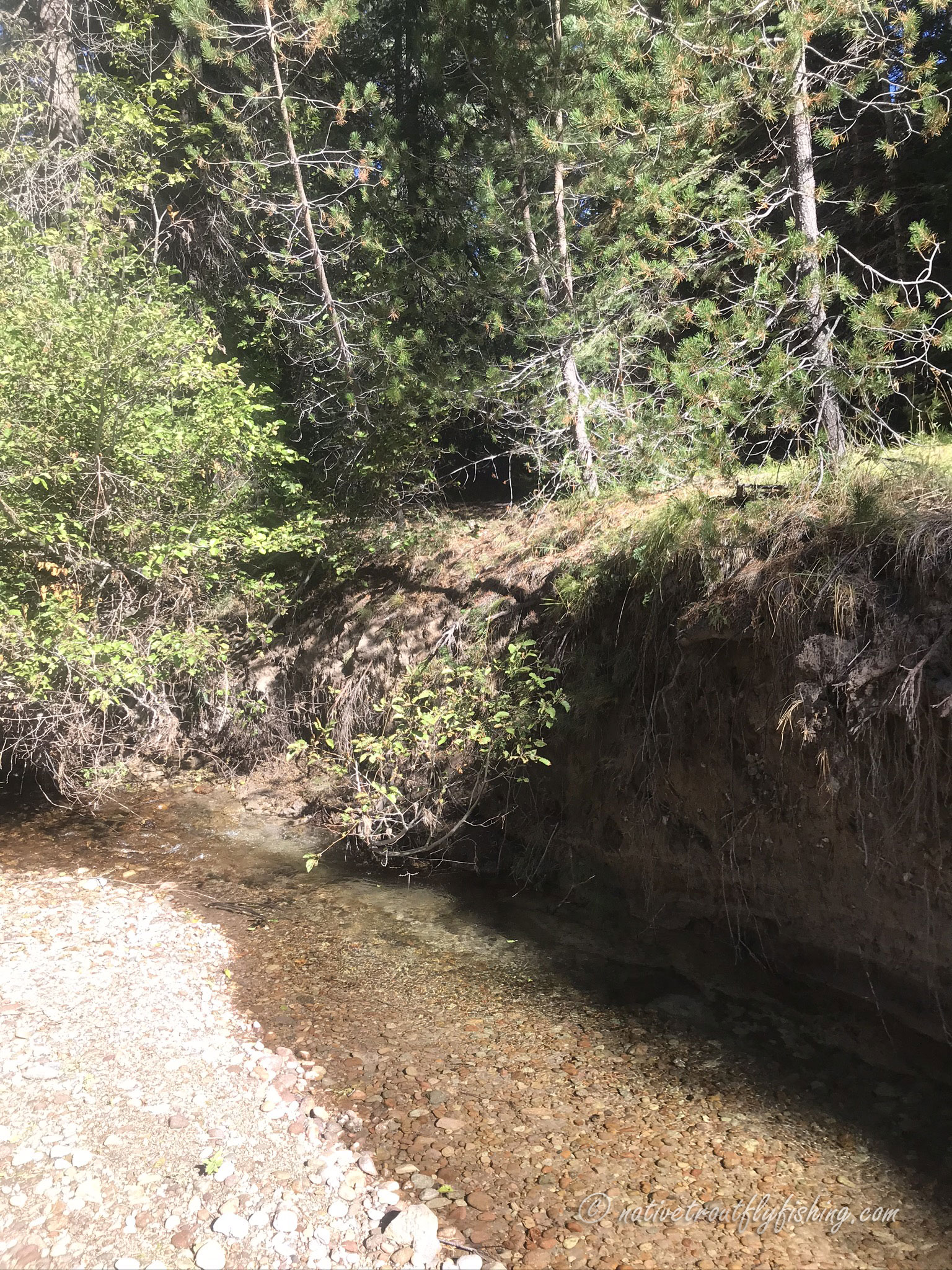
Cattle caused erosion

We covered more than double the water I had fished last time, but the habitat was absolutely destroyed, with caved in banks and erosion and we saw not a single sign of trout. 

Incised stream channels

Given the habitat, it would have been a miracle if we had found a trout in this stream and as we had a long drive home still we decided that it was best to cut our losses and get on the road again. Along the way we stopped at Crater Lake National Park and had a nice quite drive back to Olympia. 

Crater Lake

All and all, it was a great trip, with us getting 3 of the 6 fish that we had hoped to catch. Hopefully next year I will be able to get out again, as it felt great to get out for another native trout road trip after such a long time.