About this blog

This blog is all about fly fishing for native trout. On it I cover trip reports, fishing tactics, conservation, the latest news about native trout species and much more. This site provides a companion to my web page Nativetroutflyfishing.com.

Gary
Showing posts with label Nevada. Show all posts

Wednesday, July 13, 2022

High Desert Angling: Part 3 - Ending on a Good Note

Day 4: Monday July 4th 2022: After a good night sleep, we got on the road early headed for the Santa Rosa Mountains in pursuit of the Quinn River Cutthroat Trout. For years the Quinn River Cutthroat had been either lumped in with Humboldt or Lahontan Cutthroat, but recent genetics work had indicated that they are distinct enough to warrant subspecies status. Back in September of 2019, I had made a trip down to the Santa Rosa Mountains to look for Quinn River Cutthroat only to be foiled by a freak snowstorm that made access to the small streams draining the mountains impossible. This time it was a beautiful bluebird day and the weather couldn’t have been further from that first trip. 

Turning off the highway and heading for the Mountains, we hit another genuinely awful dusty and deeply rutted dirt road, that was swarming with 3” Mormon Crickets. Luckily my car was up to another rough road and we made it to the trailhead at the mouth of the canyon with no issues. The first thing that struck me when we got out of the car was the noise, which was a cacophony of thousands of Crickets and Cicadas, both of which appeared to be having population booms. We quickly geared up and hit the trail headed for a waterfall, that served as a barrier to nonnative Brook Trout, blocking them from the native Quinn River Cutthroat upstream. As we followed the canyon towards the falls, the creek remained completely obscured by an impenetrable wall of vegetation, somehow the thickest of any of the creeks we had visited so far. Mormon Crickets were everywhere, making so much noise that I was worried we might stumble upon a rattlesnake without hearing it. With that very real threat, we took the cautious slow and steady approach, but it didn't take long for us to reach the falls, above which we would hopefully find some native trout.

The falls 
So many Mormon Crickets!

As we had to go by the falls to get to the upper valley, I figured we might as well stop on the way and see if any fish had washed over. The waterfall was beautiful, but the biggest thing of note was the smell. With the cricket boom, thousands had fallen into the stream and many of these had collected along the edges of the waterfall pool.

Lots of dead crickets

Usually one of the wonderful traits of native trout in small streams is their refusal to pass up food, resulting in quick rises. However, with all of the crickets falling in the stream, the fish in this creek were not as accommodating and cast after cast produced no results. Finally, on a near perfect drift my dry fly disappeared below the surface indicating a grab on my nymph. The battle was quick and luckily for me Derek was on hand to net my first Quinn River Cutthroat. The Cutthroat was a small, exceptionally fat fish, lightly spotted across its body, with a beautiful rose color across its sides.

An exceptionally fat little Quinn River Cutthroat

After I got my Cutthroat, Derek took point for a bit but we didn’t find any other fish in the waterfall hole or the creek right below it. This prompted us to head upstream, where we hoped fishing would improve. The few promising pools directly above the falls showed no signs of life and the dense vegetation made continuing upstream impossible, so we decided to hit the trail. We worked our way up the canyon looking for an opening in the vegetation or some promising looking water, but it was hard to come by. We did find some slightly open water over a mile upstream and fished the area hard but there was no sign of fish. The morning was already wearing on and we decided to start working down the canyon and pop into the stream wherever we could find access. Again no fish.

The upper valley... No fish...

When we got back to the falls we tried that area again, but didn't find any additional fish. We did find a few more spots to access the stream as we worked our way toward the trailhead, however it wasn’t until we reached the trailhead that Derek managed to hook another fish. Unfortunately, this turned out to be a Brook Trout instead of a Cutthroat. After another fishless half hour downstream of the trailhead, the day was wearing on and if we wanted to reach our next stop at a reasonable time, so we had to get on the road.
Time to hit the road again

After leaving the stream in the Santa Rosa range, we started the last leg of our trip. It was a five hour drive to our next stream in the upper John Day drainage, which felt particularly long after so many miles on the road. After several days driving through sage brush desert, coming over a rise just north of Burns Oregon and find ourselves in driving through towering pine trees signally our exit from the interal desert basins. 

We reached the upper John Day watershed around 5pm, opting for fishing over dinner. Like our attept to catch the Humboldt Cutthroat the previous day, the John Day Westslope Cutthroat was not a new fish for me, having caught one in 2019. However, I prefer to represent as many fish as possible on my website to show phenotypic diversity, so we were back to see if we could find more this time. Acting on a tip from Steve we were targeting a very small headwater stream, which was report to only hold Cutthroat. Arriving at the stream it looked like we could jump across it in most places and flowed through a meadow upstream of the road and spruce and fir forest downstream of the road. I decided to start downstream of the road, while Derek went upstream. Upon reaching the waters edge, I was immediately met with a good sign, as handful of trout were clearly visible holding in the middle of the pool below the culvert. My first cast wasn't ideal, with my flies making the water but my line hanging up on a branch over the stream. However, the drift was good and the largest of trout made a slow and deliberate rise to my dry fly. The hookset pulled my line free of the branch and even with my 1wt I was quickly able to pull the trout away from the others and land it in the tailout of the pool. Given the challenges provided by the rest of the trip, this was a very welcome change.. 

A beautiful darkly colored John Day Westslope Cutthroat

While the light wasn't ideal at this point of the day,  I managed to get a few decent photos then turned the fish loose. The photography time allowed the hole to rest and a few more casts resulted in another fish, this time on my dropper. After I hooked a third, which I lost, effectively putting off the rest of the hole. I worked downstream a ways hooking and losing a few more fish, but also finding the stream to be quite brushy, prompting me to head upstream and see how Derek was doing. 

The creek above the road was much more open than downstream and Derek was also getting into cutthroat, with every likely and many of the unlikely lies holding trout. We worked the productive little stream for a couple of hours catching a number of Cutthroat before the need to set up camp and make dinner finally pulled us away.

Derek working the stream for Cutthroat

Another Westslope Cutthroat

With our mission for the day complete and having just experienced the best fishing of the entire trip, we settled into camp for the evening, ready to turn our path towards home the next day.

Day 5: Tuesday July 5th 2022: We awoke early on the last day of our trip, although we had a long ways to go still with a roughly eight hour drive for me to reach home, we didn't feel the need to rush. As such, we took our time breaking down camp, enjoying a slower pace before hitting the road. While we had no directed plans to fish on the way back, we found ourselves driving along a beautiful little meadow stream that was too tempting to pass by and decided we could spare a few minutes to wet a fly.

Our last stop on the trip

Fishing at this stream proved to be just as fast paced as the stream from the previous evening and within a few casts we each had caught ourselves a Redband Trout. With the fish abundant and the stream open, we only spent about 30 minutes on the water, long enough to catch 3 or 4 Redbands apiece before hitting the road.

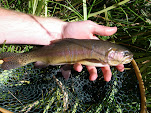
A small but beautiful Columbia Basin Redband Trout

The rest of the drive was as rather uneventful, putting back at Derek's house around lunchtime and myself home in time for dinner. This was one of the faster paced and more challenging trips that I have been on, but with with use managing to catching five varieties of native trout and three additional nonnatives, it certainly was a success. Likely this will be my only major out of state native trout road trip this year, pushing my thoughts towards next years plans of a trip to Colorado to round out my remaining Cutthroat subspecies.

Monday, July 11, 2022

High Desert Angling: Part 2 - A challenging day

 Day 3: Sunday July 3rd 2022: After an extremely long, and overall successful first day of angling, we were a bit more sluggish breaking camp than I would have liked. The reason that I was anxious to get on the road again was that we had a lot of ground to cover in a single day, fishing two streams before ending up in Winnemucca, NV for the night. While originally I had just planned on fishing a single stream Steve had told me about a stream with Tiger Trout. Tiger Trout are a bit of a frankenfish, being a hybrid cross between Brook Trout and Brown Trout and as I had never caught one I was intrigued enough to check the creek out.

Although we were still slightly behind schedule we made good timing getting to the stream and arrived by mid morning. The creek was similar in size to the Bonneville Cutthroat stream from the day before, but flowed through a tunnel of Willow in the midst of the treeless sage brush desert.

While we were rigging up for the day, a local indicated two things that didn’t bode well in my opinion. First was that otters and anglers had been very effective at harvesting fish from the creek, so hold overs would be few and far between. The second was that the creek had just been stocked for the 4th of July weekend. While in theory this meant more fish, the influx of fish was likely to disrupt the existing fish community and the new stockers would be unlikely to be used to natural prey sources. So normal tactics might not be very effective.

The Tiger Trout stream

While the stream looked like it should be quite productive, with lush aquatic vegetation good holes and a few beaver ponds, few of the likely lies showed any sign of fish.  When I did manage to spot some fish they showed very little interest in flies.

Streamside cacti

I figure that sometimes persistence pays off and as I continued working upstream I did manage to get some takes but just couldn’t get a solid hookup with any of the fish. Most of these fish were on either dries stripped under the surface or nymphs jigged in the deep holes. It wasn’t until I found a fishy looking undercut back that I finally got a solid grab on my dropper. It was a small fish and I quickly was able to net my first Tiger Trout.

My first Tiger Trout

I continued fishing upstream and didn’t find any additional trout, but when I met up with Derek he had managed to catch one hard won Rainbow Trout.

Derek's Rainbow Trout

While successful, it had taken far longer for us to find fish at this stream than planned and had eaten into our time hunting for our main target of the day, the Humboldt Cutthroat significantly. It was fun to catch a new type of trout, but I couldn’t help thinking how amazing this Creek could have been if it still held the native Humboldt Cutthroat that once swam its waters. As those native Humboldts were long since gone and it was again time to hit the road and hopefully we would be able to find Humboldts in our next stream.

A lone Pronghorn Antelope on our way to the next stream

After a few more hours on the road, with afternoon wearing on and storm clouds building on the horizon, we arrived at our second stream. I had fished this stream way back in 2006 and managed to catch a few Humboldt on that trip so I hoped trip to it would be just as successful.

I decided to head further upstream on this trip in hopes of more productive water. On my last trip I had noticed the damage the lower stream had endured from poor grazing practices and apparently the upper watershed had experienced the same damage. The stream was incised into a small a 10 foot deep trench and to make matters worse, it appeared that a fire had torn through the upper watershed recently, leaving little in the way of large vegetation.

The upper reaches of the Humboldt Cutthroat stream

We found a spot where we could reach the stream and decided that Derek would go upstream while I went downstream. Upon reaching the of the incised canyon, it was clear that there at least had been an attempt at improving the habitat as there were numerous beaver dam analogues added to the stream. These are stakes driven into the stream bed in the hopes of attracting beavers to use them as anchor for their dams. As the beavers build their dams behind the analogues they act as sediment traps and slowly build up stream channel reversing the process of incising. Unfortunately, the fire in the upper watershed had wiped out all of the larger vegetation that beavers need to feed on and as such the intended purpose of the analogues had gone unfulfilled. While they didn't live up to their full potential, the analogues did act as decent sediment traps and instead of flowing from pool to pool, the creek flowed from one knee deep swath of quicksand after another making wading extremely very difficult. This also meant an almost complete lack of suitable habitat for trout and I only managed to hook one smaller Cutthroat that unfortunately was able to shake loose.

The deeply incised stream channel

With the challenging and less than fruitful conditions on the upper part of the creek, Derek and I decided to head for the lower end of the watershed, where I had fished before. We were hoping that the creek in the lower reaches would be slightly larger and more productive than upstream and with luck we might find a few beaver ponds. As it turned out beaver ponds proved to be our biggest problem on the lower creek, as upon reaching the valley floor we discovered that since 2006 beavers had flooded the entire lower valley.

A beaver pond in the lower watershed

Often beaver ponds are one of the best places to find trout on small streams, but this particular scenario was not one of those cases. The water was extremely murky and there was almost no casting room due to extremely thick vegetation growth. I was able to wade into the muck a ways and saw many fry in the 2" range (a good sign for the viability of the population), but 45 minutes of casting didn't even result in a strike. With the beaver ponds not yield results, I tried to find some flowing water, but my attempts to find a way threw the overgrown brush all proved unsuccessful. I rarely have failed to catch a native trout on a stream that I know to harbor them, but I had to accept that you can't win them all. As such with thickening storm clouds rolling in and the day already growing late, I linked back up with Derek who had just as much success as I did and we hit the road again, headed for Winnemucca, NV and some much needed rest. With one trout a piece and neither of them natives, this had been one of the rougher days of trout fishing I have had in a long while. Fortunately, I had caught Humboldt Cutthroat before and I just had to hope that the Quinn River Cutthroat I was after the next day would be far more eager.