This blog is all about fly fishing for native trout. On it I cover trip reports, fishing tactics, conservation, the latest news about native trout species and much more. This site provides a companion to my web page Nativetroutflyfishing.com.
Gary
Showing posts with label Rio Grande Cutthroat. Show all posts
Showing posts with label Rio Grande Cutthroat. Show all posts
This past summer I had the privilege to make two trips out to the Colorado Rockies in pursuit native Cutthroat. While my original goal was just to catch the two subspecies of Cutthroat that I had yet to catch, I ended up expanding my second trip to pursue all of the extant Cutthroat lineages in the state and here they are.
Green River Cutthroat - Blue lineage - Yampa drainage
The Green River Cutthroat or Blue lineage of the Colorado River Cutthroat are found in streams draining to the Green River, such as the White River and Yampa River drainages. These Cutthroat were also stocked extensively across much of the state and are found in many streams in the upper Colorado, Gunnison, Dolores and San Juan watersheds.
Colorado River Cutthroat - Green lineage - Upper Colorado River
The Colorado River Cutthroat or Green lineage of the Colorado River Cutthroat. These fish are native to the Upper Colorado, Gunnison and Dolores watersheds. These fish were only recognized as being distinct from the Green River Cutthroat in recent years and currently only occupy about 3% of their native range.
Hayden Creek Cutthroat - Arkansas drainage Colorado River Cutthroat
While the extinct Yellowfin Cutthroat is recognized as the native trout of the Arkansas watershed, historic accounts indicate that ‘Greenback Cutthroat’ were also found in Twin Lakes in the upper Arkansas watershed. While both the Yellowfin and ‘Greenbacks’ vanished from Twin Lakes in the early 1900’s, a single population of fish found in the South Prong of Hayden Creek matched the ‘Greenback’ museum specimens from Twin Lakes. However in a twist of the story, the genetic analysis also revealed that these fish were not Greenbacks but a unique population of Colorado River Cutthroat with genes found nowhere else. While the South Prong Hayden Creek population was lost in a Fire, Colorado Parks and Wildlife has established a handful of populations across the Arkansas basin.
San Juan Cutthroat - San Juan drainage
The San Juan Cutthroat are native to the upper San Juan River basin. Until recently these fish were believed to be Colorado River Cutthroat, but genetic analysis of museum specimens showed that they represent a unique lineage of Cutthroat. At the time of this revelation, it was believed that the San Juan Cutthroat were extinct, but an extensive search of the basin turned up a handful of small isolated populations scattered across the upper watershed.
Greenback Cutthroat - South Platte drainage
The Greenback Cutthroat are native to the South Platte drainage and have a complex story. These fish were believed to be extinct by the 1930’s, but when a few small Cutthroat populations were discovered in the basin a recovery program was launched. For years this program was considered a huge success story, until genetics work showed that the fish used for the program were a mix of Green River and Colorado River Cutthroat and only a single population of a few hundred Greenbacks remained. After resetting the conservation efforts, Greenbacks have been reestablished in a handful of streams across the front range of Colorado.
Rio Grande Cutthroat - Upper Rio Grande drainage
The beautiful Rio Grande Cutthroat are found in the upper Rio Grande watershed of Colorado. These fish are the southernmost Cutthroat lineage and similar to the other Cutthroat of Colorado are now restricted to small headwater streams across their native range.
I have been fascinated with the diversity of native trout since my childhood and when James Prosek's book Trout and Robert Behnke's book Trout and Salmon of North America came out I decided to take it upon myself to document as many of the native species as possible. This included all of the subspecies of Cutthroat Trout and way back in 2009, I believed that I completed that leg of my quest and that I had caught all 12 of the extant subspecies of Cutthroat Trout plus the closest remnants of the extinct Alvord Cutthroat as well. However, shortly after catching my last subspecies (the Paiute Cutthroat), the classification of Cutthroat in Colorado was up ended by a genetics study. This study revealed several key findings, first was that instead of the four subspecies (Colorado River, Greenback, Yellowfin and Rio Grande), there were in fact 6 native to Colorado, including two that had been previously unrecognized (San Juan and Green River (aka blue lineage Colorado River Cutthroat)). The second finding came as a devastating blow to Cutthroat conservation and showed that what everyone had believed were Greenback Cutthroat were in fact Colorado River or Green River Cutthroat and only a single population in tiny Bear Creek harboring a few hundred Greenbacks remained. This effectively reset the Greenback Cutthroat recovery efforts and also meant that I had another subspecies to pursue once a viable population became established. That list continued to grow too, as the San Juan Cutthroat was rediscovered in 2018 and genetics showed the instead of the traditional 14 subspecies of Cutthroat there were in fact 25 (see Trotter et al. 2018).
Several years ago I was finally able to start documenting many of these newly recognized subspecies and going into this summer my last two remaining Cutthroat (the San Juan and Greenback) were both in Colorado. At the start of August I successfully checked the first of these two subspecies off my list, when I caught the once believed extinct San Juan Cutthroat. After that outing, I was unsure whether or not I would be able to get back to Colorado, but the opportunity to return presented itself at the end of August and I started planning my adventure. While I initially just thought this trip would include a quick excursion for Greenbacks, it evolved into an excursion for five varieties of Cutthroat spread across the state including the Rio Grande Cutthroat, Hayden Creek Cutthroat, Green River Cutthroat, Colorado River Cutthroat and Greenback Cutthroat.
Friday August 25th: With plans in place, before I knew it I was in Colorado and by noon on I was on the highway cruising south towards the native range of the Rio Grande Cutthroat. While I have caught Rio Grande Cutthroat on several occasions, all of those were in New Mexico and most of the fish that I had caught were large spotted Rio Grande Cutthroat from the Pecos River drainage. As such, on this trip I was hoping to document the finer spotted form from the main Rio Grande drainage, as the existing photos I have are dated and of marginal quality. I was fortunate to hit minimal traffic getting out of the Denver metro area and made great timing as I traveled from the plains, east over the Rockies, through the Sangre de Cristo Mountains and into the arid San Luis Valley. This meant that by 4:00pm I was turning off the highway in the San Juan Mountains and towards the trailhead to a stream that was reported to have a robust population of Rio Grande Cutthroat.
The trailhead
Anticipation was running high as I drove up the forest service road to trailhead leading me to miss a sign for the trail and take wrong turn that cost me several minutes of precious fishing time. However, after a bit of hack tracking, I found the right road and before long I was pulling into an empty parking lot at the trailhead. With the area completely to myself, I immediately threw on my wading boots, got my pack loaded, rigged up my trusty fiberglass 1WT with a Royal PMX and Blowtorch nymph dropper and hit the trail. For the first little bit, the trail proceeded on a gentle incline as it progressed along a decommissioned road through alpine meadows and scattered spruce and fir stands. I hiked in complete silence that was only interrupted when I spooked a group four Grouse that snapped me out of my reverie about a half mile in.
A well camouflaged Grouse up in a Spruce Tree
The gentle incline did not last for long, and while the hike wasn't overly strenuous, I was certainly not acclimated to the altitude and at nearly 11,000 feet even the moderate incline left me huffing and puffing as my sea level lungs struggled to get enough oxygen. This slowed my progress down significantly and as a result while I had expected to reach the the barrier isolating the Cutthroat from nonnatives downstream within a half an hour, in reality it ended up taking me at nearly a full hour.
The barrier separating the Rio Grande Cutthroat from nonnatives downstream
Luckily, after reaching the top of a particularly steep section at the barrier, the trail leveled off and I made much better time as I covered the last stretch, entered the San Juan Wilderness Area and approached the meadows above the falls.
Entering the wilderness
With daylight ticking away, I broke from the trail as soon as I came within sight of the meadows and made a beeline for the sound of running water. The creek turned out to be much smaller than it appeared in the satellite imagery I had poured over when planning the trip, but it was running crystal clear and appeared to have ample holding water. It also appeared that I had been lucky enough to emerge just downstream of a particularly nice looking pool.
The stream
With a nice pool right in front of me, I got my rod ready, positioned just downstream and made my first cast of the trip. I had decided prospect the tail out first and my fly barely had time to drift a few feet downstream when a Cutthroat swirled on the Royal PMX and I was hooked into my first Cutthroat of the trip. With the tight quarters the trout had nowhere to go and after just a moment of thrashing I brought a beautiful Rio Grande Cutthroat to the net.
First cast - first fish of the trip!
That first fish was indicative of the rest of the day, as every lie deep enough to hold a trout did and these were some of the most beautiful Cutthroat one could hope to find anywhere. As with the first fish, these Rio Grande Cutthroat preferred to hold in the slowest water in the tail outs which also made them particularly spooky. As such, with the tight conditions it took slow progress, a low profile and solid presentation to get results but after after covering about an 1/8 mile of stream I had caught about a half dozen decent Cutthroat already. It was at this point I came upon the best looking hole of the day and after careful observation I spotted several trout holding under a spruce tree and sipping occasional ants or caddis falling into the water.
Several Rio Grande Cutthroat holding in the tailout
The hole was fairly exposed and given how spooky the fish were, I knew I would only get one or two chances. I positioned myself slightly downstream and tucked behind a small tree to be obscured from sight and got a cast right into the seam. While it wasn't the biggest of the bunch, one of the Cutthroat broke away from the group and slowly but deliberately rose to take my dry fly. When the trout turned with my fly in its mouth, I set and got a solid hookup. Despite trying to get it away from the other fish, the trout thrashed on the surface a few times sending the rest fleeing for cover as I pulled it downstream and into my net.
My one Rio Grande Cutthroat from the hole
Once again this was an exceptionally beautiful Cutthroat, with the yellows and oranges of a sunset and after a quick photo and a few brief moments of admiration I watched it slip back into the current and dart for cover. By the time that I released this fish, several of the other fish had returned to their holding lies, but their air raid sirens were apparently still blaring and given that my time on the water was extremely limited I opted to push on upstream instead of waiting for them to settled down and start feeding again.
The sun getting low on a nice stretch of stream
Over the next few bends, I picked up a handful of additional Rio Grande Cutthroat in the 6" to 8" range, with most taking the dry fly, although a couple did go for the dropper. Before long I came to a straightaway with a nice deep pocket next to a rock that looked particularly fishy. With the glare on the water I couldn't see any fish, so I made a blind cast and as the fly reached the end of the pocket a Cutthroat rose to the dry and immediately put a nice bend in my 1WT. Once again the tight quarters gave the fish nowhere to run and after a quick fight, I netted a largest Rio Grande Cutthroat I had seen so far.
The fish of the day a beautifully colored "monster" Rio Grande Cutthroat
The colors on this fish were absolutely amazing, with deep orange and bronze tones that popped in the fading sunlight. One top of that the spotting was exceptional, with almost no spots on the front two thirds of the body, but dense spot one the back third and caudal fin. After releasing my 'big' Rio Grande Cutthroat, the sun was starting to inch closer to the horizon and I knew that my time was limited, so I pressed on upstream to cover a few more holes while I still had some light. However, I hadn't traveled far when the creek broke into two forks and got substantially smaller. I pushed on for a couple more bends on the bigger fork, but not seeing much in the way of good holding water, I made the call to head back downstream and fish the stretch between where I started and the falls before hiking out. After reaching my starting point, I dropped my fly in each of the deeper pockets I came to and whenever my fly landed on the mark, I was almost always rewarded with a rise and managed to catch a couple more small Cutthroat.
A set of falls on the creek
As I approached the falls, the gradient picked up and the creek tumbled over a series of cascades interspaced with deep pools. While this looked like it would be one of the best spots on the creek, I only managed a sole small Cutthroat out of the pools before I finally had to admit that my time was up and make my back to the trailhead.
Sunset over the meadows, time to hit the trail
The hike out in the fading light of the evening was gorgeous, as I passed through meadows with deer emerging from cover to graze before the sun fell behind the peaks. After paying my dues on the way in, the hike out was all down hill and as such I made much better timing and was back to the car before I knew it. The evening on the stream was far better than I could have hoped and certainly got the first leg of the trip off to an exceptional start. While I would have loved to spend more time in the area, I still had many miles to cover ahead of me I had to get right back on the road headed for a small stream in the Arkansas drainage.
As I drove through the San Luis Valley, lightning lit up the night sky and I hit intermittent downpours along the way. However, as I pulled into the campground near the trailhead for my next stream around 11:00 PM these intermittent showers had turned to a steady heavy rainfall. As such, instead of setting up the tent in dark and pouring rain I opted to hunker down in the car for the night and hoped that the morning would bring better weather.
The Western Native Trout Initiative (WNTI) was founded in 2006 to support the conservation of native trout across the Western United States. In 2019, the WNTI launched Western Native Trout Challenge with several different tiers (Master, Advance and Expert) that award anglers for catching up to 18 varieties of native trout across 12 western states. 92% of proceeds from the program go to supporting habitat /conservation projects with direct benefits for native trout across the west, providing anglers with a fun way to make a difference for these fish.
I had not initially planned on attempting the challenge as I had already caught most of the fish recognize by the challenge prior to 2019. However, after a year of native trout hunting it turned out that I had enough trout to submit for the Expert level, in which an angler needs to catch 6 varieties of native trout across 4 states. Since I had qualified for the program I decided I might as well go for it.
See my qualifying fish below:
Eagle Lake Rainbow Trout - California
"Interior Redband Trout" - Oregon
Coastal Cutthroat Trout - Washington
Bull Trout - Idaho
Westslope Cutthroat Trout - Idaho
Rio Grande Cutthroat Trout - New Mexico
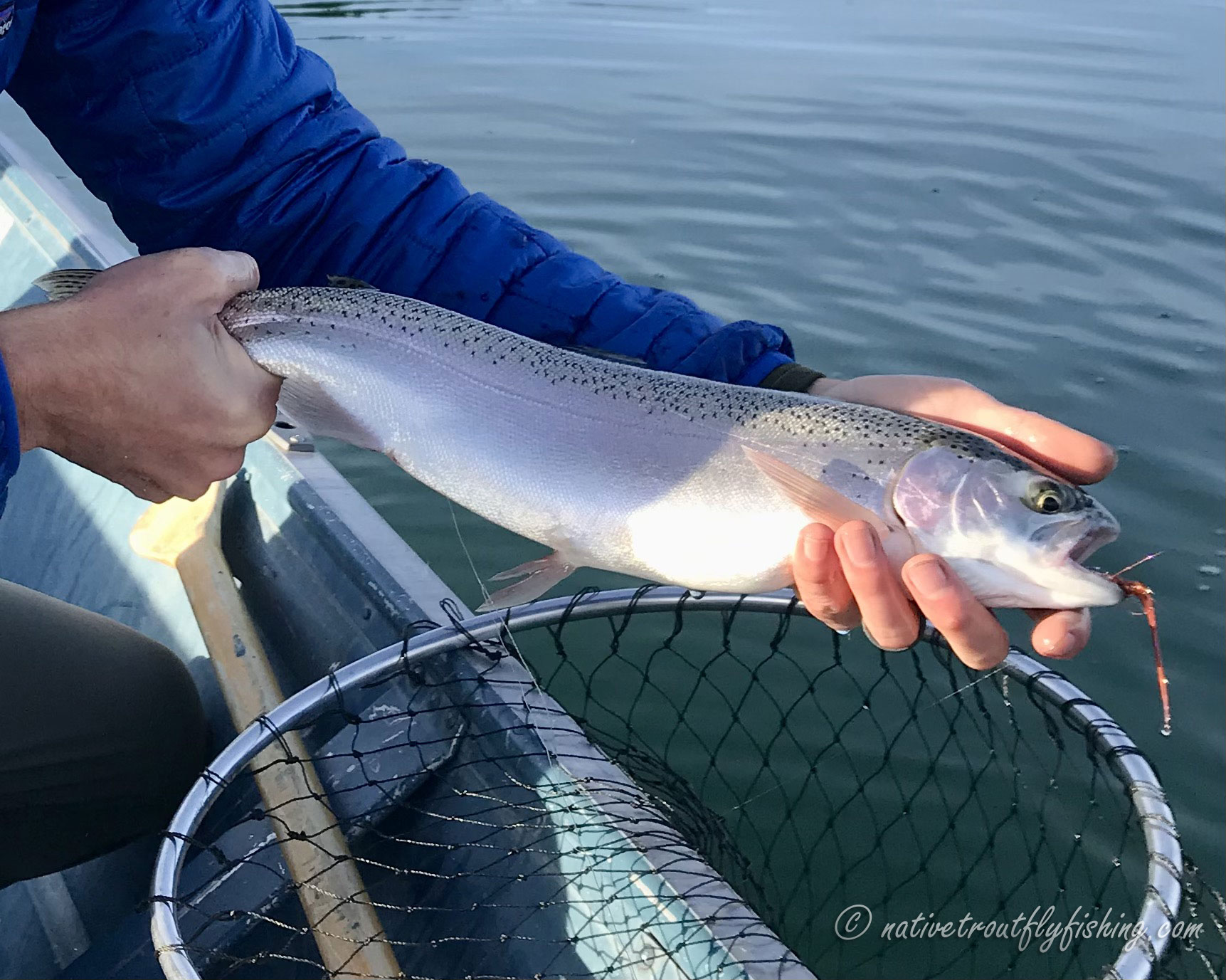
Upon submitting photographs of their qualifying fish, anglers receive different rewards depending on the level of the program completed. I completed the "Expert Caster" level, which comes with a certificate and a hat, with the first 100 completers getting a unique "First 100" hat.
My Expert Caster Certificate and "First 100" hat.
All in all, the Western Native Trout Challenge is a great program, that supports crucial conservation projects across the west. If you are interested in taking part in the challenge, you can sign up here.
With the pandemic finally becoming more manageable, my wife Alexis and I were able to plan a little getaway. After doing a little research, we decided to head to Santa Fe, New Mexico. I had been to Santa Fe way back in 2009 (here), when I went after Gila Trout and Rio Grande Cutthroat in New Mexico, however on that trip I was only there for one evening and had always wanted to go back. As we made plans we decided that we would visit Bandelier National Monument, check out the Santa Fe Plaza and the museums. and while this trip was a vacation first a foremost, it looked like I could fit in one morning to pull away for a little fishing as well.
After over a year of limited interaction with crowds, the airport was an overwhelming experience, but luckily we had a smooth flight arrived in Albuquerque safely and made the drive out to Santa Fe. The next morning we woke up early and headed out to Bandelier National Monument. I am a bit of a history nut, so this was one of those spots that really interested me and the ancient Puebloan ruins were amazing. The walk through the canyon at Bandelier was also beautiful and with the sights and smells of the valley I couldn't help but remanence on my hike into the Gila Wilderness Area all those years ago.
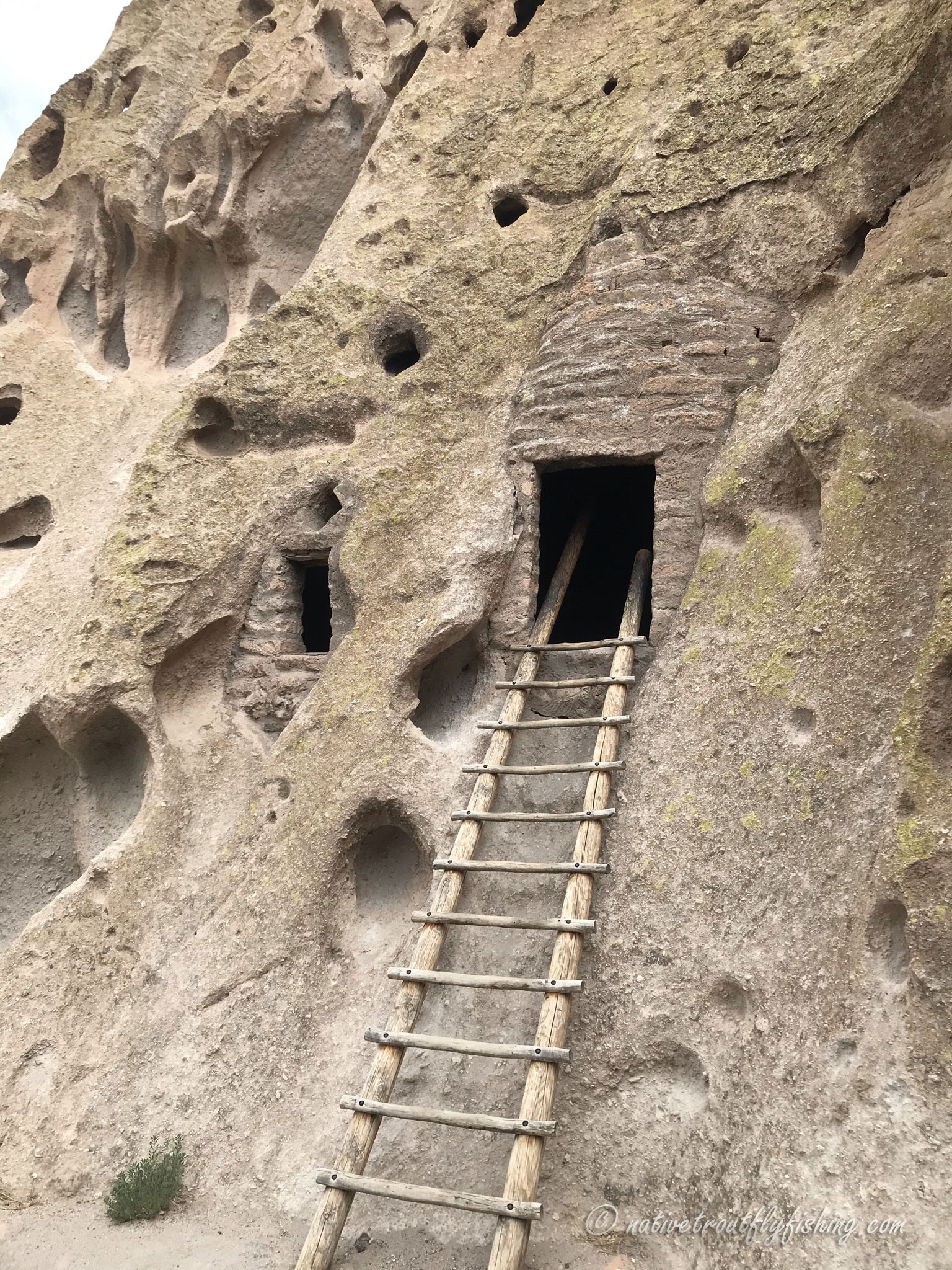
Bandelier National Monument
Cliff dwellings
We were in Santa Fe all of the next day, which proved to be a rather stormy one. However, between the thunderstorms we were still able to check out the awesome Farmers Market, the High Desert Angler Fly Shop (great little shop!), some museums and the historic Santa Fe Plaza.
Santa Fe Plaza between rainstorms
The next morning I was up early to head for the upper Pecos watershed in search of Rio Grande Cutthroat. The drive out to the stream was great as the weather was beautiful and the storm of the day before appeared to have cleared out any crowds from the valley. I had fished this stream almost 12 years ago and this time I decided to fish a bit lower down to see some new water.
The stream
As with last time I was here, the stream was rather small and fairly brushy so most casting was going to be primarily bow and arrow style. The other thing I recalled from the previous trip was that these trout were extremely spooky and required a great deal of stealth. It seemed this was still the case, as in the first likely spot I came too I was a bit careless and spooked two small trout. The next hole that I came too, I was much more prepared and made a quick bow and arrow cast into the seam and as my dry dropper set up reached the tail out, I watched a Cutthroat dart over and grab the nymph. After a quick battle, I brought a beautiful little Rio Grande Cutthroat to hand.
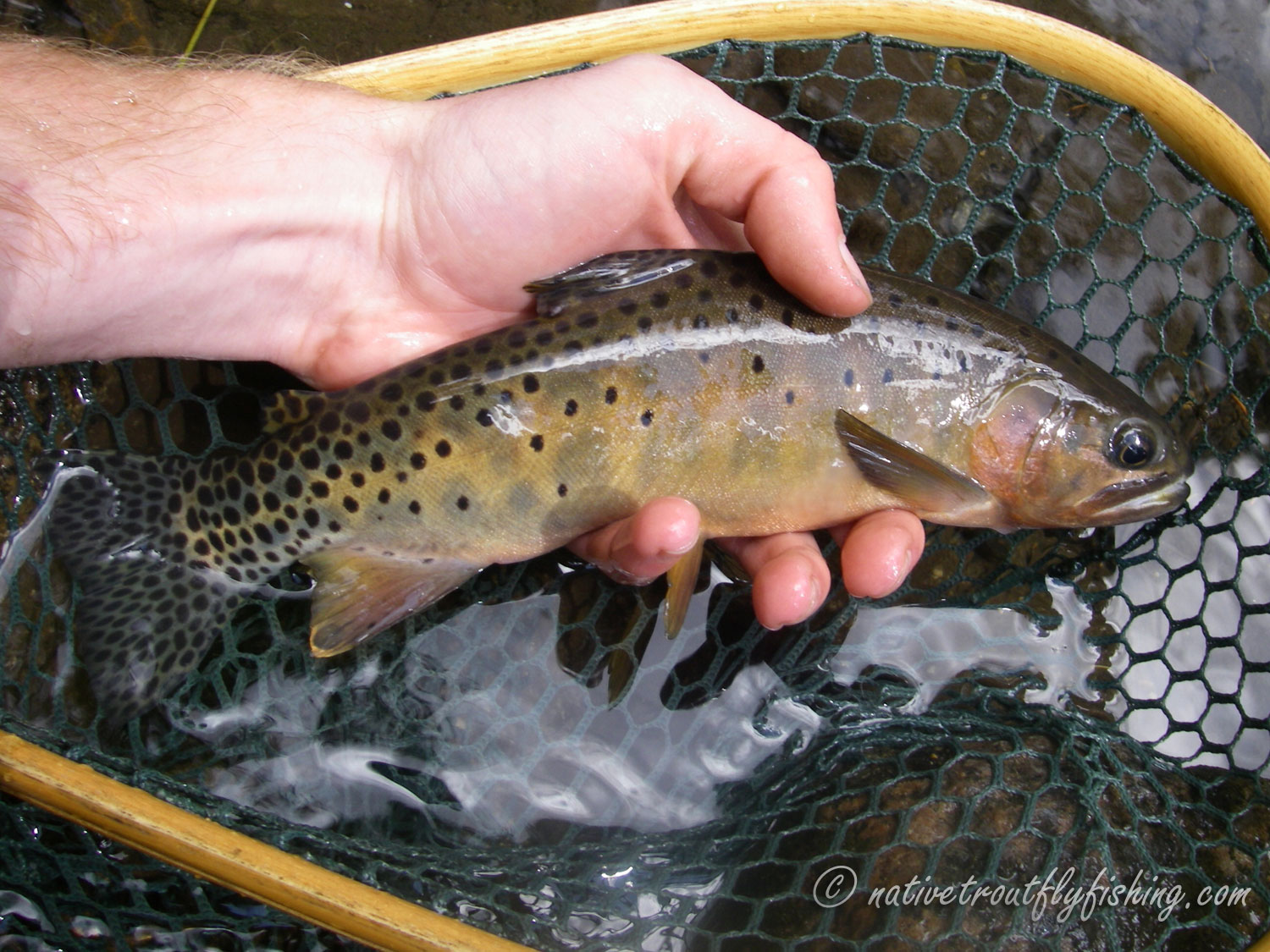
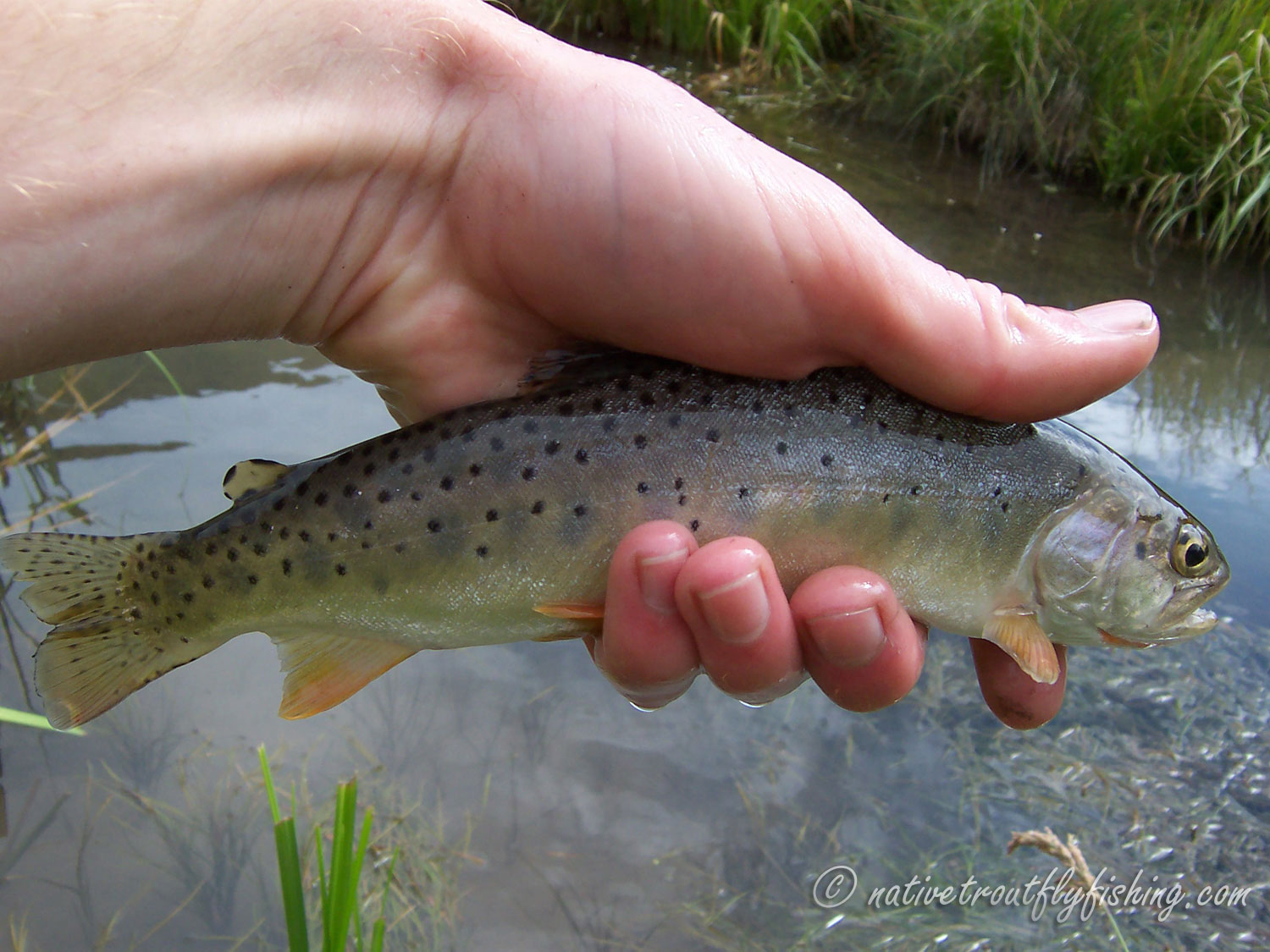
A beautiful Rio Grande Cutthroat
It amazed me just how many trout were in the creek this time. Every likely spot held at the least one fish and typically more. Last time that I was here I had noted that these Cutthroat really seemed to favor the tail outs instead of the deeper water of the pools that I usually expect to find trout in, which was still the case. This added to the need for stealth as the trout we able to see me approaching from a long distance in the calmer tail outs and had plenty of time to inspect flies before taking them. Often the fish would put their noses right on the dry only to refuse it after a couple of seconds of careful inspection. However, sneaking up to water on hands and knees I was able to find some fly patterns that the trout found acceptable and would pick up a decent Cutthroat in most pools that I came too.
Spring bloom along the creek
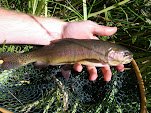
A Rio Grande Cutthroat and the Royal PMX it fell for
Another Rio Grande Cutthroat
One of the things that I love about seeking out native trout is the beautiful locations that they are typically found in. The Sangre de Cristo Mountain range is one of those special beautiful spots and this time of the year extra special, as the trees were just putting on their new growth and the first spring flowers were beginning to bloom. All to soon, my allotted time was up and I had to start heading back to the car. The trek back was a bit illuminating as after running into the third group of other anglers on my way downstream it was pretty clear why the trout in this tiny creek were so spooky and selective.
Time to head downstream
All and all, this was an amazing little getaway and with just a couple of weeks until my next outing to hopefully catch some Eagle Lake Rainbow Trout, the trout season is off to a great start.
Day 9: Wednesday September 9th 2009: The weather was clear once again when we left Santa Fe, headed for a small creek in the headwaters of the Pecos River drainage. It took us a little over an hour to reach the trailhead that would provide us with access to a small stream that was said to hold a population of large spotted Rio Grande Cutthroat.
The view of the valley from the trailhead
After rigging up, we made our way down to the creek which was smaller and brushier than what I had expected. We decided to head upstream hoping that maybe the vegetation would thin out a bit or that we could find some decent pockets to fish. Within the first five minutes I found a little pocket along an undercut bank and watched a nice looking fish grab my dropper. The fish didn't have anywhere to go, but as I went to net him my size 18 Copper John came loose and it darted off downstream. For the next half mile I only spotted a handful of fish, all of which were either holding in impossible to fish spots or spooked before I could get close enough to cast to them. Derek faired no better, but I was dead set on catching one of these fish so we continued to work our way upstream. The further upstream we got the more fish we saw, and I did manage to rise a few but couldn't get any solid hookups.
A brushy run on the creek
I finally came to a pool that had an open angle to cast from, some good cover to allow for a stealthy approach and most importantly two good-sized Cutthroat holding in the tail out. I didn't want to take any chances here so I sized up my cast and tried to aim for the larger of the two fish. My first cast was a little short but my next cast was right on target, upstream and slightly to the right of the larger fish. The larger Cutthroat slowly cruised over to my fly, took a quick look and changed its mind. I was thinking that the fish had found something wrong with my fly, but before I decided to pick up my fly up to make another cast the fish turned back around, swam over to my fly and nipped at it before changing its mind again. However, just as quickly as this fish decided to refuse my offering it changed its mind for a third time and finally confidently slurped my dry fly. I allowed a second of pause before setting the hook and was tied into the fish. This time my hook up was solid and after a short battle I was able to bring the beautiful Rio Grande Cutthroat to my net.
A large spotted Pecos strain Rio Grande Cutthroat
While photographing this Cutthroat, I noticed that the clear blue sky that we had started out with was now blanketed with scattered clouds, but I really didn't pay too much attention to it at the moment. Instead, I continued upstream and found a nice deep pool where I caught another slightly smaller Rio Grande Cutthroat and hooked a couple of others, before the now all too familiar sound of thunder told us that it was time to head back to the car.
Another Rio Grande Cutthroat
A pool on the Pecos River tributary
Stormy weather once again
It was impressive to watch how fast this storm built up, as by the time that we got back to the car and put the gear away it was right on top of us. When we hit the road, it was just beginning to pour, but a few minutes down the road we were able to leave bad weather behind us. The rest of the day was spent in the car getting to Denver, Colorado where I would be picking Blake up to head to Fly Fishing Retailers Show.
Day 10: Thursday September 10th 2009: I picked Blake up at the airport in Denver at 9:30AM for a full day at the FF Retailers Show. Our goal for the show was to look for some new products that would fit in well with the line up of gear at the Gig Harbor Fly Shop. We were most impressed with Scott the S4S, a faster action saltwater version of the Scott S4, which would go on to win the 2009 FF Retailers Choice Award. The rod that personally caught my eye though was the Scott F series 6' 1wt rod. With my day on the brushy little Rio Grande Cutthroat stream in New Mexico still fresh in my mind, this short but durable little fiberglass rod was looking VERY appealing, and is likely to find its way into my rod line up in the near future.
After the show, Blake and I walked back to our hotel a couple miles away and Derek and I discussed our plans for the rest of the trip. Since Blake and I hadn't finished looking at everything, we decided that I would join him at the show till around 10:00 AM and then Derek and I would hit the road, since we had over 20 hours of driving ahead of us. Derek and I had decided to make a side trip through Yellowstone on the way back, since he had never been there which would make for a longer drive but gave us something to look forward to.
Day 11: Friday September 11th 2009: After a quick morning at the Fly Fishing Retailers Show, it was time for Derek and I to hit the road again for our long drive. Our drive getting out of Denver was a slow due to a nasty car wreck, but once we got past that we started making good timing. The drive really wasn't all that eventful until we got within a couple of hours of Jackson Wyoming, where the combination of the Wind River Range on the horizon and Pronghorn Antelope on their annual migration through the Green River valley made things a bit more interesting. While we didn't see nearly as many antelope as I had seen last October, but the front edge of the migration had definitely reached the valley and we spotted close to a hundred antelope before we crossed the pass into the Hoback River drainage. We pulled into Jackson, WY at around 7:00 PM wandered around town for a bit before heading up the Gros Ventre valley to camp for the night.
Day 12: Saturday September 12th 2009: This was our day to see the sights of Yellowstone and the Tetons before cutting the distance between us and home down by as much as possible. The only catch to our time in Yellowstone was that with our remaining drive there wouldn't be anytime to fish. Something that I always struggle with when surrounded by so many amazing trout streams. Our first stop of the trip was Grand Teton National Park, which we more or less just cruised through on our way north, although we did have to stop for a couple of photos.
The Tetons
After getting out of the Tetons, we headed up to Old Faithful so that Derek could see the most famous feature in Yellowstone. When we pulled into the parking lot, the board walk around the geyser, it was already filled with people, which usually means that the geyser is about to go off. I didn't want Derek to miss the eruption and have to wait another hour, so I dropped him off before going to search for parking myself. By the time the I parked the car and got within a hundred feet of Old Faithful, it finally went off. This is the second year in a row that I have had such good timing. After getting to experience Old Faithful, Derek and I did a quick hike around the Geyser basin then headed over to the lodge to grab an early lunch.
The Firehole River in the Geyser basin
From Old Faithful, we headed over to the Yellowstone River valley with hopes of getting to see some more of the park's abundant wildlife. Between Old Faithful and the Grand Canyon of the Yellowstone we only saw around ten bison and one deer, certainly less wildlife than I have come to expect. We did make up for this a little bit by getting out of the car to do some hiking and sight seeing.
One of the park's many thermal features
Yellowstone Falls and the Grand Canyon of the Yellowstone
Even after covering the drive between Yellowstone Falls and Tower Junction we hadn't seen anymore wildlife, so I decided to make a quick side trip up the Lamar Valley to Soda Butte Creek. This was a good call, as we saw numerous herds of Bison and Pronghorn Antelope up and down the valley. Although it was tough for me to pass through this near perfect valley without sampling its waters, Soda Butte Creek and the upper Lamar were both crawling with way too many anglers, which eased my pain a bit. I amazes me the increase in pressure that these streams have seen just since I have been visiting the park. Another reason that I favor the small out of the way waters that the average angler will never see.
A Lamar Valley Bison
After heading back down the Lamar Valley, we made one more quick stop at Mammoth Hot Springs where the typical several dozen Elk were lounging in the grass, before we finally headed out of the park. While I had intended on driving to the Missoula area at the furthest, but I really didn't feel all that tired when we drove through town at around 9:00 PM so we decided to keep going. After having gone this far, we decided that we might as well try to get back to Derek's place in Yakima, WA and by the time that we finally pulled into the driveway at 2:00 AM I was tired enough to be happy to be out of the car.
Day 13: Sunday September 13th 2009: I got up early in the morning, or at least as early as I could manage with the combination of 18 hours in the car and transitioning back to Pacific Time and finished the drive home in a mere two and a half hours that flew by. Even though this was my longest native trout adventure to date, it flew by so fast that I hardly noticed it. I have to say that I really couldn't have asked for more out of this trip as all of the pieces seemed to just fall into place perfectly and I managed to accomplish exactly what I set out to do. However, after driving nearly 4500 miles I was definitely glad to be back home.
My goal for this trip was to catch all of the subspecies of Cutthroat Trout native to the Rocky Mountains excluding the Westslope Cutthroat, which I had caught a number of in the Cascade Mountains two weeks prior to leaving. While Cutthroat are native to a vast area of the western United States, their populations have been greatly reduced due to a variety of issues. As such, pure and healthy populations can be quite difficult to come by today. I started planning this trip during September of 2005, and relied on a variety of different resources to come up with a list of streams to fish that would hold healthy populations of Cutthroat without any hybrid influences.
Day 1: Monday July 31st 2006: My dad and I made the 12+ hour drive to Yellowstone, with nothing overly exciting occurring along the way. When we got to the park, we found out the the campground where we were planning on staying was already full, so we diverted to Indian Creek campground, which luckily had a few spots left.
Day 2: Tuesday August 1st 2006: We woke up bright and early to a chilly Yellowstone morning. After a quick breakfast, we drove over to the Lamar Valley and Soda Butte Creek to try our luck fishing for some Yellowstone Cutthroat. We arrived at the creek to find it extremely crowded and had to hunt to find a stretch that we would have to ourselves, or so we thought. We ended up being constantly high holed or low holed, which really limited the amount of water we could cover. Even so while we were there, we rose more than our fair share for Cutthroat, including one that my dad hooked and was close to 20". Even with the few larger fish around, I still only managed to catch a couple of small Cutthroat prompting us to consider a less crowded option.
A pronghorn antelope on the way out to the Lamar Valley
With Soda Butte Creek being one of the more popular streams in the park, I decided to try a relatively unknown small stream that was supposed to hold a good population of Yellowstone Cutthroat. Arriving at the stream, I found it to be completely vacant of anglers and full of small but hungry trout, with some up to 12". I rigged up my rod with a Royal PMX and Lightning Bug dropper and started catching fish in every likely looking spot. Eventually, I came to a nice plunge pool where I watched my dry fly get pulled under as a Cutthroat grabbed my nymph. After a quick fight I landed a beautiful 12" Yellowstone Cutthroat, my best fish for the creek. Soon after landing the Cutthroat, the weather began to deteriorate and I made my way back down the creek as the rain set in.
The Creek
A stream resident Yellowstone Cutthroat caught on a Lightning Bug nymph in a deep hole
Once back at the car, we made our way to one of my favorite streams in the northwestern corner of the park. The weather was better in this part of the park, but it looked like it wouldn't last long. Although this stream doesn't have much in the way of native trout, it always spoils me as every likely spot seems to hold a fish, and I caught numerous Brown Trout, Rainbows and Cuttbows before I was finally chased out by a thunderstorm.
After again being bested by bad weather, we headed back to the campground to get some dinner and settle in for the evening. After a good dinner I was feeling recharged, decided to head out fishing again to see if I could find any Brook Trout in the upper Gardner River. It didn't take long before I found a nice section of the river that was full of rising Brook Trout that eagerly took my dry fly. Well above this I found some decent pools that were packed with Brook Trout, which couldn't resist the Zug Bug that is my go to fly in this type of water.
A pool on the upper Gardner River
A Brook Trout caught on a Zug Bug
After catching my fill of Brook Trout, I headed back to camp as the sun started to drift toward the horizon. The day had been a great success, not only had I caught the Yellowstone Cutthroat that I came to the park for, but I had also caught a number of Brook, Brown and Rainbow Trout making it the first time that I had caught all four species in a single day.
Day 3: Wednesday August 2nd 2006: I am used to cold nights in Yellowstone, but this one had been especially chilly and we woke in the morning to find everything coated with a thick layer of frost. The plan for the day was to leave the Yellowstone National Park behind and head south to the Tetons to try to find some Snake River Fine Spotted Cutthroat.
Me with Jackson Lake and the Tetons in the background
The spot that I had chosen to fish had treated my dad and I very well on a trip in 2005, so I was looking forward to going back again. However after fishing all of the spots where we had done well on our previous trip all I had to show for the effort was one small Brook Trout and a few missed strikes.
A lake at the foot of the Tetons
With a less than successful first outing for Fine Spotted Cutthroat, we headed down the valley into Jackson to get lunch and possibly a hotel room so that I could try to get some Cutthroat later in the evening or the next morning. Unfortunately, we did not anticipate just how busy Jackson would be since our previous trips had not been during the peak travel season. With the town completely overrun with tourists and all of the hotel nearby were booked, as such staying here was out of the question. Even though it was busy, we did manage to get lunch at Bubba's BBQ than continued down the road toward the native range of the Bear River Cutthroat, my next target.
We ended up deciding to stay in Afton Wyoming, which was the closest town to the Bear River Cutthroat stream and was also close to several decent Snake River Fine Spotted Cutthroat streams.
That evening I headed out to try my luck Fine Spotted Cutthroat again, this time targeting small tributary of the Salt River. The creek was only about fifteen feet across in its widest spots, but was extremely fast moving and as a result had little holding water. Due to its small size, I decided to just wet wade, which was a big mistake as the water was frigid and the evening was cooling down fast.
I covered close to a 1/4 mile of stream before I finally found a bit of decent holding water and spotted a rising trout. My first couple casts landed a little short, but finally I got a good cast into his feeding lane and hooked up. Snake River Fine Spotted Cutthroat are notorious for being hard fighting fish, and with the fast water this hefty trout fit that mold perfectly, but still came to the net before long. For a stream this size, this was a great fish running nearly 15".
A Snake River Fine Spotted Cutthroat
Not to far upstream from this first cutthroat, I found a nice little pool and after placing a cast tight to a rock ledge I hooked up with another even larger cutthroat. This fish was 18" or better, but as I went to bring it to the net my small nymph popped out and the giant drifted back into the shadows. The rest of fish seemed to share this talent for tossing flies, and as the sun began to set headed back to the hotel with high hopes of getting into some Bear River strain of the Bonneville Cutthroat in the morning.
Day 4: Thursday August 3rd 2006: We continued on our route and drove over a mountain pass from the Snake River drainage into the Bonneville basin. The first stop for the day was a small stream that my research had indicated held a fair amount of Bear River strain Bonneville Cutthroat. Arriving at the stream I located a good looking stretch that had a large concentration of beaver ponds. The water in the creek was relatively murky, so I rigged up with a flashy Thin Mint Wooly Bugger with a Zug Bug as a trailer about 16" behind it. Once I was rigged up, I headed over to the largest of the beaver ponds and started fishing from the top of the dam. As I was stripping my fly in I could see golden flashes from the Cutthroat and after a few missed hits, I finally hooked up and brought and nice 16" Cutthroat to the net. After my luck in the big pond dried up, I tried some of the other ponds and caught several other smaller Bear River Cutthroat before getting back on the road again.
My big Bear River Cutthroat
Another smaller Bear River strain Bonneville Cutthroat
Me at the Bear River Cutthroat stream
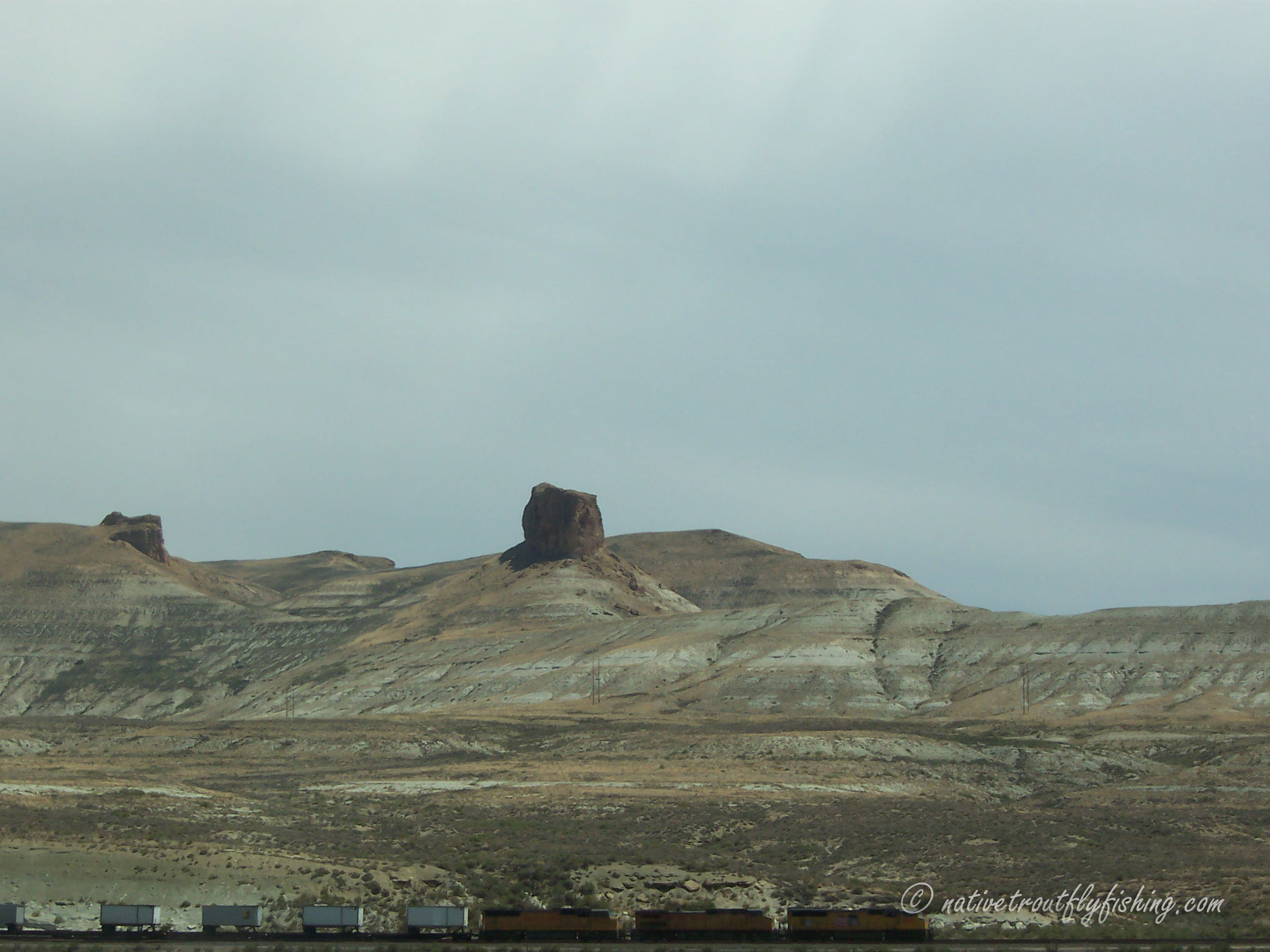
We continued down the road with hopes of making it to Rocky Mountain National Park in Colorado by dark. The countryside quickly transitioned from forested mountains to sage brush desert. This desert portion of Wyoming had some very interesting and unique rock formations and had an incredibly high population of pronghorn antelope and a large concentration of natural gas wells. After several hours of driving through this terrain, the scenery became rather repetitive it didn't revert back to mountains until we were well into Colorado.
The Wyoming desert
Just outside Steamboat Springs Colorado we ran into a large thunderhead, which seemed to follow us all of the way to Rocky Mountain National Park, but finally tapered off and disappeared in time for us to set up our tent at Timber Creek campground in the park.
Day 5: Friday August 4th 2006: We awoke early in the morning to see Elk walking through the campground. My targets for the day were set on catching some Greenback Cutthroat (note from the future - based on genetics work, we known know the the fish used for "Greenback" Cutthroat recovery in RMNP were actually misidentified Colorado River Cutthroat), so we set out for a hike in stream on the eastside of the park. The drive to the stream was through some of the most beautiful country that I have ever seen, as the road wound its way along the tops of the 12,000 foot peaks and over the continental divide.
The Colorado high country
A herd of elk in Rocky Mountain National Park
We arrived at the trailhead for the Greenback stream and the parking lot was so crowded that we could barely find a spot. We hiked up the trail about a mile before we came to the creek and started fishing. After covering a few yards of good looking stream and only managing to rise one Cutthroat, I figured that most people would also start fishing as soon as they arrived at the creek, so I decided to head further upstream. I hiked up the trail another mile or so and this made all of the difference in the world.
The Greenback Cutthroat stream
When I got down to the creek I could see several Cutthroat holding in a nice deep slot, so I cast my Royal PMX and Copper John dropper out, but couldn't get any reaction from the fish. Given the lack of interest, I figured that they must be keying in on something, and after a little pocking around I noticed an unusually high number of Yellow Jackets on the banks and a few dead ones in the stream. The closest imitation that I had was a yellow bodied Tellico Nymph, so I switched out my dropper and gave it another try. The results were immediate, as a nice sized Greenback grabbed my nymph on the first cast. There are some fish that when you catch them you have a hard time turning them loose again simply because they are so beautiful, and every one of these Cutthroat feel into this category. Drop dead gorgeous.
A beautiful "Greenback" Cutthroat. Note: In 2012 it was discovered that this population was actually made up of Colorado River Cutthroat that had been mistaken for Greenbacks.
After the first Cutthroat, fishing stayed consistently good as I worked my way upstream and each likely looking pocket produced a decent fish. After covering about a half mile of water I ran into trail crossing and reluctantly pulled myself away from fishing and headed back down the trail to the car. I still had one more fish to pursue and the next stop was back at the campground for a quick lunch, than it was off to another stream for some Colorado River Cutthroat.
Rough weather coming in over the high country on the way back to the campground
When I arrived at the Colorado River Cutthroat stream, I found it to be much smaller than what I had been led to believe from the research I had done prior to leaving on the trip. However everything that I had read indicated that it held a pure population of Colorado River Cutthroat, so I headed upstream to see if I could find any. Not to far upstream the gradient of the creek increased and there started to be a bit of decent holding water. Before long I spotted a decent trout in a small run and the fish grabbed my dry on the first cast. However, when I got it to the net it ended up being a Brook Trout instead of a Cutthroat. It seems that these fish have a special talent for turning up where they aren't supposed to be...
Small stream fishing in the extreme: the Colorado River Cutthroat stream
Luckily the Brook Trout was not the norm and in the next pool upstream I caught my first Colorado River Cutthroat on the Royal PMX. Just above this point, I ran into a fish barrier, above which the only fish present were beautifully colored Colorado River Cutthroat. As I continued upstream, the gradient steadily increased and the creek flowed down the mountainside from one stairstep pool to another.
A small, but beautiful Colorado River Cutthroat
Above the barrier, most the pools and pockets held fish, and I spent the next couple hours catching fish in most of the likely spots using dries and nymphs. In such small conditions it was fun watching the reaction of the fish to different flies. I one pocket I tossed a stimulator in only to watch it be refused at the last minute by a Cutthroat. For the next cast I switched back to a Royal PMX and watched as the fish rose to it without any hint of hesitation. In one of the larger pools upstream I caught my biggest trout on the creek at right around 10". While beautiful, this fish had an odd little hole in one of its gill plates, no doubt a testament to the harsh conditions that these fish live in.
Having successfully caught some Colorado River Cutthroat I went back down to the campground to get some dinner, then my dad and I headed out to the Colorado River for some more fishing and to see if we couldn't find some more Cutthroat that had washed down from the creek. The mosquitoes on the river were terrible, and after only catching a few small Brook Trout we decided to call it quits.
The upper Colorado River
Day 6: Saturday August 5th 2006: We broke camp bright and early and headed out of Rocky Mountain National Park bound for New Mexico to so I could try my luck for some Rio Grande Cutthroat. The park was beautiful in the crisp morning air, and there was plenty of wildlife around as well.
Looking down the Colorado River valley
A herd of elk in the alpine tundra
Looking down the east slope of the Rocky Mountains
After leaving the park we followed I-25 across the Frontrange prairies to just south of Colorado Springs where we headed back up into the Rockies. After that, we continued through southern Colorado where the terrain consisted of small groupings of mountains interspaced with desert. The desert extended into northern New Mexico and was a bit reminiscent of the scab lands of eastern Washington. Once into New Mexico, we almost immediately turned up into the mountains heading to the stream that I had chosen to fish for Rio Grande Cutthroat. As we gained elevation, the country rapidly changed from desert to high mountain forests with meadows and a picturesque stream flowing through the middle. Despite seeming to be in the middle of nowhere, it quickly became apparent that I was not going to have the place to myself, as there were fishermen in every pull off along the road. We continued upstream until we managed to find a section of the stream that was vacant of other anglers, and I got to work trying to catch some Cutthroat.
An abandoned adobe house in the valley leading up to the stream
The Rio Grande Cutthroat stream with an afternoon thunderstorm in the distance
Catching Cutthroat in this stream proved to be more challenging than expected as these fish were some extremely quick risers that often spit the hook before I had even realized that they had taken the fly. After a while I caught my first cutthroat, which was followed by several others as I got used to their lightning fast strikes.
A Rio Grande Cutthroat
Me working a productive stretch of water
I continued fishing until we were driven from the stream by a thunderstorm, at which point we got back on the road and ended up finding a place to camp outside of Durango, Colorado.
Day 7: Sunday August 6th 2006: The combination a symphony of insects and thunderstorms made for a rough night of sleep, and when we finally got up it was back on the road for an uneventful day of driving. We drove through Colorado and Utah and along the way decided that we had time to try to go after one more type of fish - the Humboldt Cutthroat. With that our destination was clear and ended the day in the small casino town of Wendover, Nevada. While in Wendover, I finalized my plans for the next day's fishing and we took full advantage of the pool and buffet at the hotel where we stayed the night.
Breaking camp in Colorado for a long day on the road
Looking out toward Wendover, Nevada and the Bonneville salt flats
Day 8: Monday August 7th 2006: We got up in the morning and headed along I-80 through the desert, turning north at Elko to search for some Humboldt Cutthroat. We than followed the North Fork of the Humboldt River up to a forest service road leading to a small tributary that was said to hold healthy population of these Cutthroat. However, not to far up the road we ran into a group of ranchers that were driving to cattle up the road and had to wait for them to pass. While we waited, I rigged up my fly rod with the Royal PMX and Copper John step up that had already proved itself so effective on the rest of the trip.
The Humboldt National Forest
Once the cattle had passed I headed down to the creek and on my second cast hooked a Cutthroat, which unfortunately shook loose before I could get it in. A little further upstream I found a small hole and rose a 14" Cutthroat, but it too shook loose. Above this pool, the stream split into a number of side channels and was impossible to fish due to lack of water and a barrier of riparian vegetation. Blocked from continuing upstream I turned around and headed back the way I came. Just below where I had started out, I found an nice little channel with a Cutthroat sitting in the middle actively feeding on insects floating by. I made cast which landed well above the fish and slightly to his right and watched as he slowly cruised over to intercept my fly. There wasn't going to be any mistakes this time, and I landed my first Humboldt Cutthroat. Not far below where I caught this fish the stream once again flowed into an impenetrable wall of vegetation, so I decided to head back out the way I came to look for another way downstream.
A Humboldt Cutthroat
Once back where I had started, I found a little game trail leading downstream to an open section of the creek. This part of the stream had been absolutely ravaged by cattle, which had caved in the banks causing the creek to cut itself a small canyon. However, I found a nice pool that had been created by a bank cave in at the upstream end of the canyon and started fishing. The water in the pool was extremely off color, so I changed my tactics and switched to a heavy beadhead Zug Bug which I fished like a jig. The method proved to be very effective and within short order I had caught a couple more Cutthroat.
Erosion caused cattle on the Humboldt Cutthroat stream
After a few Humboldts out of the hole, I decided to head back to the car so that we could me it home by the end of the day. The rest of the day was spent driving and we didn't get home until 10:30 PM after an extremely successful trip. All in all, I caught 10 types of trout on the trip, including five subspecies of Cutthroat that I hadn't caught before, making it an extremely rewarding once in a lifetime opportunity.
This blog is all about fly fishing for native salmonids everywhere. It has been my quest to catch and photograph every species and subspecies of salmonids native to North America.

















 Posts
Posts


