About this blog

This blog is all about fly fishing for native trout. On it I cover trip reports, fishing tactics, conservation, the latest news about native trout species and much more. This site provides a companion to my web page Nativetroutflyfishing.com.

Gary
Showing posts with label Puget Sound. Show all posts

Sunday, March 31, 2024

Persistence pays off

One of my goals this past winter was to start to dial in the fishing at my local beach a bit more. However, after a half dozen fruitless trips I was starting to give up on this particular spot for this time of the year. My main draw with this beach has just been its proximity to home, but so far I have found the fishing to be spotty at best. Part of the challenge has just been learning the beach, as different beaches fish better or worse on different tides and particular times of the year. While I had over a dozen beaches close to home and dialed in when I lived in the Tacoma area, Olympia has been like starting over again much more challenging to just find access to beaches. 

Part of the challenge is that some beaches are traveling beaches, where Cutthroat cruise the shoreline looking for food and others are holding spots that consistently produce. This particular beach seems to fit into the first category and as such I have been be hitting it for short 30 minute intervals throughout the winter to try to pin down when and where the fish are most likely to stop and hold as they cruise along the shore.

Beautiful weather on the beach

This particular outing I was treated by a rare western Washington bluebird late-winter day, with no wind and a strong outgoing tide, as good of conditions as I could ask for. To make sure I was prepared for any situation I brought two rods, one with a floating crippled baitfish and the other with a sinking shrimp pattern. With the dead calm conditions, I started working the beach with a surface fly at small point, but and kept the second rod in reserve just in case. For the next 30 minutes I covered a good piece of water around a point and into a slight cove where I have caught fish during the summer months, but didn't have any initial luck. However, as the tide dropped I moved back to the point, where a good current had picked up and the tide was a perfect level for fish to cruise over a patch of broken shells and barnacle covered rocks, which is a substrate that often produces sea-runs. 

Sure enough a few minutes later I had a fish roll on my surface fly about 30 feet in front of me but it didn't take. Another cast with the surface fly failed to get any attention, so I quickly switched over to my other rod, made a cast and sure enough after a few quick strips I got a solid take and hooked into a decent fish. One thing I love about sea-run Cutthroat is how hard they fight for their size, and this fish was no exception, even giving my 6WT a run for its money. Luckily I got a good hookset and within a couple minutes was able to slide my net under the chrome bright native Cutthroat.

A flawless sea-run Coastal Cutthroat

After releasing the fish, I worked the point for another 20 minutes, but I didn't see any other signs of life. While this beach has been an inconsistent producer, it was great to finally connect with a fish, and continue to dial in when and where the fish are holding on my home stretch of water.  

Thursday, February 29, 2024

Filling the knowledge gap

After moving down to Olympia Washington in the South Puget Sound several years ago I was excited to learn a new area for sea-run Cutthroat but I have been confronted with several challenges as I have been exploring the area and have had very limited success in my saltwater fishing. Yes I have caught fish but things have just been much less consistent than I would like. 

In moving down to Olympia, I quickly recognized just how different the deep south Sound is than my previous home waters around Gig Harbor and on the Kitsap Peninsula. Deep South Sound tends to be much more estuarine than the central Sound, being comprised of a number of finger inlets subject to extreme tides for example, we just recently had a 17 foot high tide at my local beach, where a 13 foot high is a big tide in the central Sound. Additionally, these beaches also tend to be much muddier than the cobble beaches and eel grass beds that I was used to fishing, which really changes fishing on windy days (low clarity) or at lower tide levels. This requires different tactics and different flies with prey items like ghost shrimp and arrow gobies being more important forage items in these areas and a lot of time to start to unlock each beach. In other words my skills up north are not fully transferable and it is time to learn a new.

However, perhaps the biggest challenges has been the overall lack of public lands in deep south Sound. I have always primarily been a walk and wade fisherman and while I had about a dozen beaches within 15 minutes in Gig Harbor, the pickings are much more slim down here and it is quite clear that public beach access was not prioritized to the same degree in Thurston County compared to what I was used to in Pierce and Kitsap counties.

Another part of my lack of overall success in deep south Sound has been a lack of effort on my part, while I once had a deep love of fishing the saltwater, after guiding and teaching classes for several years it started to feel more like work than I would like and to be frank I just think I needed a bit of a break. As such I have put much more time into exploring flowing waters over the last few years. On top of that I have also felt like I had a bit of jinx on me when it came to success on the saltwater, with how mobile sea-run Cutthroat are there is always a bit of being in the right place at the right time needed for success and it seemed like despite fishing tides and structures that I know should hold fish even at my old haunts the stars just never wanted to align. That was until my last Cutthroat outing when my friend Steve and I got into some solid Cutthroat and the old fire I had for fishing the saltwater was finally reignited. 

After that trip, I decided that it is time to start really learning these beaches even if it is just for a quick 30 minutes here or there. So putting my plan into action, first I scoured every resource I could and pinned new beaches to try out, discovering several new access points in the process, then I started hitting beaches.

A quick afternoon outing on my home beach

My first outing after coming to this resolution, was just a 30 minute quick who cares what the tide is doing outing with low expectations. By 'who cares who the tide is doing', I don't mean to say that I didn't check the tides, as I did and it just didn't look ideal for when I was getting out there, being the start of an outgoing with a relatively small tidal exchange. However, I hadn't tried this beach on such a tide and so it was worth checking. However, as expected with barely any current the fish weren't around, but it was at least still a gorgeous break on the water.

On my next outing I was a bit more excited, I had a few hours to work with, the sun was out and this time there was a great outgoing tide. I decided to go a bit further a field and my friend and coworker Alexei was able to join so we hoped in the car and scouted out a few beaches. The first beach that we stopped at looked excellent, as we could already see some nice tidal rips and seams forming, but just one hiccup. Being a weekend there were already 3 fly anglers and two gear anglers working the water. However, that was a pretty clear indicator that this beach will be worth revisiting, just at a time when the crowds are down. Next we scouted out another access spot just a few minutes away that looked promising, but the tide was just still too high to fish so again worth noting for the future, but now it was time to hit the water. 

I landed on a spot that I have fished a handful of times and caught fish at on several of those trips and luckily when we got there we had the place to ourselves. One thing that I have found over the past few years of fishing streams is that versatility greatly increases my success and as such I rarely just bring one rod with me anymore. Today was no different and I decided to start out with a surface fly on my 5WT while I put a trusty  my 6WT with an intermediate line and an orange sea run bugger on in my O'Pros Third Hand rod holder at my hip. Alexei started with a peach sea-run bugger and we got to casting. This beach is the type that I am used to fishing, with a good tidal flow and barnacle encrusted rocks and while it looked great there was no sign of fish so we relocated down the beach to a point of land that often attracts fish. The point has a drop off and I have found fish here anywhere from the deeper water to just a couple feet off shore in the shallows. With the strong tide the current was a bit pushy off the point, so I switched over to my 6WT with the sea-run bugger to try to get down to the fish and started working the water.  However, after ten minutes on the point I hadn't seen any signs of life, but as I worked my way around the point I thought I saw a fish roll not far down the beach and decided to relocate and check it out. 

I was glad that I did too as on my first cast I had a solid grab just as my fly was coming parallel to shore, but I missed it. However, when I tossed my fly back out parallel to shore this time I only got a few strips in when I got another solid grab and hooked up this time. It was clear that this wasn't a large fish, but it still fought hard for its size and when I brought to hand it was a gorgeous dime bright 10" native Coastal Cutthroat.

A beautiful little sea-run Cutthroat

After I got my fish Alexei joined me and on this stretch of beach and almost immediately had a grab but didn't hook up. I continued fishing where I had gotten my fish for another 10 minutes but didn't get any other grabs to I moved 100 feet down the beach and once again bam within the first couple casts I got into the fish again with another couple cookie 10" Cutthroat. Once this spot died down I moved again and while my first cast seemed like it wasn't going to produce anything, right as my line reached the rod tip I twitched it to the side and a 14" Cutthroat slashed it with enough aggression that it actually made me jump. As a result of this, I got a poor hookset and while a fought the fish for a few moments it was able to shake the hook. Next cast though I had another grab and this time was a bit more prepared and was able to bring another 10 or 11" Cutthroat to hand.

At this point Alexei who is still a bit new to this fishery hadn't caught a Cutthroat so I went over and described what I was experiencing, gave him one of my orange Sea Run Buggers and suggested that he try a bit further down the beach. Unfortunately, by the time we put this plan into place it seemed that the optimum tide window had passed with the shellfish beds that the Cutthroat feeding over being exposed and as such the Cutthroat seemed to have moved on.  However, on the chance that another school might move in we continued to work the beach for another half hour just enjoying the rare gorgeous bluebird evening on the Puget Sound before the current slowed and it was time to call it a day.

Alexei working the water as the sun starts to sink on the horizon

All and all, this was a beautiful day on the water and while Alexei unfortunately didn't land any Cutthroat, I had gotten into several and lost or missed several of others as well.

After my successful outing with Alexei, I focused my next few outing on scouting out several beaches scattered around the South Puget Sound with pretty minimal success. 

Scouting out 'new' local beach

These scouting trips were more opportunistic and about checking the beaches out at differing (often less than ideal tides) and while I found several promising beaches the fish just weren't there. However, on my latest of these scouting trips, I had a bit more time to work with and did a tour of three beaches on an outgoing tide. The first two spots were relatively well known access areas and while the tide looked decent, there was just no sign of life at either beach. 

Another great looking beach, just no fish around

My third stop was at a constricted passage that I have fish before with some success on similar tides and when I got there the current was already really cooking, so it was just a matter of finding some fish. With the strong current, I started out with a shrimp pattern in a little cove that was forming a back eddy, which I figured was likely to be trapping baitfish and other forage items and I started working the water. It didn't take long for my intuition to pay off as after about ten minutes on the water I got a solid grab and hooked into a decent fish. I have always found that fish in the saltwater often move in schools, so I did my best to fight this fish quickly and after a short battle I bought a beautiful 15" resident Coho Salmon to the net.

A beautiful wild resident Coho Salmon

After snapping a quick photo I turned the Coho loose and quickly got my line back out and sure enough about halfway through the retrieve I got another solid grab and briefly connected with a fish, but it popped off. Once more I tossed my line back out and got another grab, but this time didn't hook up and just as quickly as the fish had come they were gone. This clearly was a school of resident Coho and I have always found that if you can stay on the school you can continue to pick fish off. This is easy when there are jumpers, however none of these fish had shown themselves on the surface so I had to guess which direction the fish had gone and unfortunately while I went right it appeared the the fish went left. 

With no further sign of the resident Coho, I continued working my way down the beach and I did get one more great while working my fly over a shellfish bed, but otherwise the beach had gone dead and when it started pour down rain and I was not wear raingear I knew that it was time to call it a day.

While my success rate on my recent trips, was less than stellar, I still managed to find a few fish and it has been great to just get out on the water, reconnect with this fishery and start to fill in my deep South Sound knowledge gaps.

Sunday, February 4, 2024

The first of the winter sea-runs

One of the aspects I love the most about living in western Washington is the amount of unique year round fishing options available. While we may not have that great quality dry fly fishing that the Rockies, the sheer diversity of native salmonids, presence of anadromous fish and the unique fisheries help to make up for it. Growing up near Puget Sound, I spent countless hours of my teens and twenties fishing the saltwater for sea-run Coastal Cutthroat, but after spending several years guiding I had largely moved on from this fishery in favor of moving waters over the past few years. However, a recent outing reminded what makes the saltwater and these hard fighting Cutthroat so special.

After my last outing for Cutthroat on a small stream back in November, a friend of mine and fellow native enthusiast Steve Vedra reached out about coming out to Washington to try his luck for his first Coastal Cutthroat. Our original plan was to fish a couple coastal streams for Cutthroat and with a chance of steelhead, but as the day approached the weather turned for the worst and the rivers blew out. With a full day to fish and options limited, I decided to show him the saltwater fishery, after my last few saltwater outings proving to be quite fruitless, I warned Steve of the inconsistent nature of the fishery at times, but he was still all in.

With Steve coming all of the way from Indiana to try for his first Coastal Cutthroat, I wanted to give us the best possible odds, so I picked an area that has treated me well this time of the year and where we could easily beach hop if we needed to search for fish. One of the key aspects of fishing the Puget Sound is hitting the tides right and the day we were fishing there was a morning high tide that looked great, but meant that our starting options would be limited by our ability to make a back cast. As such I picked a beach that I had never fished but knew had plenty of casting room regardless of the tide for our first stop. With great company and conversations on native trout, fishing and life in general, the drive out to the beach flew by and before long we were rigging up and making our way down the hill towards the water shortly after the sun came up.

Dawn on the Sound

With our recent bout of wet and stormy weather, when we reached the beach it appeared that we had won the weather lottery, rain had been in the forecast for the day all week and while it was certainly a grey skies kind of day, it was also dry and more importantly dead calm on the Sound. With the calm weather we both started out with surface flies and it didn’t take long for the Cutthroat to notice them. With both Steve and myself getting several vicious takes within the first 20 minutes at the beach. While fishing top water results in some spectacular takes it comes with a low hook up rate but at least now we knew the fish were here.

Steve working a surface fly for sea-run Cutthroat

With fish around, Steve switched to a subsurface worm pattern, while varied between an orange searun bugger and top water baitfish pattern. As the tide started to fall, we were able to work our way down the beach towards a good looking rocky stretch with Steve getting a couple grabs along the way. After fishing for about an hour Steve got a solid grab and this time connected a short fight netted his first Coastal Cutthroat.

Steve's first Coastal Cutthroat - a beautiful 15" sea-run

Having pursued native trout for over 20 years now, catching a new variety of trout is a priceless experience and getting to share that with Steve was an absolute joy!

After Steve released his Cutthroat, we continued working our way down the beach and while I rose one more fish and Steve briefly hooked into another Cutthroat and I rose one more on the top water fly before things slowed down. With a long gap since the last take and the encounters with Cutthroat that we did have being somewhat sporadic we made the call to move to another beach that had treated me well in the past.

One thing that had played into my selection of spots for the day was the proximity of each of these beaches to spawning streams. With Coastal Cutthroat typically spawning in mid- to late-winter there are almost always Cutthroat cruising these areas and this next spot was not exception. Another plus with the next spot was that there were two beaches separated by a small cove within close proximity, so if the Cutthroat weren't at one they might be at the other. So after a short drive to our next spot, we were back on the water. We started out on the south side of the cove and quickly worked our way along the beach, but after a half hour with not so much as a tap we decided to jump over to the other side of the cove.

Looking across the water at our next spot

Upon relocating across the cove, we made our way out the the point and immediately got to work casting. This time, we were much more exposed to the wind so we focused our attention on subsurface flies and Steve worked the tip of the point with his worm pattern, while I moved a little south of and covered the edge of a decent looking oyster bed with an orange sea run bugger. Anytime I am on a beach looking for Cutthroat and come across an oyster bead, it is always worth a few casts as these areas hide lots of small critters making them prime foraging grounds of Cutthroat. As it would have it, this one was no exception and after just a few casts I got a solid tug and hooked into a decent fish. I always say the sea-run Cutthroat punch above the weight and this fish proved that by putting a solid bend in my 6WT, but luck was on my side and before long I was sliding a beautiful 17" sea-run into the net.

My first fish of the day and year - a flawless sea-run Cutthroat

Sea-run Cutthroat often travel in schools, so I quickly released the fish and got back to casting a little ways down the beach and wouldn't you know it, another Cutthroat almost immediately grabbed my fly. This fish was much smaller, at perhaps 12", so I quickly turned it loose without handling it and got back at it again. My next two casts also produced similar sized 10" to 12" Cutthroat and at this point I called Steve who hadn't gotten a grab over, gave him one of the flies and swapped spots. However, when I relocated back to the oyster bed I hooked into yet another 12" Cutthroat, then just as fast as the had moved in the school seemed to disappear. We covered the beach for another 30 minutes and I only had one more grab before the tide started winding down and it was time to move on. In my experience slack tide is typically not very productive and as such it was to perfect time head out, grab lunch and relocate.

We finished our day off by working the incoming tide at what once had been my 'home beach' in Gig Harbor, but after an hour of flogging the water we hadn't seen the slightest sign of life and when the weather finally gave out and the promised rain arrived it was time to call it a day. All and all this was an amazing day on the water that has helped to reignite my love of fishing the saltwater and chasing sea-run Coastal Cutthroat. On top of that it was an absolute joy to share this unique native trout fishery with Steve and get to watch him land his first Coastal Cutthroat.

Friday, August 26, 2022

Evening Kayaking for Coastal Cutthroat

On a recent trip up to my parent's house up in Gig Harbor, I was able to sneak away for a couple of hours to do a little kayak fly fishing for sea-run Coastal Cutthroat on the Puget Sound. Back when I lived in Gig Harbor, most of my free time was spent fishing for sea-run Cutthroat and I was quite excited to revisit on of the more productive beaches in the area. I was able to launch the kayak around 4:30PM to catch the last couple of hours of the incoming tide. My original plan was to troll a fly until I either got a fish or located some good structure However, this approach was complicated by thick mats of seaweed that were rolling in on the tide. This meant that I had to stop every few minutes and clean my fly off before continuing on. 

Looking out over the Puget Sound towards the Olympic Mountains

After covering about a mile I finally cleared the seaweed mats just as I started passing over some good looking structure of a nice point. I figured this would be a good spot to start to drift with the tide and I started retrieving my fly. When my fly was about half way in a fish absolutely crushed it and my 6WT doubled over. The fish started off coming right at me and left me scrambling to retrieve my line fast enough. Just as I caught up, the fish followed this up with several short runs. After a couple of minutes I was able to get my line on the reel, just in time to see the big Cutthroat which looked every bit of 20" come shooting out of the water.  A few minutes later I was finally able to get the Cutthroat along side the kayak and was very thankful for my long handled net as I finally scooped up the beautiful 20" native Coastal Cutthroat.

A beautiful 20" anadromous Coastal Cutthroat Trout

After catching my big sea-run, I started to drift and cast. As Coastal Cutthroat tend to travel in pods, I wasn't surprised when I immediately hooked another fish, which unfortunately popped off. This scenario repeated itself three more times before the bite seemed to die off and the seaweed floated in encouraging me to move on. I covered another mile of beach, but didn't get a single additional grab before the wind picked up and forced me to turn back towards my take out. It was at this point that I realized that my net, which I had been so thankful for an hour earlier had some how managed to fall out of the kayak. Making this my third net for fall in the line of duty over the years...

Choppy water as the wind picks up on the Sound

A greedy little Staghorn Sculpin

On the way back I stopped where I had caught the big Cutthroat, but all I managed to find were a couple of Staghorn Sculpin. With the no indication of Cutthroat, light fading and the wind still howling it was finally time to make may way back to the take out after a wonderful evening on the water.

Tuesday, November 30, 2021

Rainy season Chum Salmon

After my outing with Steve in August, I learned that he still had yet to catch two species of Pacific salmon: Chum and Coho. When I mentioned to him that both of these species can usually be found in good numbers during the fall in Washington, he started planning another trip and as it turned out both of our schedules lined up at the end of October. However, as we got closer to the trip, one complication arose - the weather.

While most years early fall is actually a pretty nice time of the year in western Washington, this year is a La Niña year. Meaning wetter than normal weather and has it ever been wet, with more than double the normal rain during October. This meant that when Steve arrived, pretty much every river was nearing flood stage and as such our only option was to try our luck in the saltwater.

This however, was also going to be a long shot as we were just coming off a major rain and most salmon will pass right through the estuaries and into the rivers following a good rain and it usually takes several days for them to stack up again. Despite this, we were good to put in our best shot at finding some fish. Our first spot that we checked out was the mouth of a small stream that has a modest Chum run, but will often draw in large numbers Chum Salmon sniffing for their natal waters as they head deeper into Puget Sound. I have had excellent success at this spot in the past during the same time of year, but have also found in vacant of Chum on other occasions.  Unfortunately this time it was the latter situation, as there were some post spawn Chum in the creek, but we only saw a couple roll in the estuary during the two hours that we tried our luck.

First spot of the day - no fish...

For me this spot was a bit of a litmus test for the day and as there were almost no salmon there, I knew that we were going to have a hard time finding any fish. Luckily for Steve, there was on sure-fire spot in front of a local hatchery that we could try, but would would have to put up with some crowds to do so. Being that it was a weekday, luckily the crowds were not as bad as they could be and given the number of Chum trying to get back, the hatchery trap was closed, meaning that there was quite the captive audience of Chum waiting for us. By crossing the creek mouth, we were able to get away from the crowds a bit, but with the tide rising so we would only have an hour or two before we had to relocate. I started out with chartreuse comet, while Steve was using a spinning rod with an orange vibrax spinner. With the Chum held up in front of us, it didn't take long for us to tie into some fish and I started things off by bringing a decent hen to hand after just a few of casts. Steve had several fish on that popped off, but finally got a solid connection and after a few minutes brought a bright female chum to shore as well, checking another species off his list.

Steve's first Chum Salmon

After Steve's fish, we noted that the tide was coming up faster than we anticipated and we knew that we were running short on time. However we figured we had a few cast left, and before long I managed to hook into another, slightly larger Chum. After several good runs and a bit of tug of war I was able to bring this one to hand as well. I turned out to be a decent buck this time, but with that fish it was time for us to get across the creek and head to another beach.

My buck Chum

As we had checked the Chum off we decided that we would grab lunch, then head for a beach that had a reasonable chance of having some Coho around. We gave this beach a couple of hours, during which we had a handful of Chum swim by, but had no grabs and saw no Coho jumpers and as things didn't show any sign of improving we decided to move on.

Beach #3 - no fish...

Since it didn't seem likely that we would find any adult Coho in the saltwater still, I figured our best bet might be to look for some smaller resident Coho and possibly some sea-run Cutthroat. However, at this point the tide was really up, which made things challenging. We ended up trying two more spots but still saw now sign of fish and as our daylight was starting to fail we opted to call it a day, having at least gone 1 for 2. Hopefully we can get a Coho for Steve next time. 

Unfortunately, a side affect of this trip and doing too many of double haul casts, was that I woke up the next day with a serious kink in my shoulder that refused to go away. After after putting up with it for a couple weeks a I learned that I either sprained or tore a muscle in my rotator cuff on my left side so there won't be any fishing for me any time soon (at least it is the off season...).

While I may not be able to go fishing, I have still at least been able to get out fish watching a couple of times at a local creek. The Chum runs to this creek are among the best in years and it has been a fun place to enjoy watching these fish and just to be in the great outdoors with my family.

The local Chum creek
Chum Salmon on a spawning flat

A Chum Salmon spawning pair

Tuesday, August 3, 2021

Washington Wanderings

 After my last native trout trip, it has been time for me to stick closer to home for a while, as well as to hunt down some local native trout with a couple friends from out of state.

My first outing after getting back was a short trip to my home river after some resident Coastal Cutthroat. As with everywhere around the west, Washington is feeling the exceptionally dry summer and the river was particularly low. On my favorite stretch of the river, the first riffle is usually extremely productive this time of the year, but barely had enough water to even hold fish. Despite this, I did manage to get one small Cutthroat and one Shiner, both on my dropper. Interestingly the Cutthroat had quite a bit more speckling than normal and appeared to have black spot disease, something I had not seen before in this stream.
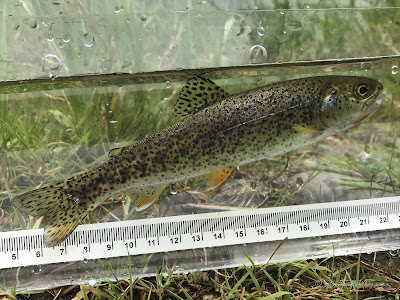
A small resident Coastal Cutthroat with blackspot disease
A small shiner caught on a dropper

Fishing my way upstream, I found a deeper run and managed to pick up a few more Cutthroat around 6-8” on my dry and while I am usually able to find a few fish in the 10-12” range on most trips, it wasn’t happening this time and after a couple of hours and perhaps a dozen small Cutthroat I figured I had seen enough and called it for the day.

The river

A healthy little Coastal Cutthroat

About a week after my Cutthroat outing, my buddies from Utah, Dan and Paul flew in for three days of fishing. The first fish that they were hoping to check off was a Coastal Cutthroat and as the local river had been producing mainly small fish, we decided to start on the Puget Sound to see if wee could find some sea-runs. 

We arrived at our first beach shortly after the low tide and at a beach with a good constricted passage, prime Cutthroat water. However, after a couple hours we had only had a few short strikes and follows but no fish landed and we decided to move on. The next beach we went too was at its ideal tide, and Paul got one Coho smolt, but again the Cutthroat were nowhere to be seen, so we decided to try one last beach. Unfortunately, this one also gave us a blank. It seemed to be one of those days where the fish didn’t want to bite... As I was out of time for the day, Dan and Paul ran to the local river and found the Cutthroat right where I had found them the week before.

A beautiful day on the water, regardless of slow fishing

The next day we were headed deep into the Olympics after native Coastal Rainbows. The stream that we were heading too is one of the more unique ones in Washington. This river has a set of barrier falls in its mid-section and as a result has Rainbows with colorations that I have not seen in other local populations. These fish are and almost pure white color, with prominent part marks and a vibrant pink/red band down the lateral line. The other interesting thing about this river, is that it is one of the only places in the lower 48 states with a true native population of Dolly Varden. These Dollies fit a different niche than the Rainbows, being more of benthic feeders, but are mixed in a about a 50/50 ratio and are known to rise to dries from time to time.

The shady river

After making the drive several hours to the river, we geared up and hiked upstream another couple of miles to a stretch that has treated me well in the past. Paul took the first crack at the river and after a few casts caught a small Dolly Varden on his nymph and in the next hole he got a nice about 10” Rainbow. Not long after, Dan too caught a small Dolly this time on a dry fly. 

A small native stream resident Southern Dolly Varden

The greatest challenge with this stream is that it is very high gradient and it can be a long distance between holding water. After Dan and Paul got into their fish, spent some time working along the river before I found a decent little run wit a few nice pockets thrown in. I started out in the soft water near the top of the run and as I picked up my line to make another cast I noticed a fish holding in the soft water side of the seam. On my next cast I got the fly right where I saw the fish and it instantly grabbed my dropper and I pulled in a nice little Dolly. After few more casts, there didn’t seem to be any other takers so I worked down the run a bit. Where the water picked turned into a bit of a riffle, a decent fish rose and this time I brought in a Rainbow. After landing that fish, I cast a couple few feet further back and rose another nicer fish. This one ended up being about 10” and was beautifully colored.

A beautiful pale white native Coastal Rainbow Trout
The fast flowing stream

We worked the stream for most of the afternoon, with each of us getting in a handful of Dollies and Rainbows, before heading back towards Olympia.

For the last day with Dan and Paul, we were heading east to the crest of the Cascade Mountains to search for some Eastern Cascades-Clearwater Westslope Cutthroat. This stream was quite a bit smaller than the last one, but holds a pure population of some of the most beautiful Cutthroat I have encountered. 

Cascade Mountain Cutthroat country

Paul headed up the road to try fishing upstream a ways, while Dan and I started right by the car. Just as with previous trips to this stream, the Cutthroat were plentiful, if not all that large. Within a few minutes Dan had his first Westslope of the day and not too long after that I had mine. As we worked our way upstream and further from the car, the holding water improved and so did the size of the fish, with a few running up to 10”.

A vibrantly colored native Cutthroat

After covering about a 1/2 mile of the creek, we decided to use our last couple hours before Dan and Paul flew out to visit my one of favorite streams in Washington. This other stream is stunningly beautiful and has equally beautiful Cutthroat. I had fished this other spot a number of times of the years, a rarely ran into other anglers, although within the last few years, a Seattle area fly shop started doing guided trips and pressure has gone up significantly since. Unfortunately, this was meant that when we got to the stream, there was already someone else fishing my favorite stretch and while we got a few minutes of fishing in upstream, it took longer to get to the water and we only had time to get a few casts in, catching a single fish before it was time to head out.

Another native Cutthroat

Despite a set back on our last spot, it was a great trip and excellent to spend time on the water with Dan and Paul, touring some of Washington's unique native trout locations. I am hoping that next year, I will be able to make it out to Utah to visit with them and hopefully check the Bonneville Cutthroat off of my list as well. 

Sunday, October 14, 2012

Back in Business...

To say that this past year has been busy is a major understatement. As a result of everything else going on in life right now, fishing and blogging for that matter dropped down my priority list. However, after a long break I finally got back after some sea-run Cutthroat at one of my favorite spots. 

The estuary

I arrived at estuary at low tide in hopes that the Coastal Cutthroat would be pushing into the river behind the salmon. As it would have it, while the salmon weren't moving in quite yet the Cutthroat certainly were waiting for them. I started out with a prawn pattern and within a couple of casts I got my first Cutthroat, a chunky 12" fish that fought valiantly on my 6 weight. I spent the next half an hour in this spot and landed three more Coastal Cutthroat before the fish seemed to wizen up. With the bite slowing down I decided it was time switch flies and head upstream. I put on one of my ever dependable Sea-run Buggers and in the next hole I missed another decent Cutthroat, then hooked into an even nicer one that looked to be about 18" to 20". However, I didn't get a very good hookset and after a few jumps the fish got the better of me.

Salmon season is underway (spawned out summer chum)

As I proceeded upstream, the Cutthroat were tucked along the undercut banks and seemed pretty interested in the Sea-run Bugger. Even when they were already full of salmon smolts they were still couldn't help themselves, such as this beauty below.

Still hungry...

Gotta love Coastal Cutthroat, they just don't know when enough is enough

 With the tide flooding in earnest at this point, I started making my way back downstream and sure enough the salmon started pushing into the river. As I was working my way down a side channel, I saw a wake coming upstream as a school of Coho worked their way over a bar. I cast my Sea-run Bugger downstream and gave it a couple of twitches just in front of the school and as fate would have it, one of the Coho broke away from the group and grabbed my fly. This Coho was big, and seemed to use its brute strength to its advantage making several good runs and putting my 6 wt to the test before finally coming to hand. This fish felt quite rewarding as last year I hooked 7 Coho without landing a single one and the year before I went one for thirteen. One for one, not bad!

 My first migratory Coho in two years.

Right as I got my fly out of this Coho and got him on his way, another school pushed through the shallows. I lucked out and these fish were grabby as well and the previous situation replayed itself. This time the Coho was a little bit smaller, but what is was lacking in size it made up for in fight and put up quite an aerial display. Luckily I got a good hookset on it and after a few minutes of tug of war, I was able to bring the beautiful 26" buck in. With the tide in at this point the Coho seemed to be done pushing in and I needed to get out before being stranded. So I cut my losses (or gains) and got out while I still could.

2 for 2!! Great way to end the day!

Time to head home!


Saturday, October 1, 2011

Sunset sea-runs

With my recent success on the Sound it was hard not to get out again, so when Colton called asking me to join him at the local beach, I was all in. When I got there the outgoing tide was underway Colton was already fishing.

Sunset at the beach

As with my prior outing, the fish seemed to be in and Colton had already gotten into a couple and within a few minutes found another nice 10" Cutthroat. While it wasn't lights out fishing, every ten minutes or so one of us would either get a hit or lock into a fish. Colton seemed to be having a bit better luck than me with the Cutthroat and was up three Cutthroat to my one Flounder before long.

My little Flounder

However, as the light faded we both decided to put some larger flies on and the change up seemed to make all the difference for me as I got a strong take and a solid hook up. This fish had some size to it and made my 6wt rod work for it. After several minutes of battling though, I brought the beautiful 16" sea-run to hand. After this fish we had a couple more hits, but the light was fading fast and we had to call an end to the day.

A great way to end the day.

Friday, September 30, 2011

Salter cutthroat again

So in between trips, I got in a couple of outings on the Puget Sound for some sea-run Cutthroat. On the first of these trips I met up with a fellow native trout enthusiast Steve from Texas to try to help him out with his first coastal cutthroat. With a promising outgoing tide we headed down to my home beach to try out luck.

Morning on the Sound

It definitely didn't take too long to see signs of fish as there were Cutthroat busting on schools of perch and sandlance. However, these fish seemed to be a bit finicky and for the amount of fish around, things seemed a bit slow. We each did manage to hook a few fish, but they all managed to pop off right at the net. As the tide started to slow I made the call to head down the beach a ways to try a point that generally treats me well. This was the ticket as the Cutthroat seemed to be much more willing biters here.

Steve's first Coastal Cutthroat

Steve was fishing a surface fly and it didn't take to long to start getting some action and to land his first sea-run. There were a few larger fish around as well and I managed to get a few in the 12-14" range.

A nice sea-run

As is usual with Cutthroat fishing on the Sound though, as the tide slacked off and so did the fishing, so we headed to another beach. We did get into a few nice fish at the other spot, but it definitely took a bit more searching and after fishing through almost the entire incoming we had only brought a few more Cutthroat to hand. Without a whole lot of beach left, we headed down to another point with a good tide rip and I got a short lived surprise by a migratory Coho. I was retrieving my fly at my standard speed and decided to pick up the pace a bit and within two strips; bam! I set the hook only to have nothing there and when I brought my line in I saw why... No fly and no tippet left. Just as I was thinking that this wasn't the work of a Cutthroat, the culprit a 7 or 8lb Coho with a some line hanging out of its mouth jumped and confirmed my suspicions. No complaints, but as with last year it appears that my Coho curse continues... After my incident with the Coho, Steve picked up a smaller resident Coho, another first for him before the tide forced us to call it a day.

Steve's resident Coho