About this blog

This blog is all about fly fishing for native trout. On it I cover trip reports, fishing tactics, conservation, the latest news about native trout species and much more. This site provides a companion to my web page Nativetroutflyfishing.com.

Gary
Showing posts with label Chinook Salmon. Show all posts

Sunday, September 15, 2024

The pre-spawn exploratory

Over the years, fall has by far become my favorite time of the year to fish and a central component of that is the salmon spawn. For trout, salmon arrive at the perfect time, providing a critical energy rich food supply - salmon eggs are about 3 times as energy rich as aquatic insects -  just before the lean winter months arrive. This wealth of food often attracts migratory trout from far and wide and when timed right makes for the best fishing of the year. Generally I find that Labor Day kicks off the season, but every river is a little different and sometimes it pays to get in early while the trout are hungry and still anticipating the incoming salmon run.

It was this thinking, as well as a desire to see how the river had changed after the high flows of winter that led myself and Dyllon to hope in the car and head for the water on a stormy mid-August afternoon.

Low water and stormy weather

We arrived to the sound of thunder in the distance, but luckily found ourselves in a pocket of decent weather between storm fronts, and were met with are river starved of water after a summer with barely a drop of rain. However, that did not deter us and as it is always interesting to see all of the changes to a river that you know well. 

The river we were fishing can be quite dynamic and we were immediately struck by the changes, with the first two previously decent holes we came to being completely filled in and the next one upstream having changed for the worse, being much shallower and the riffle at the top being far less pronounced then last season. However, it was here that we got our first look at a trout for the day, as a what we suspect was a 14" Cutthroat darted out to investigate Dyllon's presentation before deciding it wasn't too its liking and disappearing again. As we continued on, almost every change we saw was a disappointment, with a tree down in one of our favorite riffles, and another across a confluence hole causing most of the hole which had been my favorite spot the previous season to fill in. While I did manage to briefly hook an ~16" Rainbow at the confluence hole, we found holding spots to be few and far between this year and with this stretch a shadow of its former self we decided to move on and try another spot.

This next spot was quite a mixed bag, a few holes and riffles looked just as good or slightly better then they had last year, while again one of my favorite spots was nowhere near as good as it had been during previous seasons. So with the first 1/2 mile of water we covered it seemingly lifeless and having changed for the slightly for worse, we were starting to debate whether we should continue on when we finally spotted a lone female Chinook starting to dig a redd in a tailout.

First redd of the year, a lone female Chinook starting to dig

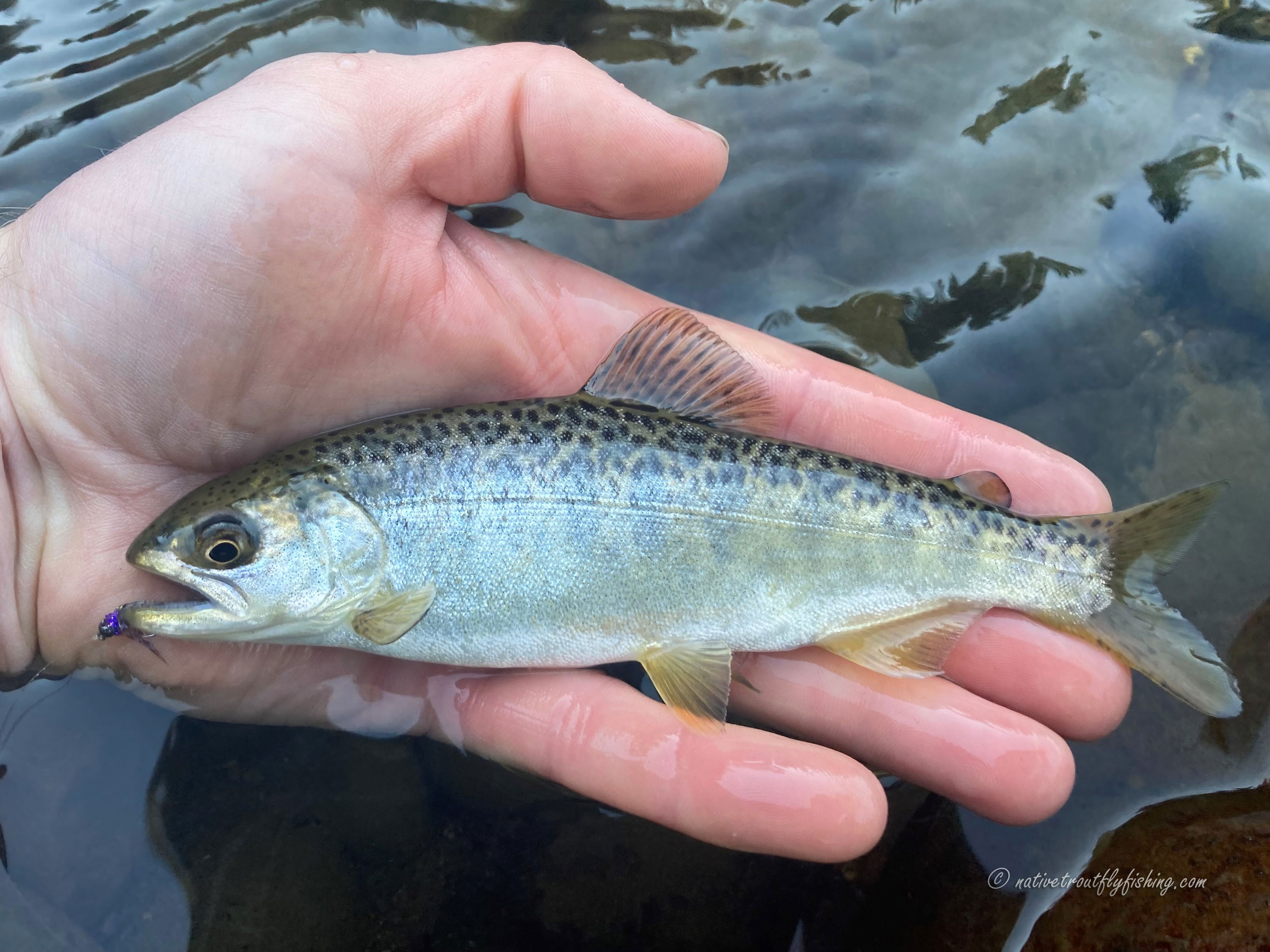
There just happened to be a good riffle and log jam just downstream of the redd and it seemed that the trout were already there looking for eggs as Dyllon caught several small Rainbows, before hooking into a beautiful 13" leopard spotted native.

Dyllon's gorgeous native Rainbow

After the bite slowed down at this spot, we moved further upstream and while we didn't see anymore spawners, it seems like the trout were already keyed in on eggs as Dyllon immediately hooked into another albeit smaller Rainbow in the next riffle upstream.

Vine maples showing the first signs of fall over some good holding water

It was my turn next and just downstream of where Dyllon got his fish, I got a good take and a few moments later had a decent native Rainbow to hand. While it had gorgeous coloration and spotting, I briefly thought that it was a hatchery fish as it had some major fin wear, but on closer inspection, the fish just looked to be battle scarred, with a part of its dorsal missing 

My battle scarred Rainbow

Just as the fishing seemed to be picking up, the stormy weather that had surrounding us finally broke and the sound of thunder kept getting closer and closer providing as clear of a signal as any that it was time to get off the river.

Getting off the river with thunder clouds hot on our heels

We made record timing getting back to the car, and it was a good thing too as just a couple minutes down the road we ran into a major storm cell with torrential rain that made it near impossible to see. However, despite being pushed off the river in a hurry and the downgrade in some of the habitat, it was great to see some fish around and know that the spawn is just around the corner.

Thursday, August 25, 2022

Westslope Cutthroat of the South Cascades

After my trip up to the Methow drainage after Westslope Cutthroat in the North Cascades in Washington, I wanted hunt down some Westslope Cutthroat in the Southern Cascades of Washington this summer as well. In particular, I was hoping to find some fluvial Westslopes. One thing I strive to do on my website is represent as much of the diversity as possible in each variety of trout, such as the different life history forms. The fluvial life history forms are also known as riverine migrants and are known for making concerted migrations throughout larger river systems as well as typically reaching much larger sizes than stream resident forms. The difference in the two life history trajectories also typically results in slightly different phenotypic traits, which is why I was hoping to document the fluvial life history.

After a bit of research, I landed on a moderate sized stream that I had fished way back in 2006, but at that point the stream was dominated by small Columbia Basin Redband Trout, with Westslopes only being a rarity. Since that point, catch and release regulations have been adopted in parts of the watershed and supposedly the Cutthroat population had responded very well to the new regulations. When I mentioned my plans to my neighbor Dyllon, he was interested in joining me, so set a date on the calendar and made plans for the trip.

The day of the trip we were on the road by 5:30 AM and made good time getting over to the east side of the Cascades. As we drove up the road once we hit the stream, we were both shocked with the number of anglers out already. I had specifically chosen a stretch as it appeared to have a good concentration of pools based on satellite imagery hoping that it might hold a few large Cutthroat and luckily it was still free of anglers. . While the morning was extremely chilly, we opted to wet wade as the clear skies promised that it would be quite hot by the afternoon. Dyllon opted for a streamer setup, while I brought, my 2WT with a dry/dropper and my 6wt with a double nymph rig. Once we were rigged up, it was time to get on the water.

Dyllon took to the river first and had a few good grabs in the first hole, but it wasn't until we got to the next riffle upstream that we landed any fish. I opted for the nymph rig and after a couple casts got a good take and after a quick battle landed a beautiful fluvial Westslope Cutthroat on my October Caddis nymph.

A beautiful orange-bellied Westslope Cutthroat Trout

After I got my Westslope, Dyllon got a nice Redband on his streamer and I picked up a couple small trout on my dry at the head of the riffle before we moved further upstream. The next stretch of the stream was a mix of riffle and pocket water habitat and turned out to be the most productive of the day. With the abundance of pocket water I grabbed my 2WT and started working up the run. The fishing was fast and furious with a fish on almost every casts and two Cutthroat (one on the dry and one on the dropper) on one of the casts. The recovery of the Westslope Cutthroat population was on full display in the section of river, as about 75% of the fish we encountered were Cutthroat. Despite the predominance of Cutthroat, it still was a mystery what would grab on each cast, and I was surprised by a couple of Chinook Salmon parr on dries in addition to the Redbands and Cutthroat.

A healthy wild Chinook Salmon parr

Dyllon managed to get a few decent fish up to 12" and continued upstream on ahead of me. Just as Dyllon was vanishing from sight I landed a nice cast along a boulder on the far bank and saw a big flash as a nice trout grabbed my dropper. I got a solid hookset and 2WT was completely doubled over by the powerful fish. The trout stayed deep and made a number of runs before I was finally able to net a beautiful 17" fluvial Westslope Cutthroat.

A beautiful fluvial Westslope Cutthroat Trout

The big Cutthroat managed to thoroughly put down the run, prompting me to continue moving upstream. The water for the next 1/4 mile was predominately pocket or shallow riffle water and most likely looking spots seem to produce a fish on my dry/ dropper rig.

The stream

I linked up with Dyllon at a series of deep pools, where it was time to switch back to my nymph set up. The most productive of these pools was quite deep and required a long drift to get to where the fish were holding. This resulted in a low take to hook up ratio, but by being persistent I was rewarded with some nice Cutthroat and a beautiful Columbia Basin Redband.

A beautiful native Columbia Basin Redband Trout

After the deep nymphing hole, we found one more productive run before we started to run into the afternoon innertube and swimmer hatch and decided to relocate. We headed downstream to where a few major tributaries came together to try our luck in some larger water. Right off the bat we found a nice run and I dredged up a beautiful 11" Westslope on my October Caddis nymph, which was definitely a good sign. After that first Cutthroat, the fishing slowed down considerably. 

The second river

We finally found some more good water about a 1/4 mile upstream, where both Dyllon and I managed to get into some more fish. For me it was another Columbia Basin Redband and a few smaller Cutthroat on my nymph rig, but Dyllon got the real surprise when he hooked into a nice fish on the streamer. I saw him hook into it from downstream and was able to reach him just in time to net a beautiful Bull Trout for him. Bull Trout are quite rare in this watershed making this a very special catch. We took extra care handling this beautiful fish and it was a joy to watch it glide back into the depths after being released.

Dyllon's surprise Bull Trout

We covered a bit more water, but didn't find much more in the way of fish and with temperatures reaching their peak for the day we both decided to call it a day. After encountering 4 native species and finding an amazing Westslope Cutthroat fishery I am already looking forward to my next trip to the east slope of the Cascade Mountains.

Thursday, October 28, 2021

Fall Salmon Spawn

With the start of fall, the leaves are changing colors and the first major rains of the season have hit western Washington. With that rain, the salmon have started to ascend the rivers in earnest and for those that know where to look, there are a number under the radar trout fisheries that really come alive once the salmon start spawning that under the right conditions can rival fisheries in Alaska. 

I recently, Chris and I had a day free to visit one of these fisheries and it seemed that our timing was spot on. When we arrived at the river, the first thing we saw was a pair of Chum Salmon sitting on a redd, telling us that the trout should be looking for eggs. Despite several pairs of Chum Salmon spawning above the first run that we tried, we failed to find any fish. However, just upstream of this the river braided into three channels and two of these were stacked with spawning salmon. Chris took one side and I took the other side. At the top of the side channel that I choose there was a fast riffle that dropped into a nice pocket. A classic spawning season holding water, providing a steady supply of eggs from spawning fish upstream, but being too fast for salmon to want to hold in the same water. I positioned myself just upstream of this slot and on the first drift, my egg imitation had barely gone over the lip of the pool when my indicator shot under the surface. Upon setting the hook, I could tell that this trout was no push over and unfortunately for me this was not going to be an easy spot to land a fish as both sides of the pocket we brushy meaning I would have to get the fish to come upstream. This led to a series of tug of wars with a fish that I got a good look at several times and could tell was well over 20". Despite a decent hook set, I just could not get this fish up over the lip of the pool and after a few minutes the trout finally won the battle and threw the hook.

Spawning Chum Salmon

Chris's side channel had only produced one small fish and as my fish had certainly spooked anything holding in the pool we decided to continue upstream, especially as we both knew there was some great water ahead of us. Not to far upstream Chris spotted a nice Rainbow that was holding in shallow water not far from some spawners. While took a few casts, Chris was able to get a good drift and as able to bring a nice 18" Rainbow to hand.

A spawned out Chum Salmon
A nice native Coastal Rainbow Trout

The next spot upstream was a slow moving trench that screamed sea-run Cutthroat water, but instead Chris got another similarly sized Rainbow, while I got a nice Pink Salmon on a streamer.

A Pink Salmon on a black sclupin pattern

The next two runs upstream were some of the best water we saw all day, but oddly seemed to be devoid of large fish and only held a few smolt sized fish. This may have been due to the spawners here being predominately Pink Salmon, which trout seem to avoid and also appear to select against eating Pink eggs compared to other species. We did find one little riffle with a pair of Chinook spawning at the top and this was where we ran into some Coastal Cutthroat, with Chris picking up a couple of nice fish.

A particularly spotty Cutthroat

After this, we decided that it was time to head back downstream as the best luck we had so far had been right near where we started. In area where Chris had gotten his first Rainbow, both Chris and I managed to pick up a nice Coastal Cutthroat. Additionally, as the side channel I had started at had gotten a nice rest, I got another shot at it and this time was able to pick up a decent albeit much smaller Rainbow, which this time I successfully got over the lip of the pool and landed. 

An egg eating Coastal Cutthroat

A bright native Cutthroat

Downstream of here, Chris and I picked up a handful of decent fish before coming to the best looking water of the day where a tributary entered the river forming a deep trench. It was here that I again hooked into another big Rainbow. This fish took several long runs almost making it into the backing before was able to turn it and bring it to shore where Chris netted it. While not quite as big as the one that I had hooked earlier in the day this 20" Rainbow definitely made the trip for me and was a great way to finish off the day.

My big egg eating Rainbow
A fat native Coastal Rainbow Trout, a great way to end the day

Saturday, October 31, 2020

Summer in the Olympics: Part 2

 After our last trip scouting for some new water on the Olympic Peninsula, Chris and I did some additional research a found another promising stream to check out. This one was a bit more off the beaten path and would require some serious leg work, but looked very promising. Per the norm in the Olympics, the morning we headed out dawned gray with a fresh marine layer rolling in off the Pacific. We started up the trail through towering old growth, but when we caught our first glimpse of the river, it was too much to resist and we decided to just start fishing right there. As it would turn out, this paid off and a few casts in, Chris caught a nice wild Spring Chinook jack. With our first taste of success on the river, we decide we would just use the river as our trail for the day and started our way upstream. From here things didn't slow down and the river was absolutely gorgeous and each hole and run seemed to have something in it.

Hooked into a fish

A beautiful native Coastal Cutthroat

A beautiful Bull Trout

Working a good seam

A little after lunch, Chris was working on other best runs of the day, when he hooked into something big. The fish turned out to be a bright summer run of about 7-8lbs and was not having any of it. Chris fought it for about 10 minutes until finally he was able to get it in netting range. However, the fish decided it wanted to do one more run, and unfortunately after a tail-wagging leap it spit the hook. We worked the hole a bit longer, but nothing else wanted to bite and with our excitement high, we continued upstream.

Chris working the summer run hole

Very fresh prints from a bear we could hear running off

As the day wore on, we found ourselves at the best hole we had seen all day. We got pretty focused on fishing and each hooked a couple of fish in the hole, when we started to notice that the sun was starting to get low in the sky. It was at this point that we realized that we hadn't stopped moving almost all day and had covered a bit more ground than we had expected and needed to find the trail and start heading back. Unfortunately, this was more easily said than done and ended up being a rough 1/2 hour of bush whacking until we finally found the trail. The hike out made it quite apparent just how far we had gone, with us dragging by the time we reached the trailhead at dusk after what we end up figuring out was a 14 mile day trip.

A beautiful stretch of the river

A giant spruce tree on the way out.

My next adventure was to a couple of my favorite Olympic streams with one of my neighbor Dyllon. As summer was wearing on at this point, I was hoping that the native Rainbows would be starting to think about spawning salmon and the eggs that would be right around the corner. With luck this same thing and a recent rain would also draw a few sea-run Cutthroat in from the salt water as well. The first stream of the day we hit, is usually more productive, albeit with slightly smaller fish. However, today fishing proved very slow and after covering a mile of water and only getting one small Cutthroat we decided to try the other river. 

The first few holes we fished on the next river were just as slow as the last river, but when we got down to one of the "salmon tanks" on the lower river, that changed. I had a large streamer imitating a lamprey on and started with a short perhaps 20' roll cast just to get some line out. However, I watched as a big Cutthroat quickly shot out from behind a log and charged my streamer. The fish seemed to hesitate, so I gave it a couple quick twitches before letting my fly fall and the Cutthroat crushed the fly. The fight was pretty quick as the Cutthroat was close to shore already and I really wanted to avoid spoking the hole. The fish was beautiful and looked as though it had only been out of the saltwater for a day or two at most. 

My big Cutthroat

I gave my Dyllon the next shot at the hole and after floating a few feet, his indicator went down and he hooked into a big Rainbow. This fish was hooked right in the heart of the hole and put up quite a battle before coming in, effective spooking the rest of the hole.

The Rainbow

We figured we had one more hole we could hit before the end of the day and this one also looked promising, as I could see a big Cutthroat sitting in the tail out when we approached. However, before we could get more than a couple casts in a flotilla of inner tubers came floating down the river and spooked the hole and with that we decided that since we had already gotten a couple nice fish and it was time to head back.

Thursday, September 8, 2011

Back home - August in review part 2

The last couple weeks of August were a blur of fishing trip after fishing trip. The first thing on the agenda was a trip for Pink Salmon. The smallest of the Pacific Salmon, Pinks are only around in Washington during odd years, so I always try to at least get out a few times for them when they are running. So the night before my first outing for them Colton and I did a little fly tying challenge, with only a handful of materials at our disposal, we had to invent a fly and then try to catch something on it and whoever caught the most on their fly won. Won what exactly, I still have no idea but still I wanted to win.

My fly tying concoction a pink and purple prawn

So in the morning we meant up with another buddy of mine (Eric) at the dock and headed out for some Pink fishing. While the run was predicted to be around 6 million fish to the Puget Sound this year, the numbers in our area have been a little less then what I am used to. Due to that it took us a bit of hunting to find some fish, but finally we got into some in the mid-morning. For about an hour we had some decent fishing and my fly fished on a fast sinking line got the first pink of the day.

My first Pink of 2011

However, the fish just didn't seem to be overly thick or in much of a biting mood so before long we had to go hunting for more. We found some good numbers after about a half hour of searching and while the fish still required some work we managed to pick up a few more. Unfortunately, for Colton his fish popped loose after a solid battle and while he hooked a fish on the next cast and landed it, the competition only applied to salmon and not flounders.

Colton's Starry Flounder

While it wasn't lights out Pink fishing like I have seen in the past, it was still a great day on the water.
After the Pink Salmon outing, my buddy Wayne invited me out to Sekiu on the Olympic Peninsula for another salmon trip. While I tried hard to get something on the fly, the fish just weren't up top and with only a brief hook up for a day's effort I finally switch to conventional gear and started getting results. Fact of the matter was this was a meat hunting mission and the conventional gear could get the results with the fish at 50' to 75'.

Morning on the water

Wayne with a nice Pink Salmon

A nice sized wild Chinook Salmon just before release

Some BBQ and smoker guests

End of a beautiful day on the water

Thursday, June 2, 2011

Eastside wanderings

My recent drought of blog posts has been accompanied with an equal drought of fishing for me. Oddly enough this is despite being stationed on one of Washington's better Steelhead and salmon streams for my job at WDFW. Part of this is due to the long hours I have been working with 12+ hour shifts the normal. The other half is that during the month of May the only open water on this particular river was the lower two miles and it was only open two days a week while I was there. So between gale force winds, high flows and working late I only managed to fish the lower river once during my time there. However, that one time will go down as one of the most memorable outings of my life. With only a few hours of daylight left after work I made the hour drive down to the river only to find that of the two miles of open water only about a 1/4 mile was actually accessible due to the rugged terrain.

However, that 1/4 mile held some pretty enticing water, being situated between a rapid and a series of falls, it was clearly a place where migratory fish would keg up. When I arrived there were a couple fisherman working the upper part of the run, who said that fishing had been decent and a few salmon and Steelhead had been caught earlier in the day. With that I headed downstream to the tail out. It didn't take long once I started fishing to see signs of fish. These included rising trout, a school of suckers holding on the bottom and every now and again the tell tail roll of a spring Chinook Salmon.

The lower river

With Steelhead around and I rigged up my nymph rod and started working the closest seam. Within a few casts I started to see results too, as I had a few good takes and a brief hook up, before solidly locking into a fish. While it wasn't a Steelhead like I was hoping for it was a nice sized sucker fish and I was just happy to catch something.

The sucker fish

I hooked into a few more sucker fish, before deciding to try out the next run downstream. The water was quite a bit faster in this section of river, but the fastest water was on the far side and the near water looked like great traveling water and the type of place that I would expect an anadromous fish to hold. My fish cast was in a little too close and it resulted in my indicator going down me snagging up with the bottom. I put the next cast a few feet further out and once again my indicator went down in just about the same spot. However, the take down was followed by a couple good head shakes and line peeling off my reel. I didn't realize how big the fish was at first, but as my line got into the backing a huge spring Chinook breached on the opposite side of the river. This was easily the biggest fish that I have ever hooked and my conservative estimate was 30lbs. The fish held in the run for a couple of minutes, with me doing my best to try to control it. During this time it jumped a few more times giving me a rather good look at it. However, before long it started to work its way into the rapid below me and I knew that I was in trouble. I held the fish on the edge of a back eddy for a short bit before I could tell that it was going to make a run for it. To counter this I gave just a couple more turns to my drag in hopes of tiring the salmon faster. However, this turned out to be my undoing. As the fish turned downstream it came up and did one more slash on the surface and in doing so snapped my 20lb tippet like it was nothing, leaving shaken and in awe of what had just happened.

The springer run

After a few minutes to collect my wits, I went back to fishing the run again and although I spotted a few rolling fish I wasn't able to hook into another monster. I left as the sunset with hopes of returning on the next open day, however with the higher than average spring the flows just didn't allow it again.

Mt. Adams

However, there was plenty to explore in the area and hiking around and scouting out the watershed kept me pretty occupied in the evenings...

Plenty of water to explore next time

Wednesday, January 5, 2011

Evergreen State Anadromous Challenge Complete!

First off this is an unofficial challenge that I set out to complete a couple of years ago, to catch (on a fly) and photograph the anadromous form of every salmonid in the State of Washington. While this challenge should have been completed back in October, however all of the coastal variety of steelhead that I had caught had been slightly too crafty for me to get a picture. A couple of weeks ago that changed and I finally finished this mini-quest off.

Steelhead - Coastal Rainbow Trout - Oncorhynchus mykiss irideus

Steelhead - Columbia Basin Redband - Oncorhynchus mykiss gairdneri

Coastal Cutthroat Trout - Oncorhynchus clarkii clarkii

Bull Trout - Salvelinus confluentus

Chinook Salmon - Oncorhynchus tshawytscha

Coho Salmon - Oncorhynchus kisutch

Chum Salmon - Oncorhynchus keta

Pink Salmon - Oncorhynchus gorbuscha

Sockeye Salmon - Oncorhynchus nerka

It is possible that sea-run Dolly Varden may also exist in Washington State, but I have not found any evidence yet to show that the anadromous char found in our waters are anything but Bull Trout. Plus the fact that it is challenging to tell the two species apart without a genetic test would make it near impossible to prove that a fish is a Dolly and not a Bull, so I consider the quest complete!