This post has been a long time in coming, but here it is at last.
Shortly after my outing for trout matching the description of the elusive and supposedly extinct Alvord Cutthroat Trout last year (
click here for details), a couple of native trout enthusiast Scott and Dan from Utah had contacted me about making another trip out to southeast Oregon in search of these trout. Initially I wasn't sure I would be able to pull it off, but finally found a week in early July that worked for all of us and we made plans to meet up for some fishing.
As part of this trip, we had also decided to take data on the number of trout displaying Alvord vs. typical Lahontan characteristics, photograph each fish and take measurements, to send what we collected to Robert Behnke. As of right now nothing whatsoever is being done to protect these fish or begin to restore them to their native habitat and with any luck this data will help to get the ball rolling soon.
Originally it was just going to be my dad and I heading down for this trip, but shortly before the trip a slight complication arose as my sister whom had to travel to the same area for business proposes decided to join us. She seemed fine with the plans I had and as such I decided to roll with it. As Scott and Dan were coming from Utah and hadn't been to this area, we made plans to meet at a campground on Monday not far from the creek before embarking on our Alvord adventure on Tuesday.
Day 1: Sunday June 28th 2009: In order to split up the driving a bit, I figured that it would be best to head out on Sunday after I got off work at 6:00 PM. With me off at 6:00 PM, we were on the road by 7:00 PM, bound for Bend, Oregon where we would be spending the first night. The drive out to Bend was quite uneventful, although due to the shear distances involved and we didn't arrive in Bend until after 1:00 AM.
Day 2: Monday June 29th 2009: We had decided to spend the first half of the day in Bend before heading out to the campground. So while my sister took care of some of here business stuff, I checked out Bend. One of my favorite discoveries in Bend that I had heard about prior to the trip was the Orvis casting course. The concept of this course is similar to that of a golf course, where the caster earns points for landing his fly within the target area. The course also has a wide range of difficulty for their targets, that will challenge anglers from the beginning to the advanced level.
 |
| One of the ponds on the Orvis casting course in Bend, OR |
Right after lunch we finally departed Bend and made the long drive out to the high desert. While had to deal with several slow downs due to road work projects, the most trying part of the whole drive was resisting the urge to stop and fish as we drove across the native range of four different forms of Great Basin Redband. This was especially difficult as we were stuck at a road work project along a nice meadow stream in the Chewaucan Basin within plain view of a pool holding several actively rising fish. However, the wait ended up only being a few minutes not giving me too much time to dwell on things and by late-afternoon we were making our way up the long gravel road to the campground.
Even if I had no interest in fly fishing I would still enjoy this area, which has some the most diverse terrain in Oregon, ranging from high mountains, desert basins to grassland prairies.
 |
| A herd of Pronghorn Antelope |
 |
| The road into the campground |
We arrived at the campground in the late afternoon, got the tent set up, made dinner, then I was off to check out a nearby Redband stream in the Caltow Valley. Upon reaching the stream, it didn't take long to know that there were fish in it, as my first cast with a Royal PMX and black Copper John dropper produced a beautiful little Redband. From that point on fishing pretty much continued to be fast and furious and it was just a matter of seeking out pockets large enough to hold a trout or two.
 |
| It is easy to see where these fish get their name of "redbands" from on this one. |
I fished until the sun fell below the horizon and only called it quits when I could no longer see my fly. Shortly after getting back to the campground, Scott and Dan arrived and we made plans to do a little Redband fishing in the morning before heading to the Alvord stream.
Day 3: Tuesday June 30th 2009: I got up with the sun and by 6:30 AM we were on the water making our way down the creek to some good water. The creek in this area wound its way through stands of willows and aspens, and was best fished anywhere that the vegetation opened up a bit. We found one such open spot that had a couple nice pockets and within a few seconds Dan had caught his first Catlow Valley Redband. The fishing on the creek was just as good as the night before and within a couple minutes Scott and I also had a few fish under our belts. For the most part this was simply tap and dap fishing, and I was long arming my dry dropper step up into the pockets with very good success. While the dropper did help here, the dry still worked great and I was getting about a 50/50 mix of fish above and below the surface.
 |
| Dan fish a promising looking spot on the Redband stream |
 |
| A beautiful little native Catlow Valley Redband Trout |
We ended up covering about a mile of the creek and caught about 10 to 15 Redbands a piece with the average size going 5"-7" and a few fish up to 10" thrown in here and there. At 9:00 AM called it on the Redband stream and headed back to camp to grab some breakfast before heading out across the desert to fish for some of the rarest trout in the world.
Before taking off again, I decided to join Dan and Scott for the next leg of the trip looking for Alvord Cutthroat, followed by Harney-Malheur Basin Redbands. My dad and sister would take care of her business out in Burns, Oregon then would meet back up with me at the Harney-Malheur Basin stream.
By mid-morning Scott, Dan and I were in Dan's truck bumping along the long gravel road to the creek. I cannot begin to express how much nicer it was to drive to this stream instead of hiking as I did last year. However, with the 2WD car that I drove last year, which already had one a flat I am glad that I didn't risk it as the road into the creek was pretty darn rough and I could have easily ended up stranded in the middle of nowhere.
Coming into the meadows along the creek, it was clear that a wet spring and early summer had made a big difference on the valley, as it was much greener this year. We drove he truck as far down the road as far we dared, before pulling off, rigging up the rods and deciding to hike downstream below the section that I had fish last year. A side effect of the wet spring in the form of hordes of mosquitos made itself know as we rigged up and we were all thankful for coming prepared with bug spray this year.
 |
| This should give a little idea of the amount of mosquitoes that we were dealing with. |
 |
| Looking down the valley |
We followed the "road," which was more of a trail at this point downstream to where it crossed the creek before we started fishing. Last year when I had fished this creek, I had found that about 90% of the water was relatively fishless, but anywhere that the creek turned a corner or got narrower it was usually deep enough to hold a couple of trout. Being earlier in the season and a wetter year, there was a quite bit more water in the creek then I had seen last year, but it looked like fishing the with the same methods would work well again. I started out at the road crossing, while Dan went downstream and Scott went slightly upstream. Being three of us, we did a bit of leap frogging around each other as we fished with each person picking a 50 yard stretch of the stream and person in the back of the group moving to the front after they had fished through their section.
Once again I started out with a dry fly and a dropper that had worked last year and would allow fish that were holding beneath the weeds or under-cut banks to still see my fly. In the road pool I couldn't get anything to look at my flies, even though it looked like prime holding water, so I grudgingly moved downstream a little further. Just downstream I found a nice narrow troth that I fed my fly into and just as it drifted past some aquatic vegetation, my dry shot under the water. I set the hook and was into a trout on my dropper. Although I had fish higher up, last year I had only caught a couple of trout with typical Lahontan Cutthroat traits. As such was a little disappointed when I brought this fish in and saw that it looked like a typical Lahontan Cutthroat. Even so I took a photograph and measurements to be sent to Dr. Behnke. While it is thought that all of the fish in this stream we introduced, evidence points to Alvords from Trout Creek being stocked first likely before the 1920's, with Lahontan and Willow-Whitehorse Cutthroat being stocked several times between the 1950's and 1970's. However, the trout in the creek appear to display two distinct phenotypes, with some typical of Lahontan and others typical of Alvords. It is unclear weather this is due to some level of reproductive isolation or other mechanism.
Within a few minutes, Dan had also caught a fish, which also turned out to be a Lahontan type fish.
I continued downstream and found a great little pool that was about two feet deep and had a decent looking trout holding towards the tailout of the pool. I drifted my fly through the hole about twenty times and had my dry go under once at the head of the pool but couldn't get the Cutthroat at the tailout to as much as look at my fly. This meant that it was time for a change of tactics. If I have learned anything living in Washington and fishing for trout, it is that you usually have to think outside of the box once and a while if you want to be successful. One major lesson that I have learned, is that most native trout in slow pools or ponds will be triggered into biting when they think that the food is going to get away if they don't act quickly. It is in these situations that I pull out a fly like the ever dependable Zug Bug.
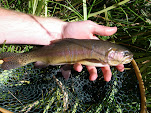
This situation ended up fitting this mold exactly as I hoped it would. I tied on a size 12 Zug Bug, cast it just upstream of the Cutthroat I could see on the bottom, gave it a few seconds to sink before stripping it back in. At first the Cutthroat didn't seem too interested, but as soon as it looked like it was going miss its opportunity to eat my fly that changed and it rushed the Zug Bug. I saw and felt the strike at almost the same time. I set the hook and the fish was on with nowhere to run. The battle was short and as I slid the fish into my net, I was thrilled to see that it was what I had come for; an Alvord Cutthroat. However, my next realization was that my camera was nowhere to be found and I must have left it on the ground where I had caught the last fish. It is times like these that I am glad that I bring a net. I was able the keep the fish in the water and in the shade while I made a quick dash upstream and grabbed my camera, which still sitting on a sand bar. I rushed back downstream where the Alvord Cutthroat was still resting in the net, but unfortunately the rest had restored some of its energy. As such its plans and mine about the photoshoot were quite different and it made a dash for freedom before I could get a picture. With having had my dry go under at the head of the pool I figured there might be a fish there as well and my hunch was rewarded with a nice sized fish that looked like a Lahontan Cutthroat.
 |
| Zug Bug eating "Lahontan" |
Seeing how well the Zug Bug had worked for me in this pool I decided to leave it on for a bit and head back upstream. This fly seemed to work well in most of the deep holes, including the road crossing pool where I hooked two fish and landed one of them. I continued upstream to a small canyon stretch where I had stopped fishing last year, catching another six fish along the way, although all of them had Lahontan Cutthroat traits. Once I reached this stretch the size of the stream shrunk and I switched back to my previous dry dropper system.
 |
| Covering the water just above the canyon |
Just above this canyon stretch in one of the pools that I remembered catching a fish out of last year, I spotted a fish that looked to be about 8" long. It was sitting right below a weed bed at the head of the pool and on my first cast I got it to take but didn't hook up. I threw another cast into the pool but it got rejected by this fish. I allowed my fly drift downstream a little further than I had planned and just as I was about to go for another cast my dry shot under the surface. This fish was much larger than the one that I had been aiming for, but with the small quarters had nowhere to go and I quickly brought it to the net. Immediately knew that I had seen this fish last year, as out of all of the fish that I caught in this creek I had only seen one with this spotting pattern and this level of the distinctive red coloration that Alvord Cutthroat were known for. Dan seeing the commotion came over and assisted with the photos and measurements, pegging this fish in at 10.5". I knew that I had photos of this fish at home and would only know for sure then, but I was all but sure that I was right.
 |
| Wait doesn't this fish look familiar... Check out the photo below... |
 |
| Yep it is the same fish that I caught last year. Although it had really grown. (Note the spots below the eye and behind the gill plate). |
Dan told me that he had seen a fish in the next pool upstream, so I went to check it out and was rewarded with another fish on my dropper. This one ended up being a perfect representation of the Alvord Cutthroat phenotype and was absolutely beautiful.
 |
| After catching so many fish with Lahontan characteristics, this Alvord was a very welcome change. |
 |
| An underwater shot of an Alvord |
It seemed like each time the creek deepened out in this stretch, one of us would hook up with a fish. The nice thing too was that after getting above the canyon stretch the ratio of fish with Alvord traits versus typical Lahontan traits had increased and although the largest fish were around 11", we all started getting a few of the Alvord Cutthroat that we came here for.
 |
| A typical stretch of the creek |
The higher up the creek that we moved, the tighter conditions got and holding water began to be spaced out much further. To complicate matters, the creek meandered through stretches of six foot tall grass and small groves of willows that made casting or even getting a fly in the water all but impossible. The few pockets that were free of obstructions though continued to produce fish, including my only fish on a dry for the day, which was an 8" Alvord. Before long we reached the upper end of the fishable section of the creek and it was time to move on.
 |
| Another Cutthroat with the coloration and spotting pattern typical of Alvord Cutthroat |
After a long day on the water at the Alvord stream, it was time to head to the Harney-Malheur Basin where we would be camping for the night. I fished the stream we headed for back in
2006 and had found a good number of Redbands, including one in the 20" range, which had spit my fly before I could land it. Needless to say I was a little anxious to check it out again.
The drive across the desert was fairly uneventful, with a fair few Antelope sightings along the way. When we got there we grabbed a campsite near the river, rigged up our rods and hit the water.
The first thing that I should mention about this place is that the Alvord stream may as well have been a mosquito free zone in comparison. The second that we got on the water hordes of mosquitos descended on us and even DEET couldn't keep them at bay.
If it weren't for the mosquitoes the fishing would have been a lot more enjoyable, as even though the trout weren't overly large there were lots of them and they eagerly rose to dry flies. These Redbands are also some of the more acrobatic fish I have come across and once hooked seemingly spent more time out of the water than in it. We worked upstream catching trout after trout, but just about all of the them were only in the 6" to 8" range.
 |
| A small Harney-Malheur Basin Redband Trout |
The notable exceptions were a nice 15" Redband that Scott rose along a seam but didn't end up getting a solid hookup and a 12" fish that rose to Dan's fly but popped off at the net. After a couple hours the combo of failing daylight and an increase in the already bad mosquito problem made us decide to head back to camp. We fished a few of the better spots on the way back downstream, and I put on a size 6 golden stone colored Jumbo John and fished it on a downstream swing. While Dan and Scott continued to catch fish on just about every cast, I would maybe get a hit on one out of three casts. However, I was hoping for something bigger so this was fine by me. When we got to the spot where Dan had hooked the 12" fish, he pointed me to the spot that it was holding and on the first cast it took. I got a solid hook set and the fish started running and jumping like crazy. However, being on a 2WT there was only so much I could do to keep him out of the snags along the shore and before long the fish finally pulled my line into a root wad and got off. At this point it was finally time to call it quits for the day.
Day 4: July 1st 2009: My original plan for this day was to meet up with my dad and sister and head to the Whitehorse Basin to fish for some Cutthroat. I told Scott and Dan and to go ahead and make their way over to Whitehorse and as long as everything went to plan I would meet them there. Everything did not go as planned though. While I had very clearly marked a map with directions how to get to the campground, my dad and sister managed to take the wrong turn. They didn't discover their mistake for some time, leaving me stranded at the mosquito infested river. When I got the call telling me how late they were going to arriving, I had a choice between being eaten alive by mosquitoes in the campground or on the river, so I chose the river.
 |
| The Harney-Malheur Basin Redband stream, a haven for trout and mosquitoes amid some very thirsty country |
Once again even armed with bug spray the mosquitoes were ravenous, so even though the weather was hot I threw on a hooded sweatshirt to combat the bugs and got on the water. As with the day before, I started out with a dry and dropper and was getting smallish trout on just about every cast. When I reached the spot where Scott had hooked his big fish the night before, I made a cast and sure enough the fish was still there. However, just as with Scott this fish spit my fly after only a few seconds and it was back to casting for small trout again.
I hiked upstream a little ways to where I found a couple of deeper pools and decided to switch tactics up a bit and put the Jumbo John on again. I fished this fly on the swing and in the first pool I managed a nice trout at about 10", which was an improvement from the average size that I had been seeing on the dry and dropper. The next pool upstream was fairly broad with a deep drop off on the far bank. I made my way up to the head of the pool and had a strike on my first cast but didn't hook up. After a few more casts a fish slam my fly as it neared the middle of its swing and I was fast into a nice sized Redband. Unlike the spot that I had hooked my big fish the night before this pool was relatively free of obstructions, so while the fish fought valiantly on my 2wt I was able to work him into my net. While there are undoubtedly larger fish in this drainage this 13" Redband seemed like a giant in comparison to the six inchers that I had been catching so I decided to call it quits and head back to the campground for lunch.
 |
| A nice Redband that took a golden stone colored Jumbo John swung across a pool |
At around 3:00 PM my dad and sister finally showed up. At this point it was already way to late in the day to head down to the Whitehorse Basin, so we decided to head up to the Blue Mountains to grab a hotel for the night as we started working our way home.
Day 5: July 2nd 2009: Although I had planned on staying an extra day, we all agreed that it would be nice to get home a little early, so we made the long drive from the Blue Mountains back to Gig Harbor. Scott, Dan and I a currently compiling all of our photos and data to send to Dr. Behnke and it will be fun to hear what he has to say when we get everything to him.



 Posts


