About this blog

This blog is all about fly fishing for native trout. On it I cover trip reports, fishing tactics, conservation, the latest news about native trout species and much more. This site provides a companion to my web page Nativetroutflyfishing.com.

Gary
Showing posts with label Oregon. Show all posts

Wednesday, July 13, 2022

High Desert Angling: Part 3 - Ending on a Good Note

Day 4: Monday July 4th 2022: After a good night sleep, we got on the road early headed for the Santa Rosa Mountains in pursuit of the Quinn River Cutthroat Trout. For years the Quinn River Cutthroat had been either lumped in with Humboldt or Lahontan Cutthroat, but recent genetics work had indicated that they are distinct enough to warrant subspecies status. Back in September of 2019, I had made a trip down to the Santa Rosa Mountains to look for Quinn River Cutthroat only to be foiled by a freak snowstorm that made access to the small streams draining the mountains impossible. This time it was a beautiful bluebird day and the weather couldn’t have been further from that first trip. 

Turning off the highway and heading for the Mountains, we hit another genuinely awful dusty and deeply rutted dirt road, that was swarming with 3” Mormon Crickets. Luckily my car was up to another rough road and we made it to the trailhead at the mouth of the canyon with no issues. The first thing that struck me when we got out of the car was the noise, which was a cacophony of thousands of Crickets and Cicadas, both of which appeared to be having population booms. We quickly geared up and hit the trail headed for a waterfall, that served as a barrier to nonnative Brook Trout, blocking them from the native Quinn River Cutthroat upstream. As we followed the canyon towards the falls, the creek remained completely obscured by an impenetrable wall of vegetation, somehow the thickest of any of the creeks we had visited so far. Mormon Crickets were everywhere, making so much noise that I was worried we might stumble upon a rattlesnake without hearing it. With that very real threat, we took the cautious slow and steady approach, but it didn't take long for us to reach the falls, above which we would hopefully find some native trout.

The falls 
So many Mormon Crickets!

As we had to go by the falls to get to the upper valley, I figured we might as well stop on the way and see if any fish had washed over. The waterfall was beautiful, but the biggest thing of note was the smell. With the cricket boom, thousands had fallen into the stream and many of these had collected along the edges of the waterfall pool.

Lots of dead crickets

Usually one of the wonderful traits of native trout in small streams is their refusal to pass up food, resulting in quick rises. However, with all of the crickets falling in the stream, the fish in this creek were not as accommodating and cast after cast produced no results. Finally, on a near perfect drift my dry fly disappeared below the surface indicating a grab on my nymph. The battle was quick and luckily for me Derek was on hand to net my first Quinn River Cutthroat. The Cutthroat was a small, exceptionally fat fish, lightly spotted across its body, with a beautiful rose color across its sides.

An exceptionally fat little Quinn River Cutthroat

After I got my Cutthroat, Derek took point for a bit but we didn’t find any other fish in the waterfall hole or the creek right below it. This prompted us to head upstream, where we hoped fishing would improve. The few promising pools directly above the falls showed no signs of life and the dense vegetation made continuing upstream impossible, so we decided to hit the trail. We worked our way up the canyon looking for an opening in the vegetation or some promising looking water, but it was hard to come by. We did find some slightly open water over a mile upstream and fished the area hard but there was no sign of fish. The morning was already wearing on and we decided to start working down the canyon and pop into the stream wherever we could find access. Again no fish.

The upper valley... No fish...

When we got back to the falls we tried that area again, but didn't find any additional fish. We did find a few more spots to access the stream as we worked our way toward the trailhead, however it wasn’t until we reached the trailhead that Derek managed to hook another fish. Unfortunately, this turned out to be a Brook Trout instead of a Cutthroat. After another fishless half hour downstream of the trailhead, the day was wearing on and if we wanted to reach our next stop at a reasonable time, so we had to get on the road.
Time to hit the road again

After leaving the stream in the Santa Rosa range, we started the last leg of our trip. It was a five hour drive to our next stream in the upper John Day drainage, which felt particularly long after so many miles on the road. After several days driving through sage brush desert, coming over a rise just north of Burns Oregon and find ourselves in driving through towering pine trees signally our exit from the interal desert basins. 

We reached the upper John Day watershed around 5pm, opting for fishing over dinner. Like our attept to catch the Humboldt Cutthroat the previous day, the John Day Westslope Cutthroat was not a new fish for me, having caught one in 2019. However, I prefer to represent as many fish as possible on my website to show phenotypic diversity, so we were back to see if we could find more this time. Acting on a tip from Steve we were targeting a very small headwater stream, which was report to only hold Cutthroat. Arriving at the stream it looked like we could jump across it in most places and flowed through a meadow upstream of the road and spruce and fir forest downstream of the road. I decided to start downstream of the road, while Derek went upstream. Upon reaching the waters edge, I was immediately met with a good sign, as handful of trout were clearly visible holding in the middle of the pool below the culvert. My first cast wasn't ideal, with my flies making the water but my line hanging up on a branch over the stream. However, the drift was good and the largest of trout made a slow and deliberate rise to my dry fly. The hookset pulled my line free of the branch and even with my 1wt I was quickly able to pull the trout away from the others and land it in the tailout of the pool. Given the challenges provided by the rest of the trip, this was a very welcome change.. 

A beautiful darkly colored John Day Westslope Cutthroat

While the light wasn't ideal at this point of the day,  I managed to get a few decent photos then turned the fish loose. The photography time allowed the hole to rest and a few more casts resulted in another fish, this time on my dropper. After I hooked a third, which I lost, effectively putting off the rest of the hole. I worked downstream a ways hooking and losing a few more fish, but also finding the stream to be quite brushy, prompting me to head upstream and see how Derek was doing. 

The creek above the road was much more open than downstream and Derek was also getting into cutthroat, with every likely and many of the unlikely lies holding trout. We worked the productive little stream for a couple of hours catching a number of Cutthroat before the need to set up camp and make dinner finally pulled us away.

Derek working the stream for Cutthroat

Another Westslope Cutthroat

With our mission for the day complete and having just experienced the best fishing of the entire trip, we settled into camp for the evening, ready to turn our path towards home the next day.

Day 5: Tuesday July 5th 2022: We awoke early on the last day of our trip, although we had a long ways to go still with a roughly eight hour drive for me to reach home, we didn't feel the need to rush. As such, we took our time breaking down camp, enjoying a slower pace before hitting the road. While we had no directed plans to fish on the way back, we found ourselves driving along a beautiful little meadow stream that was too tempting to pass by and decided we could spare a few minutes to wet a fly.

Our last stop on the trip

Fishing at this stream proved to be just as fast paced as the stream from the previous evening and within a few casts we each had caught ourselves a Redband Trout. With the fish abundant and the stream open, we only spent about 30 minutes on the water, long enough to catch 3 or 4 Redbands apiece before hitting the road.

A small but beautiful Columbia Basin Redband Trout

The rest of the drive was as rather uneventful, putting back at Derek's house around lunchtime and myself home in time for dinner. This was one of the faster paced and more challenging trips that I have been on, but with with use managing to catching five varieties of native trout and three additional nonnatives, it certainly was a success. Likely this will be my only major out of state native trout road trip this year, pushing my thoughts towards next years plans of a trip to Colorado to round out my remaining Cutthroat subspecies.

Thursday, June 30, 2022

Oregon Coastal Cutthroat

At the beginning of April I decide to make a major career shift and after 11 years with the Washington Department of Fish and Wildlife, I accepted a position as the Science Advisor for the Trout Unlimited's Wild Steelhead Imitative. June, I found myself in Reedsport Oregon for a weeklong work retreat. While we put in long hours during the day, the evenings were reserved for team building time (i.e. fishing time!!). 

Since the retreat was taking place during the off-season for steelhead (too late for winters and too early for summers), we had opted to do our part for the Umpqua River steelhead and instead targeted Striped Bass for a few days. The Striped Bass population on the Umpqua River have experienced a recent boom and are currently considered on of the leading threats to wild steelhead in the basin, especially the summer-run population which was at critically low abundance in 2021.  As such suppressing the non-native striper population is through angling is one of the strategies that ODFW is suggesting to aid the struggling native summer steelhead population.
The Umpqua River estuary

We fished stripers on a variety of top water poppers, flies and swimbaits. The fishing never quite it the "red hot" level, most likely due to the cooler to normal spring. However, we did get into some decent fish and hopefully saved a few steelhead smolts in the process. For more details the our post about Stripers and our retreat on the Wild Steelheaders United blog.

A solid Striped Bass caught on top water

The last day of the retreat, the weather was predicted to be much rougher and my coworkers and I decided to change things up a bit and try some small stream fishing for Coastal Cutthroat. Based on research I had down there was a stream a short distance away holding a robust population of both resident and sea-run fish and as such we decided to head there.

A beautiful day for smalls stream fishing

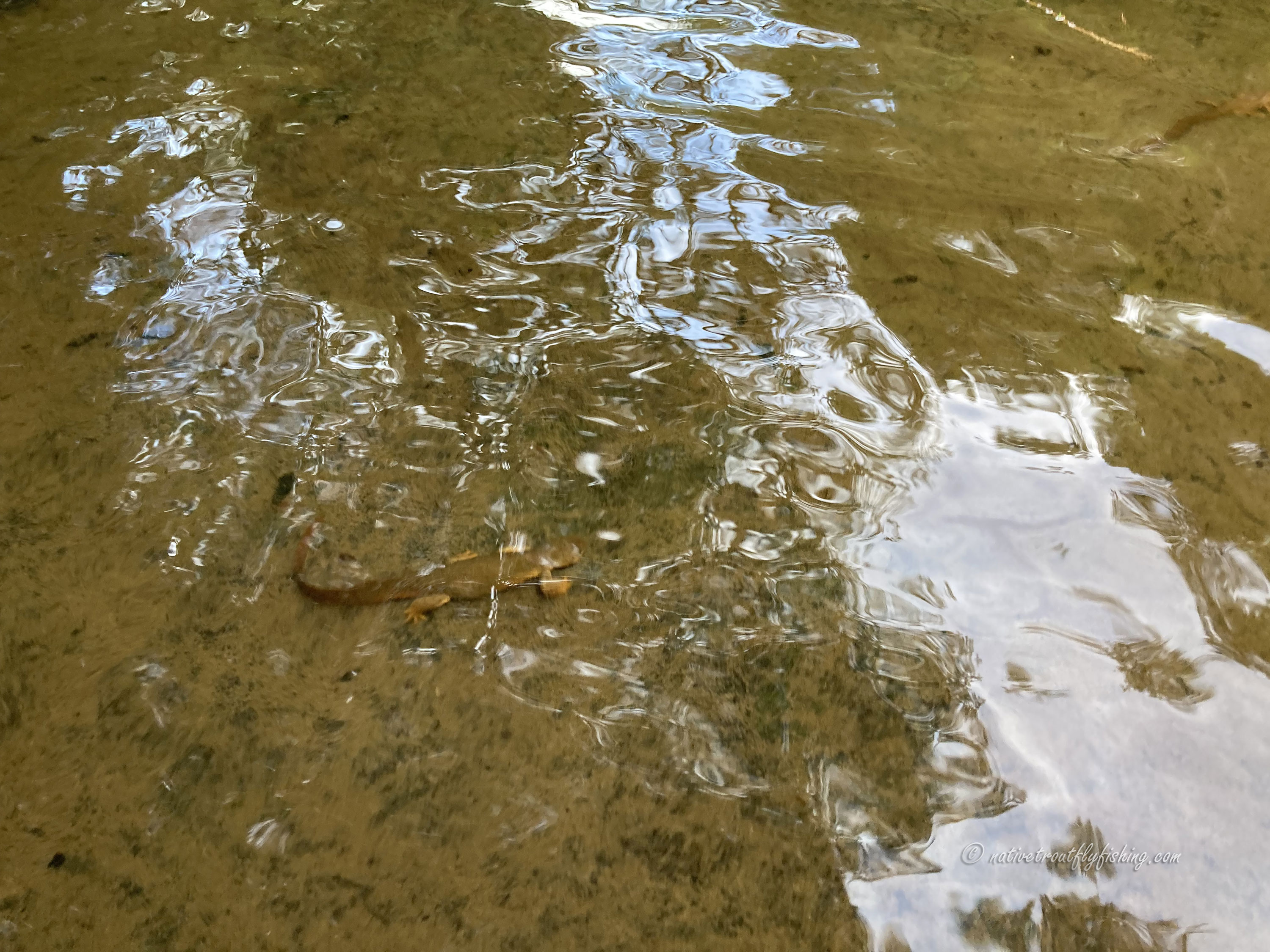
The stream flow through a beautiful canyon with mature stands of Douglas Fir, Western Hemlock and Red Cedar, with the wild Rhododendron in full bloom. Given the small size of the stream, I decided to go with my trusty 2wt and rigged up with a #12 Royal PMX and a #16 Blowtorch nymph dropper (new fly for me). While my coworkers headed upstream, I started off at a deep hole below some cascades not far downstream of where we parked. It was immediately apparent as soon I a got in the water that this stream was healthy and full of life, with crayfish, newts and small fish inhabiting the shallows. Additionally, the Cutthroat population appeared to be quite healthy as well and my second cast produced a bright 10" sea-run fish with its cutthroat slash just starting to reappear on the nymph. 

A bright sea-run Coastal Cutthroat

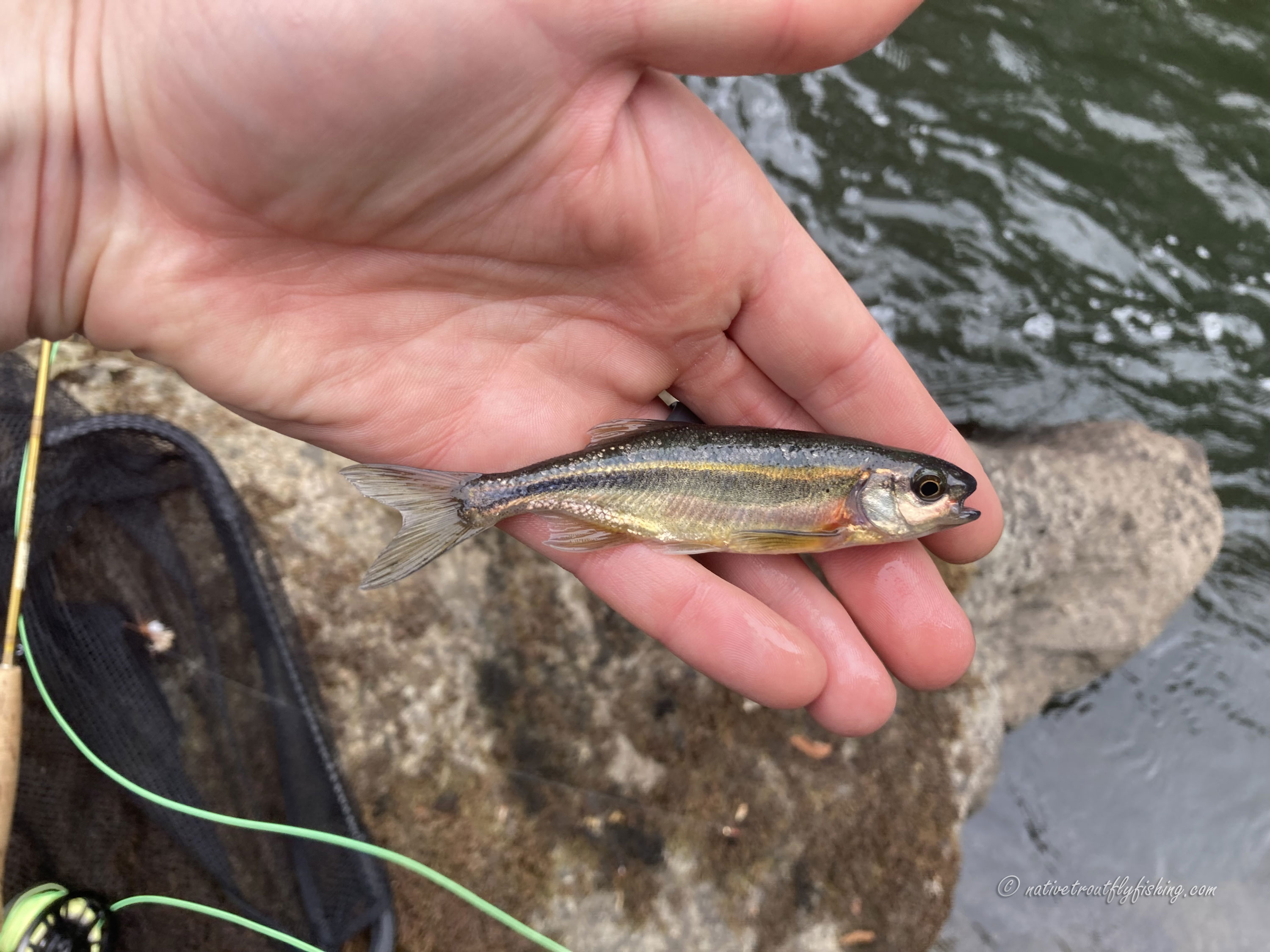
I managed to get one or two smaller Cutthroat and caught a small dace (possibly an Umpqua Dace?) before I decided some exploring further downstream. 

A small dace

With this I headed down the road to look for some more good water. While I saw plenty of good water, the problem was getting to it, as the riparian zone was a dense ticket Red Alder, Big Leaf Maple and Salmonberry bushes and occasional briars of invasive blackberries. However, I finally found a deer trail and was able to get back on the water. The first piece of water that I started on was a nice run with a log across riffle at the top end. While the run didn't produce any results, the fast water and pocket just upstream of the log looked like good holding water. Sure enough on my second cast, a big Cutthroat (~15") rose to my dry fly and doubled my 2wt over. Unfortunately with the current speed I didn't get a good hook set and after a little thrashing on the surface my fly popped loose. Several more casts with the dry/ dropper rig didn't entice the fish to return, so I switched to a small streamer. This did get a few vicious strikes from under the log, but nothing hooked up, so I switched back to my dry/ dropper and continued on my way upstream.

Quality Cutthroat holding water

A newt in the stream margins

The next run upstream had a perfect fishy looking riffle that swept along a large boulder. The first few casts didn't get the attention of any trout, but by fully covering the water I got a nice rise and hooked into a solid fish. This fish gave my 2wt a good workout, but this time I had a solid hookset and was able to bring the beautiful 12" native cutthroat hand after a short fight.

My big native Coastal Cutthroat

Upstream of this spot, the stream picked up gradient quickly and the abundance of trout also increased. While, most of the fish were cookie cutter 6-8" juveniles, I was able to dredge up another bright 10" sea-run on my dropper in a deeper pocket right below the hole where I got my first fish of the day. As I had covered all of the water up to the hole that I started out on, I found a path back up to the road and was able to meet up with my coworkers.

Another sea-run Coastal Cutthroat

After each having success working our initial patch of water we decided to head up the road a bit and try another location. However, after spending another 45 minutes here the habitat seemed subpar and we each had only found a couple of small Cutthroat or juvenile Coho. At this point the weather was degrading on us we decided to head back into town.

A juvenile native Coho Salmon

My coworker Alexei working a good run


A beautiful day on the water

This trip was a great kick to summer, with a productive week of work, time to get to know my new coworkers and some great fishing while we were at it. The summer trout season is now in full swing and next week I am off to the Lahontan and Bonneville Basins to hunt for Cutthroat, with a report to follow soon after!

Tuesday, September 28, 2021

End of August Adventure

A couple of years ago, while reading up on the Redband Trout of the Northern Great Basin, I found a genetics study that indicated that beyond the Great Basin Redbands, there was also an ancestral form of Redband Trout found in a tributary of the Deschutes River, that is unique enough to warrant being considered a distinct subspecies. These fish are the White River Redband Trout and have been isolated upstream of a barrier falls for thousands of years. Due to this isolation, they have more in common with Fort Rock Redbands than what the do with the Redbands in the Deschutes River. While I was able to make a trip to the White River a couple years ago, I was limited on time and only managed to catch a couple of Redbands on that first trip. Due to this I have had plans to make it back to the White River watershed ever since. After discussing the White River Redband with one of my friends and fellow native trout enthusiast Steve, it looked like our schedules would line up at the end of August, so we made plans for a trip. In addition to White River Redbands, Steve had yet to catch an anadromous Coastal Cutthroat so we also hoped to check that off his list as well.

Friday August 27th 2021: Steve flew in the previous night and I was up bright and early and picked Steve up at his hotel at 5:30AM bound for a small stream in the White River watershed. It was a gray and drizzly drive through the western Cascade Mountains, but as soon as we crossed the crest of the mountains, the sun came out, the clouds broke and we were greeted with a breath taking view of Mount Hood.
Clear skies over Mt. Hood - bare of snow after a dry summer

The quickest route to the stream was off a forest service road off the slopes of Mt. Hood, however after following the road for several miles we were greeted with a barricade blocking our way due to a wildfire. This came as a pretty big surprise to me as I had checked the forest service's webpage for current conditions and there had been no mention road closures in the area. With our first route in blocked, we set out to find a way around, unfortunately the next two forest service roads were also closed and we ended up having to drive an extra hour around to get to the stream. Luckily the fire had no impact the creek we were going to all and upon arriving the creek looked perfect. 
The Creek

I rigged up with my 1wt and a dry - dropper combo, while Steve went with a dry fly on a tenkara rod. While I had struggled to find fish on my last trip to the watershed, this time my research hit the mark and within a few casts we had both risen fish. I started out downstream, while Steve went upstream and after working downstream a ways had caught a half dozen 6-8" Redbands, primarily on the dropper. While the fish that I had gotten on my previous trip were rather pale, these fish had darker tones, with a much more pronounced redband. Given quick fishing, I checked in with Steve, who had also managed to get some decent Redbands. 
A small White River Redband

Steve was still working a good stretch of water, so I hiked a bit further upstream until I found a promising stretch of the stream. As I was a bit further from the road here, the size of the fish seemed to have gone up a few inches and the fish also started rising to dry flies a bit more consistently. After fishing for while, I found a larger pool that had good cover, from an over hanging tree. I managed to get a bow and arrow cast up and under the branches and was rewarded with a nice rise and a solid hookup. This fish was a bit bigger than the others I had hooked and really made my 1wt work, but after a short while a landed a close to 12" Redband. A monster for this stream.

My big fish of the day a beautifully colored Redband.

After getting this big fish, I worked my way upstream until I connected with the trail and headed back down to where Steve was. Steve had also managed to get some nice Redbands, and as we had a 3.5 hour drive back wanted to try for some sea-run Cutthroat we hit the road again. 

After getting back to the Olympia area, we headed for a local beach where we hopped to catch the end of the tide. Unfortunately, the wind was up and after and after an hour of fishing the good tide was running out and we still hadn't seen any sign of fish so we decided to call it a day and regroup in the morning.

Saturday August 28th 2021: After a success for day fishing for Redbands, we hoped that today we would be able to find a few Coastal Cutthroat and Coastal Rainbow Trout on one of my favorite rivers. The plan was to fish a combination of egg imitations and streamers and hopefully find a few fish that were starting to think about spawning salmon. Like the previous day we got an early start and upon reaching the river, it seemed that there may be a complication. Odd years in Washington are Pink Salmon run years. Most of the time this doesn't have too much of an impact on trout fishing, but apparently this river was experiencing a particularly strong Pink Salmon run this year. 
Lots of pinks (every dark shape is a salmon)

Typically during conditions like this, I find the trout concentrated in the faster riffles, but this time with how thick the pinks were, even nymphing primarily produced Pinks, although I did get one smaller Rainbow to grab an egg imitation. This did end up working in Steve's favor however, as he had not caught a Pink prior to this and given the conditions one could not help but catch a Pink checking yet another species off his list. The only sea-run Cutthroat that we saw was holding in a tailout behind several thousand Pinks, which we too aggressive to allow us to successfully get a cast to it. Given that Steve still hadn't caught his Cutthroat, we headed to my back up stream for the day, a small creek on our way home. 
A Pink Salmon caught nymphing

A small but native Coastal Rainbow Trout

The stretch of stream were going to try was only a few hundred yards upstream of the saltwater and sea-run Coastal Cutthroat will commonly dip into these lower reaches during high tide so I figured it was as good of a bet as anything. As Steve was the one looking for the fish, I let him do the fishing and sure enough at our first hole we spotted some Cutthroat and on his first cast he landed a bright fish fresh out of the saltwater. We fished for another 30 minutes or so and Steve got one larger fish and had a couple other grabs before it was time to call it a day. We managed to check three fish off of Steve's list while seeing some beautiful water, not a bad way to spend a couple of days!

Thursday, June 17, 2021

Oregon and California Redband Round-up: Part 1 Klamath Basin and Eagle Lake

Of all the Rainbow and Redband Trout varieties in the United States, the Eagle Lake Rainbow Trout has been the most daunting to catch. There are three primary factors why, first is that to catch them with a fly there are two short windows when these trout are shallow enough; in the spring and fall. This alone makes planning any trips more limiting. Next is the size of Eagle Lake, which is the second largest natural lake in California and is known for its strong winds. The final thing is just simply that it is in a lake, which I fish way less than streams and thus feel much less proficient at fishing than streams.

Back in October of 2019, I had the opportunity to fish Eagle Lake, but was unfortunately unsuccessful at catching an Eagle Lake Rainbow Trout (see here). As this was one of my last Rainbow/ Redband Trout subspecies to catch failing to catch one was definitely a disappointment and I had hoped to make another trip down to the lake last spring. However, the pandemic made those plans fall though and my schedule during the fall didn’t allow a trip either. This year though, the stars aligned and I had an extended weekend come up where I could break away for four days to try to again. Add to that when I mentioned that I was planning the trip to my neighbor Dyllon he said he could join as well and with that plans were set!

Friday: June 4th 2021: After tying flies every spare moment for the the previous few weeks, it was finally time to hit the road. Our plan for the trip evolved from just going after the Eagle Lake Rainbow, to also chasing down a few varieties of Redbands as well, considering that the lake treated us well. On the morning of the trip, Dyllon and I planned on departing at 4:00 AM. However, upon getting out to the car we noticed that there had been a neighborhood wide egging overnight, so first we had to clean out cars off, which cost us a half hour. Great way to kick things off... 

Once we finally hit the road, our plan was to drive straight to a creek in the Klamath Basin to try to catch some Redbands, prior to heading to Eagle Lake. A study that was published in 2009 indicated that the Redbands associated with Klamath Lake were genetically distinct on a subspecies level, making this fish a priority for me. However, this Redband outing would have to be short, as we were on a timeline and had to make it to the marina at Eagle Lake before 6:00 PM to reserve our rental boat for the next day. Luckily, the drive down to the creek was a smooth 6 hours with no traffic and not long after one quick stop for gas and we were at our first fishing spot.

I had put quite a bit of research into the streams to fish on this trip, and now that we were on the water we would find out if it paid off or not. This stream was a classic cascading mountain creek with lots of pockets and pools. However, despite looking like good water, the first couple holes didn’t show any signs of life. That changed in the next hole upstream where I managed to rise a small trout and after a few more casts I caught a little Redband and we were on the board. 

The stream

A beautiful native Klamath Lake Redband

A little Brookie

As we moved upstream and away from the road, the water and the fishing both improved, with trout holding in pretty much every likely spot. This included some Brook Trout, which I none of my research had indicated were in this stream. However, the majority of the fish were vividly colored Redbands and after a couple of hours we had caught at least a dozen trout and decided it was time to make the rest of the 4 hour drive to Eagle Lake. 

We made it to the marina with an hour to spare, got our rental boat reservation squared away, then headed back over to the campground and got our camp set up. As it turned out, another buddy of mine and native trout enthusiast Steve had been out on the lake earlier in the day and was able to swing by our camp to say hello. We spent a good hour talking native trout and Steve gave a report and some pointers on where he had luck as he had gotten a beautiful 5lb Eagle Lake Rainbow that morning. After Steve headed out and we had a quick dinner and Dyllon and I got a few quick fruitless casts in on the lake before turning in with high hopes for the morning.

Saturday: June 5th 2021: We were up before the sun to make it to the marina by 5:15 AM to get our boat. Luckily the lake was glassy calm and we decided to start out trolling flies on sink tips with our 6WT rods until we found the fish. As we moved out from the marina, the boat in front of us got a fish, but otherwise we saw no sign of fish until we came close to a steep stretch of shore and started to see fish rising. As we passed a point, finally I got a solid grab and was hooked into a nice fish. This was a strong fish and made several blistering runs and also charged the boat multiple times making me scramble to keep up. However, after a few minutes I eased the fish into the net and I finally had caught an Eagle Lake Rainbow Trout and a beautiful 3-4lb perhaps 20” fish at that!

A calm Eagle Lake morning

My first Eagle Lake Rainbow Trout

My box full of streamers for Eagle Lake

As trolling had worked once, we made another pass through the same area and right where I had hooked into the last fish, I hooked into another one. The fight was almost identical, but unfortunately as the fish neared the boat, the hook popped out. After two more passes, we only had one more short strike and as we didn’t see anyone else hooking into fish, but there were still risers, we decided to change tactics. There were Callibaetis mayflies coming off so Dyllon decided to try a dry fly, while I put on a double Chironomid rig.

Time to change things up

After fifteen or twenty minutes with no action, Dyllon asked if we should try trolling again or keep with chironomids? As if on queue, my indicator shot down and I responded chironomids. This fish was a bit smaller than the first one, but as my chironomid rig was on my 4WT it still put up one heck of a fight. Luckily this time my hook held and I managed to land it.

Another Eagle Lake Rainbow Trout

Not long after, I managed to get another, fish on the chironomid rig, which inspired Dyllon to change over his dry fly set up, which had not gotten any attention yet. Over the next half hour, we both had a couple hook ups, but lost our fish. Then the infamous Eagle Lake wind kicked up and we had to head back to the marina as we did not want to risk getting swamped.

After turning the boat back in and grabbing a quick lunch, we decided to head up to the headwaters of Pine Creek the main tributary to Eagle Lake to see if we could find any fish up there while we waited out the wind. Unfortunately, the drought had not been kind to Pine Creek and what we found was barely a trickle. We probably should have checked further upstream, but we saw no sign of life here so we decided that we would head back to camp and see if the wind at the lake had calmed down at all.

Upper Pine Creek

After grabbing a quick early dinner at camp, Dyllon and I decided to brave the wind and try the lake from shore in the area where we had found fish in the boat during the morning. The beach we were fishing faced right into the wind and was being lashed by 2-3 foot waves, definitely challenging conditions, but we were able to cast so we decided it was worth a try. This time it was Dyllon's turn to get into the fish and a small scud under and chironomid soon produced at solid fish. The Rainbow gave Dyllon a good battle before he brought the exceptional fish to the net.

Dyllon's Eagle Lake Rainbow

Before it was time to turn in, Dyllon got one additional Rainbow and lost another amid the surf. However, the persistent wind and fading daylight finally forced us off the water and it was time to head back to camp. It had been a great day on the lake and with both of us having caught some truly beautiful Eagle Lake Rainbow Trout, and with our success we could go ahead with our plans to chase down some Redbands in the morning.

Sunset on the lake

Monday, October 14, 2019

Back on the Road Again: Native Redbands and Cutthroat of Eastern Oregon

With all of the changes that life has thrown my way over the last few years. For the first time in years I headed out on the road (along with my cousin Derek, who has joined me on several other past trips) with some new native trout to target as well as some old ones to revisit. This trip was all revolving around the American Fisheries Society in Reno, Nevada at which I was presenting, but I was able to add a couple of days on each side of the conference to target some native trout.  The main targets of the trip were the White River Redband, John Day Westslope Cutthroat, Willow-Whitehorse Basin Cutthroat, Quinn River Cutthroat, Eagle Lake Rainbow Trout and possibly some McCloud River Redband Trout.

Day 1: Friday September 27th 2019: Derek and I hit the road bright and early, heading south from my home in Olympia, Washington towards the White River watershed in north-central Oregon. The White River flows from the glaciers of Mt. Hood into the of the Deschutes River just downstream of Maupin, OR.  While the Deschutes River holds Columbia Basin Redband Trout, the Redband Trout found above a series of waterfalls on the White River are genetically distinct from the fish in the Deschutes and identify more closely related to Fort Rock Redbands in the Great Basin, with recent studies indicating that they likely warrant a subspecies designation. As the White River is glacially fed, it has very poor visibility so I selected a couple of tributary streams to fish for these trout. Unfortunately, when we arrived the first of these streams had no public access on the lower end and the flows on the second stream were so low that we could not find any holding water and only managed to rise one small fish. Luckily we were able to find a small irrigation impoundment on the second stream that offered some great looking holding water.

The irrigation pond

This spot called for beaver pond tactics, so Derek and I tied on some Zug Bugs and started fishing. Letting the Zug Bugs sink for several seconds and retrieving them with short twitches proved quite effective and in short order I had caught a a few beautiful Redbands including a 10" beauty.

A White River Redband Trout

While we were successful on our first fish of the day, it took much longer than planned and we still had a long drive to the upper John Day River to look for Westslope Cutthroat and it looked like with the shorter days of fall every minute of daylight was going to count.

The middle John Day River from the road

We arrived at the stream with about an hour of daylight to spare and got to fishing with a dry dropper rig right away. We were able to locate a good piece of holding water almost right away, and on one of the first cast I hooked a fish. Could it be that easy? Unfortunately not, it turned out the fish was a small Columbia Basin Redband - likely a juvenile steelhead and the next fish out of the hole also turned out to be a Redband too.

A small Redband from the stream

After the second fish, the hole shut down so we started heading downstream. Unfortunately it seemed that this stream was lacking in good holding water and while we found a couple more small Redbands and a juvenile Chinook, there was no sign of any Cutthroat nor any water that was likely to hold them. After trudging downstream close to a half mile and watching the daylight fade, I finally came across a great looking piece of holding water where a tributary entered the stream. However, while the first spot had produced fish right away, this spot which looked even better showed no sign of life. After a number of a great drifts through every inch of the hole, I crept closer for a better look. Right where I figured a trout should be holding, there was a nice summer run Steelhead, which also saw me and decided it was time to head for cover.

Steelhead holding water

At this point the daylight was fading fast and it was time to head back upstream. While it seemed that I was going to have to admit defeat on the John Day Cutthroat, I figured a couple more casts in the first spot I tried wouldn't hurt. On the second cast I was rewarded with a rise and after solid hookup and after a short fight I brought a nice little John Day Cutthroat to hand!

A John Day Westslope Cutthroat

By the time I let the Cutthroat go, it was clear that there wasn't enough light to continue fishing so we hit the road for Burns, Oregon where we were staying the night.

Day 2: Saturday September 28th 2019: Overnight a cold front had blown in an we woke to a frosty morning in Burns with the possibility or rain and snow in the forecast. Our goal for the day was to fish for Willow-Whitehorse Cutthroat in southeastern Oregon before crossing to border into Nevada and trying for Quinn River Cutthroat. I had fished for and caught Willow-Whitehorse Cutthroat in 2006 (over 13 years ago already - yikes!), but fire had ravaged the area in 2012 and I wanted to return and see how it was looking and if I could find a few trout. By the time we got to the stream it was mid-morning and the temperature had warmed to the mid 40's F although a stiff wind was blowing. Luckily the fire had missed this stretch of stream and looked almost exactly how I remembered, so it was time to look for some trout.

Desert Cutthroat water

Looking for trout didn't take too long, and the first spot that I came to, the outflow a beaver pond produced two nice Willow-Whitehorse Basin Cutthroat.

Willow-Whitehorse Basin Cutthroat

Just like the last time that I had been to this stream a dry dropper rig with a black Copper John appeared to be the ticket. We fished up and down the stream for a couple hours, running into on lethargic rattlesnake and catching a bunch more Cutthroat in the 6-10" range before the weather started to turn on us, with snow clouds visible on the hills just a few miles off and it was time to hit the road again.

The rattlesnake

Another Willow-Whitehorse Cutthroat

While we were doing to just fine on daylight this time, the weather was whole other matter was turning fast. By the time that we hit the Nevada border, it was snowing in earnest and the Quinn River Cutthroat which required some rough roads up into the mountains was going to have to wait for another trip, so we headed on for Winnemucca, NV to grab a hotel for the night.

Snowed out of for the day

Day 3: Sunday September 29th 2019: With a good coat of snow on all of the hills around Winnemucca in the morning there was no way we were going to have any luck fishing for Quinn River Cutthroat so we headed for Reno, NV for the conference.

Day 4: Monday September 30 - Day 7: Thursday: October 3rd 2019: These days were all spent at the conference. Lots of great talks and I even got myself a great new book!

Also picked up a new book at the conference

Day 8: Friday October 4th 2019: We got up in the morning and made the drive out to Eagle Lake, California to try for Eagle Lake Rainbow Trout. We were still a bit early as the trout are known to move into the shallows in mid-October as the water cools. However, I was hoping that recent cold front might have done the trick. This proved to be wishful thinking. We fished for the better part the day, trying everything we could think of, from casting into the tulles to trolling flies deep. We only saw one fish rise and may have had one soft take but other than that lots and lots of fruitless casting.

Eagle Lake, California

Fishing Eagle Lake

The Eagle Lake Rainbow had been the fish I was most keen on getting on this trip, as I have had a number of potential trips planned over the years but had never been able to make it happen. Hopefully I will be able to make another try at the Eagle Lake Rainbow next spring, but regardless it is always hard getting skunked on a trout so far from home. After trying Eagle, we headed north towards home and ended up camping on a McCloud River Redband stream near the slopes of Mount Shasta that I had fished back in 2007. We got camp set up right before dark and temperatures plummeted quickly on us dropping into the 20's F and proving to be one chilly night in a tent.

Day 9: Saturday October 5th 2019: It was quite chilly in the morning, but the sun was out and it warmed up rather quickly. Once it was warm enough to feel our fingers, we got the rods rigged up and went to check out the creek. The last time that I had been to this stream, the fishing had been great, with every likely looking spot holding a trout. However, a lot can change in 12 years, and unfortunately for this stream those changes were not good. Upon checking out the stream, it was clear that cattle had been unleashed on the watershed and had done serious damage.

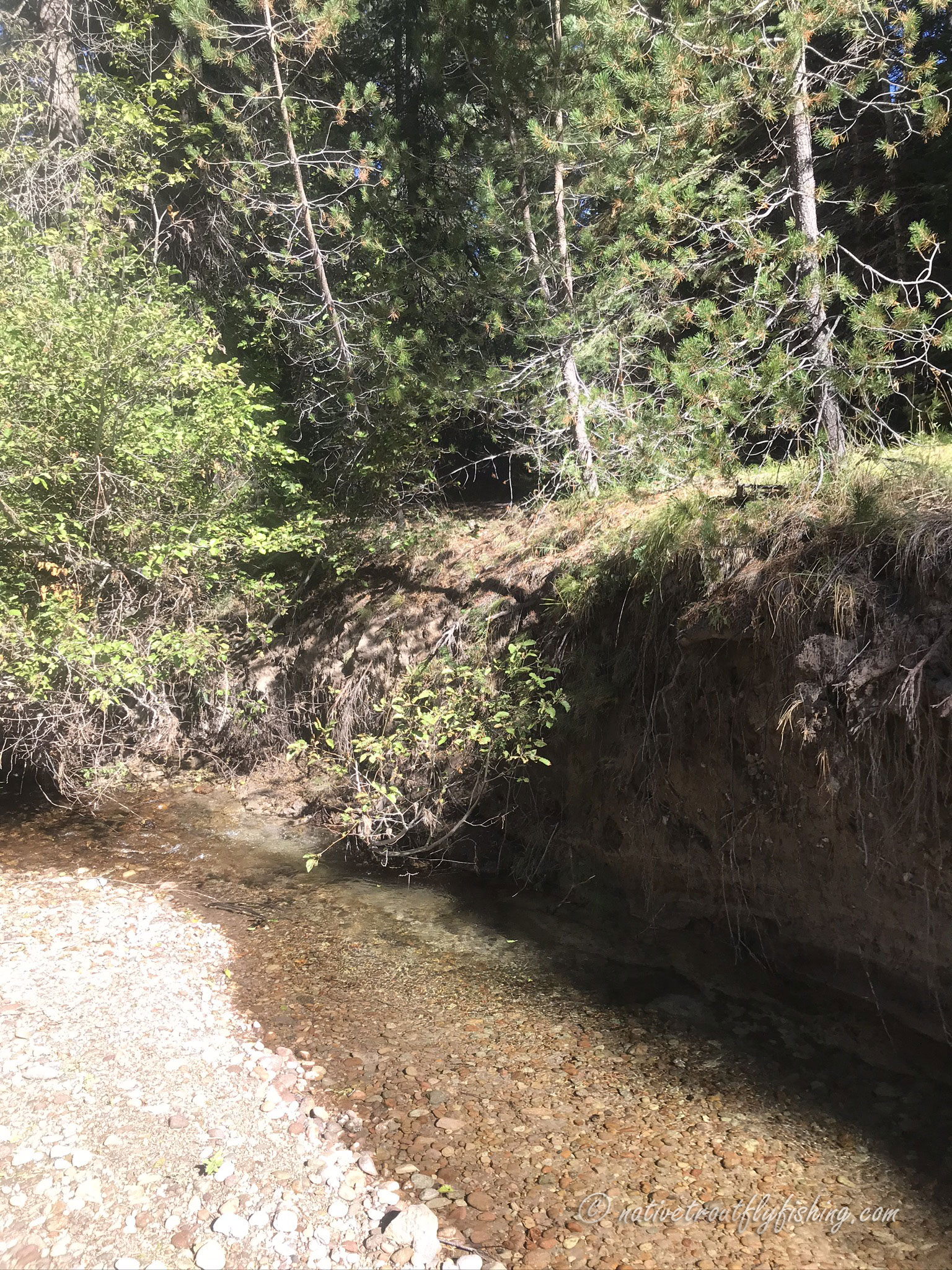
Cattle caused erosion

We covered more than double the water I had fished last time, but the habitat was absolutely destroyed, with caved in banks and erosion and we saw not a single sign of trout. 

Incised stream channels

Given the habitat, it would have been a miracle if we had found a trout in this stream and as we had a long drive home still we decided that it was best to cut our losses and get on the road again. Along the way we stopped at Crater Lake National Park and had a nice quite drive back to Olympia. 

Crater Lake

All and all, it was a great trip, with us getting 3 of the 6 fish that we had hoped to catch. Hopefully next year I will be able to get out again, as it felt great to get out for another native trout road trip after such a long time.