Day 1: Friday September 27th 2019: Derek and I hit the road bright and early, heading south from my home in Olympia, Washington towards the White River watershed in north-central Oregon. The White River flows from the glaciers of Mt. Hood into the of the Deschutes River just downstream of Maupin, OR. While the Deschutes River holds Columbia Basin Redband Trout, the Redband Trout found above a series of waterfalls on the White River are genetically distinct from the fish in the Deschutes and identify more closely related to Fort Rock Redbands in the Great Basin, with recent studies indicating that they likely warrant a subspecies designation. As the White River is glacially fed, it has very poor visibility so I selected a couple of tributary streams to fish for these trout. Unfortunately, when we arrived the first of these streams had no public access on the lower end and the flows on the second stream were so low that we could not find any holding water and only managed to rise one small fish. Luckily we were able to find a small irrigation impoundment on the second stream that offered some great looking holding water.
 |
| The irrigation pond |
This spot called for beaver pond tactics, so Derek and I tied on some Zug Bugs and started fishing. Letting the Zug Bugs sink for several seconds and retrieving them with short twitches proved quite effective and in short order I had caught a a few beautiful Redbands including a 10" beauty.
 |
| A White River Redband Trout |
While we were successful on our first fish of the day, it took much longer than planned and we still had a long drive to the upper John Day River to look for Westslope Cutthroat and it looked like with the shorter days of fall every minute of daylight was going to count.
 |
| The middle John Day River from the road |
We arrived at the stream with about an hour of daylight to spare and got to fishing with a dry dropper rig right away. We were able to locate a good piece of holding water almost right away, and on one of the first cast I hooked a fish. Could it be that easy? Unfortunately not, it turned out the fish was a small Columbia Basin Redband - likely a juvenile steelhead and the next fish out of the hole also turned out to be a Redband too.
 |
| A small Redband from the stream |
After the second fish, the hole shut down so we started heading downstream. Unfortunately it seemed that this stream was lacking in good holding water and while we found a couple more small Redbands and a juvenile Chinook, there was no sign of any Cutthroat nor any water that was likely to hold them. After trudging downstream close to a half mile and watching the daylight fade, I finally came across a great looking piece of holding water where a tributary entered the stream. However, while the first spot had produced fish right away, this spot which looked even better showed no sign of life. After a number of a great drifts through every inch of the hole, I crept closer for a better look. Right where I figured a trout should be holding, there was a nice summer run Steelhead, which also saw me and decided it was time to head for cover.
 |
| Steelhead holding water |
At this point the daylight was fading fast and it was time to head back upstream. While it seemed that I was going to have to admit defeat on the John Day Cutthroat, I figured a couple more casts in the first spot I tried wouldn't hurt. On the second cast I was rewarded with a rise and after solid hookup and after a short fight I brought a nice little John Day Cutthroat to hand!
 |
| A John Day Westslope Cutthroat |
By the time I let the Cutthroat go, it was clear that there wasn't enough light to continue fishing so we hit the road for Burns, Oregon where we were staying the night.
Day 2: Saturday September 28th 2019: Overnight a cold front had blown in an we woke to a frosty morning in Burns with the possibility or rain and snow in the forecast. Our goal for the day was to fish for Willow-Whitehorse Cutthroat in southeastern Oregon before crossing to border into Nevada and trying for Quinn River Cutthroat. I had fished for and caught Willow-Whitehorse Cutthroat in 2006 (over 13 years ago already - yikes!), but fire had ravaged the area in 2012 and I wanted to return and see how it was looking and if I could find a few trout. By the time we got to the stream it was mid-morning and the temperature had warmed to the mid 40's F although a stiff wind was blowing. Luckily the fire had missed this stretch of stream and looked almost exactly how I remembered, so it was time to look for some trout.
 |
| Desert Cutthroat water |
Looking for trout didn't take too long, and the first spot that I came to, the outflow a beaver pond produced two nice Willow-Whitehorse Basin Cutthroat.
 |
| Willow-Whitehorse Basin Cutthroat |
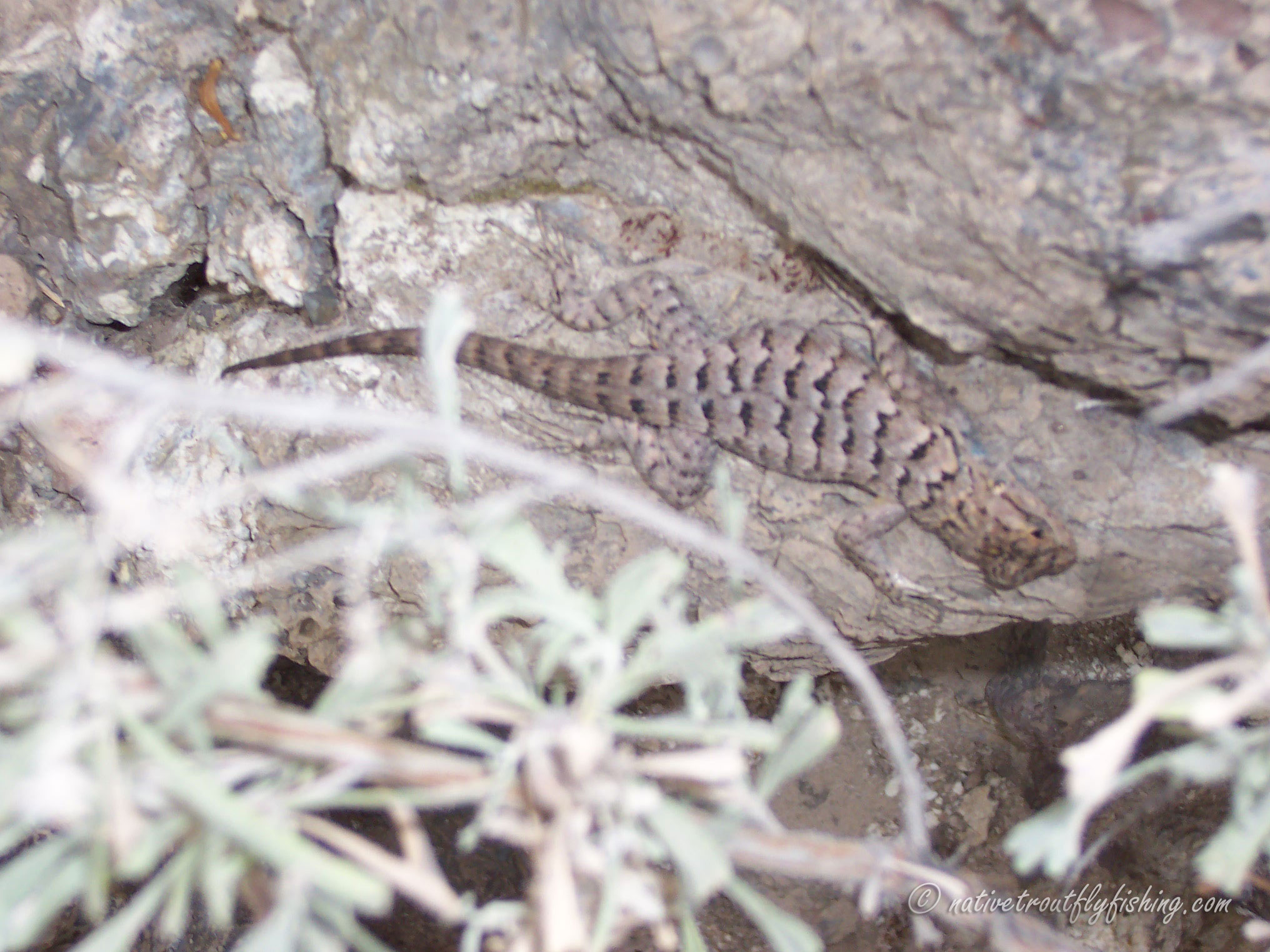
Just like the last time that I had been to this stream a dry dropper rig with a black Copper John appeared to be the ticket. We fished up and down the stream for a couple hours, running into on lethargic rattlesnake and catching a bunch more Cutthroat in the 6-10" range before the weather started to turn on us, with snow clouds visible on the hills just a few miles off and it was time to hit the road again.
 |
| The rattlesnake |
 |
| Another Willow-Whitehorse Cutthroat |
While we were doing to just fine on daylight this time, the weather was whole other matter was turning fast. By the time that we hit the Nevada border, it was snowing in earnest and the Quinn River Cutthroat which required some rough roads up into the mountains was going to have to wait for another trip, so we headed on for Winnemucca, NV to grab a hotel for the night.
 |
| Snowed out of for the day |
Day 3: Sunday September 29th 2019: With a good coat of snow on all of the hills around Winnemucca in the morning there was no way we were going to have any luck fishing for Quinn River Cutthroat so we headed for Reno, NV for the conference.
Day 4: Monday September 30 - Day 7: Thursday: October 3rd 2019: These days were all spent at the conference. Lots of great talks and I even got myself a great new book!
Day 4: Monday September 30 - Day 7: Thursday: October 3rd 2019: These days were all spent at the conference. Lots of great talks and I even got myself a great new book!
 |
| Also picked up a new book at the conference |
Day 8: Friday October 4th 2019: We got up in the morning and made the drive out to Eagle Lake, California to try for Eagle Lake Rainbow Trout. We were still a bit early as the trout are known to move into the shallows in mid-October as the water cools. However, I was hoping that recent cold front might have done the trick. This proved to be wishful thinking. We fished for the better part the day, trying everything we could think of, from casting into the tulles to trolling flies deep. We only saw one fish rise and may have had one soft take but other than that lots and lots of fruitless casting.
 |
| Eagle Lake, California |
 |
| Fishing Eagle Lake |
The Eagle Lake Rainbow had been the fish I was most keen on getting on this trip, as I have had a number of potential trips planned over the years but had never been able to make it happen. Hopefully I will be able to make another try at the Eagle Lake Rainbow next spring, but regardless it is always hard getting skunked on a trout so far from home. After trying Eagle, we headed north towards home and ended up camping on a McCloud River Redband stream near the slopes of Mount Shasta that I had fished back in 2007. We got camp set up right before dark and temperatures plummeted quickly on us dropping into the 20's F and proving to be one chilly night in a tent.
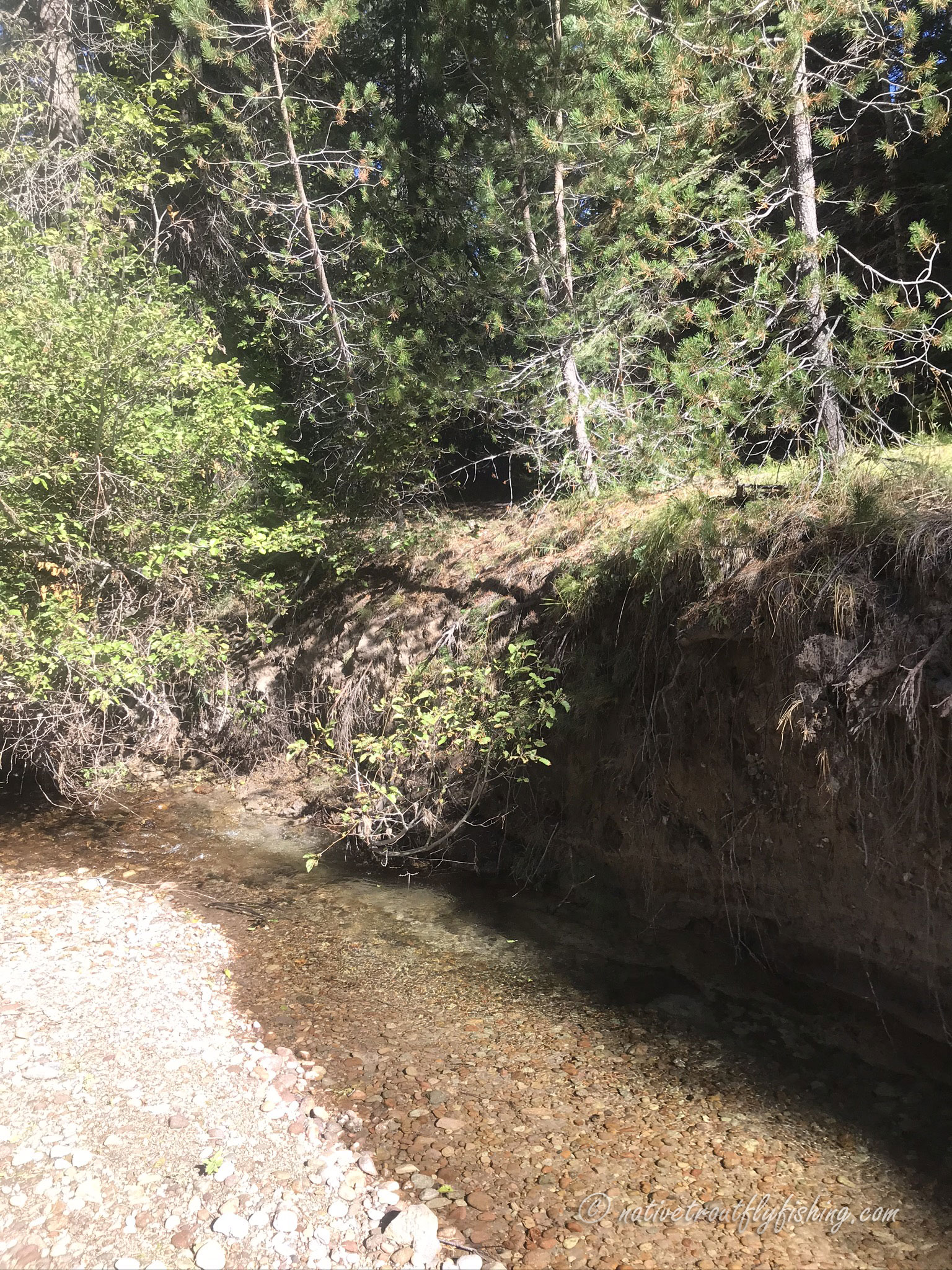
Day 9: Saturday October 5th 2019: It was quite chilly in the morning, but the sun was out and it warmed up rather quickly. Once it was warm enough to feel our fingers, we got the rods rigged up and went to check out the creek. The last time that I had been to this stream, the fishing had been great, with every likely looking spot holding a trout. However, a lot can change in 12 years, and unfortunately for this stream those changes were not good. Upon checking out the stream, it was clear that cattle had been unleashed on the watershed and had done serious damage.
 |
| Cattle caused erosion |
We covered more than double the water I had fished last time, but the habitat was absolutely destroyed, with caved in banks and erosion and we saw not a single sign of trout.
 |
| Incised stream channels |
Given the habitat, it would have been a miracle if we had found a trout in this stream and as we had a long drive home still we decided that it was best to cut our losses and get on the road again. Along the way we stopped at Crater Lake National Park and had a nice quite drive back to Olympia.
 |
| Crater Lake |
All and all, it was a great trip, with us getting 3 of the 6 fish that we had hoped to catch. Hopefully next year I will be able to get out again, as it felt great to get out for another native trout road trip after such a long time.





 Posts
Posts


