About this blog

This blog is all about fly fishing for native trout. On it I cover trip reports, fishing tactics, conservation, the latest news about native trout species and much more. This site provides a companion to my web page Nativetroutflyfishing.com.

Gary
Showing posts with label Conservation. Show all posts

Monday, January 31, 2022

Western Native Trout Challenge


The Western Native Trout Initiative (WNTI) was founded in 2006 to support the conservation of native trout across the Western United States. In 2019, the WNTI launched Western Native Trout Challenge with several different tiers (Master, Advance and Expert) that award anglers for catching up to 18 varieties of native trout across 12 western states. 92% of proceeds from the program go to supporting habitat /conservation projects with direct benefits for native trout across the west, providing anglers with a fun way to make a difference for these fish.

I had not initially planned on attempting the challenge as I had already caught most of the fish recognize by the challenge prior to 2019. However, after a year of native trout hunting it turned out that I had enough trout to submit for the Expert level, in which an angler needs to catch 6 varieties of native trout across 4 states. Since I had qualified for the program  I decided I might as well go for it. 

See my qualifying fish below:

Eagle Lake Rainbow Trout - California

"Interior Redband Trout" - Oregon

Coastal Cutthroat Trout - Washington

Bull Trout - Idaho

Westslope Cutthroat Trout - Idaho

Rio Grande Cutthroat Trout - New Mexico

Upon submitting photographs of their qualifying fish, anglers receive different rewards depending on the level of the program completed. I completed the "Expert Caster" level, which comes with a certificate and a hat, with the first 100 completers getting a unique "First 100" hat. 

My Expert Caster Certificate and "First 100" hat.

All in all, the Western Native Trout Challenge is a great program, that supports crucial conservation projects across the west. If you are interested in taking part in the challenge, you can sign up here.

Monday, May 4, 2015

Long overdue update - fishing for science

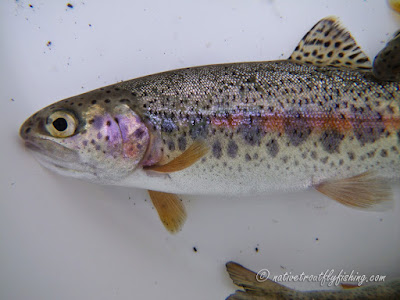
The last few years for me have been marked by some of the best and busiest times of my life. During this time, I finally started my career as a fisheries biologist for the Washington Department of Wildlife, met my wonderful wife and started Graduate School at the University of Washington. To a large extent fishing has taken a back seat during this time, as has my search for native trout. However, this is not to say that I haven't been working with fish. Since starting my Masters degree program, I have been very involved with native trout and currently I am right in the midst of a project looking at the interactions between native resident Coastal Rainbow Trout and Steelhead. As these are two life history forms of the same species (Oncorhynchus mykiss), this will help to tease apart the relationship between these fish.
Research time

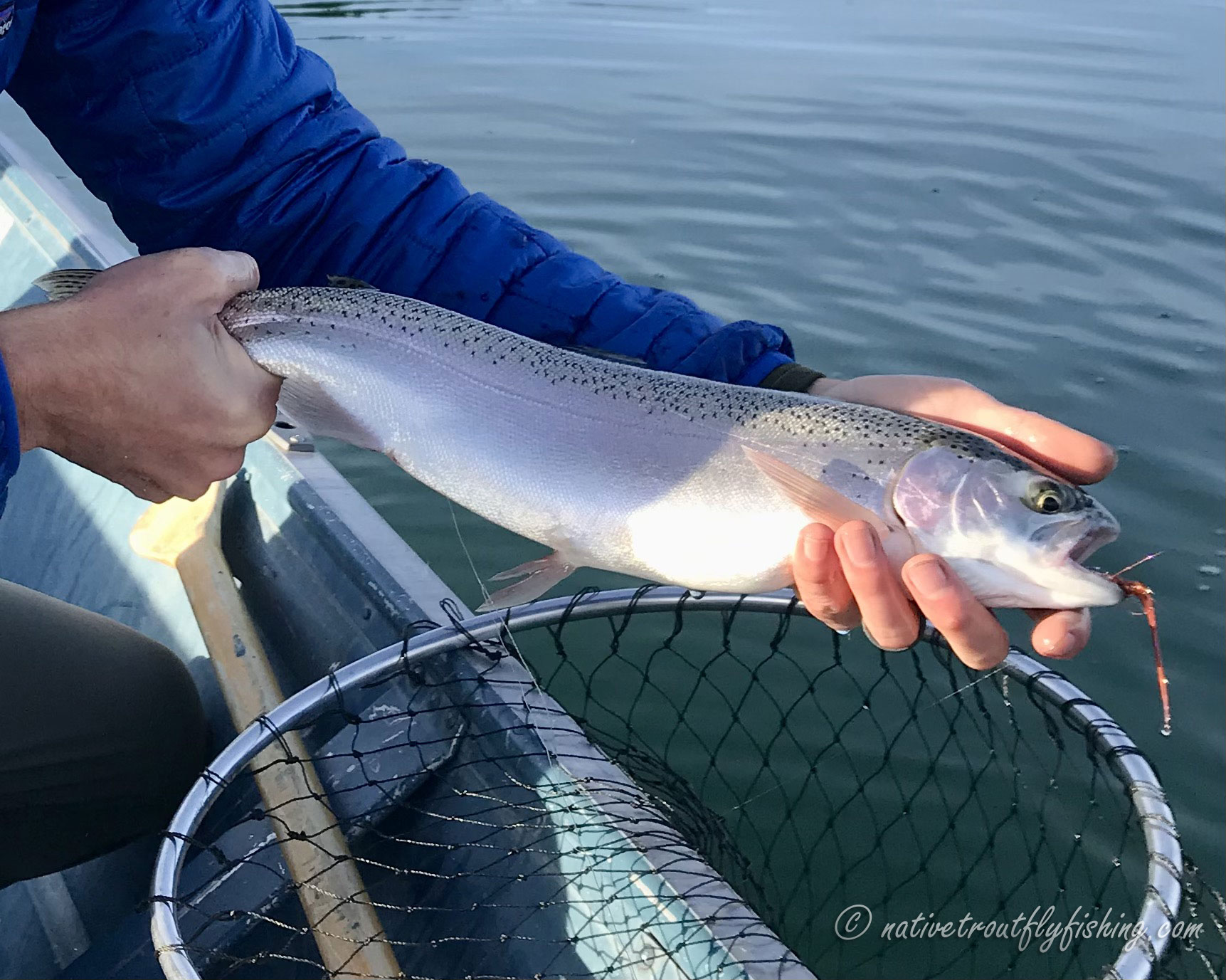
A native Coastal Rainbow for the study

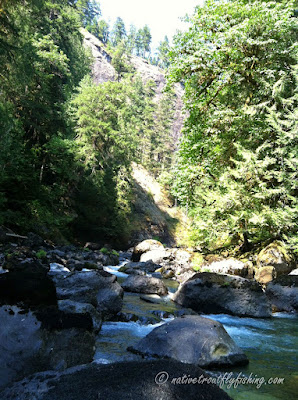
The project is occurring on two rivers Olympic Peninsula rivers that have seen precipitous declines in their Steelhead returns in the last two decades, with lows in the 10's of fish (lowest years had 3 and 6 fish respectively). Due to this a restoration program was initiated 1998 (http://www.lltk.org/rebuilding-populations/hcsp/summary) leading to some improvements in Steelhead abundance. While Steelhead returns have been relatively low in the watershed, the resident Rainbow Trout population appears to be healthy, making unclear what role Rainbow Trout may play in the success of the restoration.
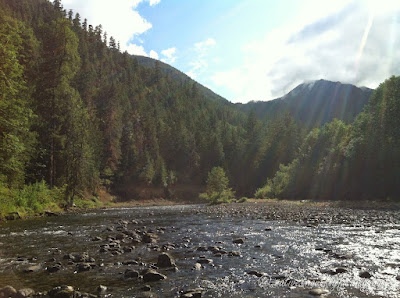
Study River A

Study River B

As both watersheds have natural waterfalls that bar all anadromous fish from the upper reaches, where resident fish are the sole inhabitants. We are interested in a) if the these resident fish are passing downstream over the falls b) whether they still may have the ability to migrate out to sea and c) the food web interactions and growth patterns of fish both above and below the falls. To do so we are using a mark recapture study where we are catching fish via hook and line and electrofishing, tagging them with PIT (Passive Integrated Transponder) Tags, which allow us to identify individual fish and detect fish at antenna arrays near the mouths of the rivers. This allows us to see who is staying and who is going.
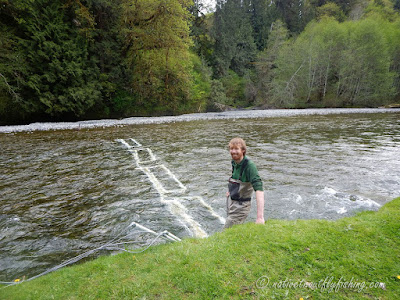
At the PIT Tag Antenna Array

While tagging the fish we also collect a fin clip (for DNA analysis), a scale samples (to determine age and growth patterns), a diet sample (food web interactions) and length and weight.
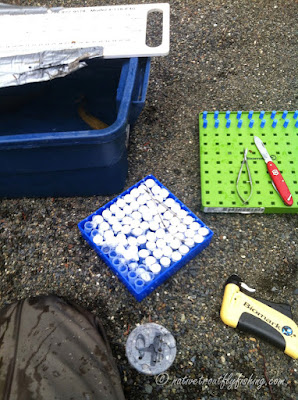
Streamside sampling gear

I am aiming to wrap up work on this project in late spring of 2016, so updates will be forthcoming. Needless to say this post is long, long overdue, and I hope to post more in the future.
Thursday, April 28, 2011

New piece of art work above the tying desk

As a parting gift from my previous job at the Gig Harbor Fly Shop to my new job as a Fisheries Biologist with WDFW, my good friend and the shop owner Blake got me an awesome replica of an Alvord Cutthroat that I caught back in 2008. This extraordinary piece of art work was created by another friend of my Luke Filmer, who runs Blackwater Fish Replicas and has never ceased to amaze me with the beautiful work that he turns out. I have to say that this is a very welcomed addition above the tying desk!

My new piece of artwork!

Also a reminder if you haven't already written a letter to the Oregon Department of Fish and Wildlife in regards to the remaining Alvord Cutthroat, please do so. For more information please follow this link.

Monday, March 28, 2011

Call for Support! Alvord Cutthroat

The Alvord cutthroat has been declared extinct for most of the past century, however in one small creek in Southern Oregon there is still a remnant of these fish left. Although it is unclear how genetically pure the fish in this creek are, some are phenotypically correct representations of the Alvord cutthroat trout and this may be the last chance to save these fish from extinction. The problem is that closely related Lahontan cutthroat have also been stocked in the creek and the greatly out number the Alvord type fish and seem to be slowly but surely replacing the Alvord type fish. For more information of these fish, please visit http://kortumofdiscovery.wordpress.com/ or http://www.nativetroutflyfishing.com/alvordcutthroat.htm.


Now is the time for action and I urge any of my readers to write letters in support of a restoration project. Such a letter should include the following information:
1. Conducting a transplant of the most "Alvord-like" fish to a stream with suitable habitat. Such a stream should have good riparian habitat and water quality so that a self sustaining population can be created.
2. The stream currently holding these fish should to made catch and release only and no bait to help protect the remain "Alvord-type" fish found there.
3. The restoration of these fish should not hinge on waiting for genetic testing as such testing is timely and this population is too fragile to await such delays. Also this testing is going to be difficult to conduct as the Alvord cutthroat is lacking in quality genetic samples to compare with.
Please submit letters of support for an Alvord phenotype rescue and restoration project to: Shannon Hurn, ODFW District Office, 237 Highway 20 South/PO Box 8, Hines, OR 97738 or via email to shannon.m.hurn@state.or.us

Friday, June 25, 2010

Paiute Cutthroat update - The Good and the Bad

Last month I posted about the plight of the Paiute Cutthroat, which is a rare trout only native to one small stream in the Sierras of California. The original post (here) was to rally support of the restoration of these fish to their entire native range and there is some good news on that front. A couple weeks ago the US Fish and Wildlife Service (USFWS) announced that they have decided to go ahead with their plan to restore the Paiute to their native range. For the full announcement click here.

A California Paiute Cutthroat

The bad news is that the same environmentalist groups that stopped project in the 11th hour last time have filled a lawsuit in an attempt to complete stop the project. This is even in light of the Environmental Impact Statement put together by the USFWS showing that any impacts would be minimal and that the benefits to ecosystem from eliminating the nonnative trout would by far outweigh any potential impacts. With any luck the courts will see through the baseless lawsuit and let the facts speak for themselves.

For the news article on the lawsuit click the link below

Sunday, May 2, 2010

SAVE THE PAIUTE!! LAST CHANCE!!!!

The Paiute Cutthroat Trout is one of the rarest and most beautiful trout in the world and needs your support! Paiutes are unique in that they are the only North American trout completely lacking body spots. These fish extirpated from all of their native stream habitat, which includes roughly 10 miles of Silver King Creek in California below Llewellyn Falls. However, the US Fish and Wildlife Service and California Department of Fish and Game are proposing to reintroduce them. Last year I had the privilege to fish for these Cutthroat (outside of their native range) and they are truly amazing fish.

A Paiute Cutthroat

For more information on these fish click the following link: Paiute Cutthroat

There is an open public comment period for the Final Environmental Impact Statement (EIS) for the proposed restoration of the Paiute cutthroat into Silver King Creek below Llewellyn Falls until May 10th 2010. I strongly encourage all of my readers to write in support of the plan to reintroduce these fish, as this will be the LAST chance to get your voice heard before the final decision comes down! If you consider yourself a conservation minded angler please take the time to write!
Please write your letters in favor of option # 2 which entails eradicating the non-native trout below Llewellyn Falls using rotenone.
For more information and to see the EIS
You can address your comments to:
Robert D. Williams, State Supervisor,
by US mail @
Nevada Fish and Wildlife Office
1340 Financial Boulevard
Suite 234
Reno, NV 89502
Or call: (775) 861-6300
Or fax: (775) 861-6301

Sunday, April 25, 2010

Book Review: An Entirely Synthetic Fish by Anders Halverson


When going through the different species of trout on my Trout and Salmon Species Page, one common thread are the problems Cutthroat and Redband Trout face from competition and hybridization with non-native Rainbow Trout. While Rainbows are native to the west coast of North America and northeastern Asia, they have miraculously managed to find their way into streams on every continent (expect Antarctica of course!). The question is what made people fall in love with the Rainbow Trout, while other trout species got swept under the rug?

I recently had the pleasure of reading Andres Halverson's book An Entirely Synthetic Fish: How the Rainbow Trout Beguiled North America and Overran the World. This book dives in the history of the Rainbow Trout's spread and the mindset of the fisheries managers that deemed it in the public's best interest to spread this trout as far and wide as possible despite the negative implications on native populations of salmonids. The book comes full circle, starting by showing mind set that set the stage for the spread of this trout. During which time the Rainbow Trout came into favor as environmental degradation led to diminished native populations and the hardy Rainbow Trout was pumped into as many waters as possible in an effort to "improve on nature." However, as the environmental movement began these management practices started shift first to prioritizing wild trout management and then native trout. I would strongly recommend this book to any fisherman!

For more information check out:

Wednesday, November 25, 2009

Gila Trout restored in Frye Creek, AZ

With the Gila Trout restoration in New Mexico being largely successful, the state of Arizona is starting to follow suit and has recently reintroduced Gila Trout in Frye Creek. Frye Creek is a small stream flowing from the Penaleno Mountains of southeastern Arizona and like some many other Gila Trout waters these desert natives have been absent since the introduction of non-native Rainbow, Brown and Brook Trout.

Gila Trout

With the recent down-listing of the Gila Trout to threatened and opening to fishing in New Mexico, Arizona is hoping to meet the same success and plans to open up some limited catch and release options in the future. For full details: http://sports.espn.go.com/outdoors/fishing/news/story?id=4663995

Friday, October 2, 2009

Can the Big Hole Grayling be saved??

The headwaters of the Missouri River in Montana were once home to thriving populations of fluvial Arctic Grayling, far from the core of their native range. However, after years of habitat destruction and non-native fish introductions the Arctic Grayling has vanished from many Montana watersheds. One of the last strongholds of these fish is in the Big Hole drainage, but even here their populations are in sharp decline. One of the biggest issues in the watershed has been the over use of water for irrigation resulting in low flows and high water temperatures. Now the question is can fluvial Grayling in the Big Hole River be saved.

The Arctic Grayling

One of my good friends Jonathan Stumpf spent much of his time at grad school in Montana looking into the issues that are currently threatening the Big Hole Grayling, with the prospect of extinction unless action is taken soon. His story was recently covered in New West Travel and Outdoors and does a great job of showing what is standing in the way of a successful recovery for these rare fish. Please take the time to read through his article at: http://www.newwest.net/topic/article/can_conservation_and_collaboration_save_the_big_hole_grayling/C41/L41/

Wednesday, April 22, 2009

Support Needed for the Restoration of the Paiute Cutthroat

The Paiute Cutthroat are a subspecies of Cutthroat Trout only native to one small watershed in the Sierra Nevada of California, and they need your help. These fish were extirpated from their native stream - Silver King Creek, after non-native Rainbow and Brown Trout were stocked there. Paiute Cutthroat were only saved from extinction due to a chance stocking by a Shepard who carried a coffee can of these trout above Llewellyn Falls, isolating them from the invasive species below. Now the California Fish and Wildlife Department is seeking to restore them to their native waters below Llewellyn Falls in what could be the first project to fully restore a subspecies of Cutthroat to their entire native range.
 
The Paiute cutthroat, often called the rarest trout in North America: Photo Credits (USFS 2005)

The California Fish and Wildlife Department is asking for public support in favor of this project. As seen in the message from the department's threatened trout coordinator; David Lentz below:
I would like to request that Sac-Sierra TU write a letter of support for the Paiute cutthroat restoration project on Silver King Creek. This would entail endorsing the alternative number 2, eradicating non-native trout below Llewellyn Falls using rotenone, from the draft EIS/EIR that is in comment period now. Here are links to information about the restoration project. First, DFG's website which has the NEPA/CEQA documents(600+pgs, about 9MB). Comment letters can be snail mailed to DFG in Rancho Cordova or emailed, as well. Comment Deadline is May 4.-- www.dfg.ca.gov/fish/Resources/WildTrout/..._PaiuteCutRestor.asp Also, a link to Ted Williams, Conservation writer for Fly Rod and Reel Magazine that has a lot of background on the Paiute cutthroat project and other western native trout restoration issues: www.flyrodreel.com/node/11698 Letters from individuals (in addition to a chapter letter) that support restoring the Paiute cutthroat would be greatly appreciated--this may turn out to be "numbers game", supporters v. opponents, in certain of the approval arenas that the project must pass. There are several permitting steps that are vulnerable to opposition. Supporters should favor Alternative 2 in the EIS/EIR and support returning the Paiute to its native home. So, this would be asking a favor of you individually, as well to write. Letters to: Stafford Lehr, Calif. DFG, 1701 Nimbus Rd., Rancho Cordova, CA 95670 or email letters: SilverKingPublicComment@dfg.ca.gov let me know if you need more info. Have a great board meeting and keep up the good work!! thanks, Dave Lentz David Lentz Threatened Trout Coordinator California Department of Fish and Game Fisheries Branch 830 S Street Sacramento, CA 95811
I urge my readers to write in support of this project, so that in the future when people discuss the Paiute Cutthroat it will be about the success story of how this trout was completely restored to it's native range and not about how it was allowed to slip into extinction when there was every opportunity to save it.