About this blog

This blog is all about fly fishing for native trout. On it I cover trip reports, fishing tactics, conservation, the latest news about native trout species and much more. This site provides a companion to my web page Nativetroutflyfishing.com.

Gary

Sunday, May 17, 2009

A Terrible Trifecta

Yesterday we finally had some good weather, which change my plans from staying home to tie flies, to heading out to a local beach to try my luck instead. When I arrived at the beach the tide was low and just starting to move in, but there was no sign of fish. I began at a point that typically holds a fair number of Cutthroat, but all I found was seaweed on every cast. From here I headed down to a little Eel Grass cove where I finally spotted some fish down the beach. When I got the area where I saw the fish all that I found were a few schools of Chum fry and covered a few hundred yards of beach with only one bump before moving on to another point.

Low tide at the Eel Grass cove

Upon arriving at the point a school of 4" long Sand Lance shot past me and a 3-4lb fish broke the water scattering another big bait ball. This definitely looked like the right spot. I started out using a baitfish imitation and was getting a lot of shot strikes but no solid hook ups, so I switched to a Sea-run Bugger. On the first cast with this fly it got hammered and a minute or so later I brought a healthy 18" Coho to hand. After this I got one more really good tug before I started to only get a few short strikes here or there again prompting me switch to a Marabou Clouser Minnow. Sure enough this change up got the attention of the fish and on the first cast I caught another slightly smaller Coho (see below).

Species #1: Coho salmon

The cast after getting the Coho, my fly got crushed again but this time the fish shook itself loose. After a few fishless minutes I hooked up with another fish, which ended up being a small Coastal Cutthroat. At about this point I was surprised to see Clint and Jake show up in Clint's boat and when they pulled up it was like somebody flipped a light switch and the Coho and Cutthroat vanished.

Species #2: Coastal Cutthroat Trout

However, with the Cutthroat and Coho gone some roving Chinook decided to move in and not long before deciding to call it quits I managed to complete a task that I have only done a handful of times and got the Puget Sound Trifecta: a Coastal Cutthroat Trout, Coho Salmon, and Chinook Salmon. Clint and Jake were kind enough to give me a lift back to my car, but it seems that a good day can turn bad in a heart beat.

Species #3: Chinook Salmon

When I got back to my car I was in for a rude awakening as the first thing that caught my eye was a shattered front driver's side window. It was clear that somebody had riffled through my car even though I had nothing of value in sight. Unfortunately they also went through my trunk where they made off like bandits, stealing some spare waders, a gear bag, the tube for my new Scott rod a fly box full my lake patterns, which had over 200 flies in it. I had spent countless hours at the vise tying these flies and this was a sickening loss. To add insult to injury whoever broke into my car also siphoned over half of my gas while they were at it. The fishing may have been good on this outing, but it is one time that I really wish I would have just stayed home to tie flies instead.

Monday, May 4, 2009

Crazy Washington weather

Over the past few days, I managed to get out fishing on the Puget Sound several times, albeit with some mixed results. On the first outing, a friend of mine Zach joined me on what turned out to be more of an exploration/ scouting trip than anything. We started out at a local beach that we hadn't tried before, with a fast incoming tide and current that was moving faster than some rivers that I have been on. As such our approach was to cast out at a 45 degree angle and allow the fly to swing across to the current stripping it a few times here or there for some added action. There was plenty of bait around, but after a half an hour there was no sign of fish so we decided to move on. 

Next we headed to a couple of spots just to take a look and check out beach access before finally picking another new spot to toss some flies at. This beach was defined by a lot of cobble inter-spaced with some large boulders - perfect habitat for sea-run Cutthroat. Within the first twenty minutes we saw a decent about 16" fish jump and after Zach placed a cast in the vicinity I got a good tug, but no hookup. I saw one more fish jump, but after that there was no sign of fish for the next hour so we moved on once again. We ended the night at one of my favorite beaches, but appeared to have arrived a little to late in the tide as we only spotted a couple of jumpers and I only a had one tug. 

Zach casting as the sun falls below the horizon

On Sunday night I didn't have much time but conditions looked good so I headed down to a local estuary. Unfortunately, when I got there I noticed that I had somehow managed to walk out of the house without my rod. I was glad that I had picked this beach as it took me less then 10 minutes to correct this situation and finally get on the water. Once on the water it was hard not to take note of the amount of Chum fry in the shallows and before long I spotted some jumpers down the beach. This prompted me to move down the beach and into range to cast to them. However, by the time I got to where they were, they had already moved so I started covering the water with an olive Sea Run Bugger, which does a good job of imitating juvenile staghorn sculpin; a Cutthroat favorite. 

After a while some fish finally showed themselves slashing at a school of Chum fry, so I put on a Chum Baby and made a few casts to them. The only problem was that there was so many Chum fry around that the fish seemed to be almost overwhelmed and my little initiation's odds of being seen among the countless naturals seemed to be far to low for my liking. In hopes that something different would catch the attention of the fish I switched marabou Clouser Minnow. This was the ticket and before long I hooked into a nice Coho, which I brought in after a quick battle.

A underwater shot of the wild Coho's face

Shortly after landing the Coho, a seal decided to move in a harass the Coho, effectively shutting things off. The evening ended with a great sunset and thousands of Chum fry rising on the surface in what looked like a rainstorms' worth of dimples.

On Monday a rainstorm engulfed western Washington, but I had an itch to get out again so I called Clint up, grabbed some rain gear and headed out to the beach. There was a lot of bait around where the trail hit the beach, but nothing really feeding on it so Clint and I headed down the beach to a point that has been fishing well lately. On the first cast, I hooked into a decent Cutthroat and landed it a few minutes later.

A rainy day baitfish eating Cutthroat

As I was releasing the Cutthroat Clint spotted a good sized jumper and on the next cast hooked up with nice Coho.

Clint hooked up during the middle of a downpour

Clint's rainstorm Coho

These two fish would end up being the only two for us the rest of the day, as after another hour of fishing in the pouring rain we decided that we had taken enough punishment and called it a day.

Wednesday, April 22, 2009

Support Needed for the Restoration of the Paiute Cutthroat

The Paiute Cutthroat are a subspecies of Cutthroat Trout only native to one small watershed in the Sierra Nevada of California, and they need your help. These fish were extirpated from their native stream - Silver King Creek, after non-native Rainbow and Brown Trout were stocked there. Paiute Cutthroat were only saved from extinction due to a chance stocking by a Shepard who carried a coffee can of these trout above Llewellyn Falls, isolating them from the invasive species below. Now the California Fish and Wildlife Department is seeking to restore them to their native waters below Llewellyn Falls in what could be the first project to fully restore a subspecies of Cutthroat to their entire native range.
 
The Paiute cutthroat, often called the rarest trout in North America: Photo Credits (USFS 2005)

The California Fish and Wildlife Department is asking for public support in favor of this project. As seen in the message from the department's threatened trout coordinator; David Lentz below:
I would like to request that Sac-Sierra TU write a letter of support for the Paiute cutthroat restoration project on Silver King Creek. This would entail endorsing the alternative number 2, eradicating non-native trout below Llewellyn Falls using rotenone, from the draft EIS/EIR that is in comment period now. Here are links to information about the restoration project. First, DFG's website which has the NEPA/CEQA documents(600+pgs, about 9MB). Comment letters can be snail mailed to DFG in Rancho Cordova or emailed, as well. Comment Deadline is May 4.-- www.dfg.ca.gov/fish/Resources/WildTrout/..._PaiuteCutRestor.asp Also, a link to Ted Williams, Conservation writer for Fly Rod and Reel Magazine that has a lot of background on the Paiute cutthroat project and other western native trout restoration issues: www.flyrodreel.com/node/11698 Letters from individuals (in addition to a chapter letter) that support restoring the Paiute cutthroat would be greatly appreciated--this may turn out to be "numbers game", supporters v. opponents, in certain of the approval arenas that the project must pass. There are several permitting steps that are vulnerable to opposition. Supporters should favor Alternative 2 in the EIS/EIR and support returning the Paiute to its native home. So, this would be asking a favor of you individually, as well to write. Letters to: Stafford Lehr, Calif. DFG, 1701 Nimbus Rd., Rancho Cordova, CA 95670 or email letters: SilverKingPublicComment@dfg.ca.gov let me know if you need more info. Have a great board meeting and keep up the good work!! thanks, Dave Lentz David Lentz Threatened Trout Coordinator California Department of Fish and Game Fisheries Branch 830 S Street Sacramento, CA 95811
I urge my readers to write in support of this project, so that in the future when people discuss the Paiute Cutthroat it will be about the success story of how this trout was completely restored to it's native range and not about how it was allowed to slip into extinction when there was every opportunity to save it.

Friday, April 17, 2009

Last Chance - Winter Steelhead

This last week I decided to make one more go at catching a winter Steelhead on the fly. However, on Sunday heavy rains pummeled western Washington blowing virtually all of the rivers out of shape. With the high flows I had to delay my trip a bit, but by Tuesday the rivers started to fall back into shape, so I made my way out to the Olympic Peninsula again. I pulled into Forks, WA on Tuesday afternoon and headed up one of the Quileute system rivers to try my luck. 

I found myself some good looking water and rigged up with a nymph setup. I fished a few pockets before coming to a section of white water with slower seams on either side. After a couple of casts I got a good drift going and my indicator shot under the surface. Instinctively I raised the rod tip, even if I was only expecting to feel the typical tension from my fly being caught on a rock. That was not the case though, and instead I felt the throb of a powerful headshake of a Steelhead. This was repeated two more times and then there was nothing as my line went slack. This seems to be how my luck has been going this season, but any outing with a take from a Steelhead is success in my book.

The spot where the steelhead was holding; right below the white water
   
After hooking into the fish and covering the remaining water in the area, I headed downstream and tried out a stretch where a small tributary flowed in. There was some decent looking water here, but after a couple hours of fishing there was no sign of fish, so I headed back upstream to check out another section of the river. This spot had even better looking holding water, but yielded the same results as the last spot, with no sign of fish and I decided to call it a day as it was getting late at this point.

The upper section of the river

The next day I headed down to one of the rain forest rivers to catch the last day of the season. The weather was beautiful and scenery along the river was hard to beat, with moss laden old growth trees, the Olympic Mountains and even a few Roosevelt Elk.
 
Old growth forest

A herd of Roosevelt Elk not far from the river

A beautiful little spring feed tributary stream - a perfect nursery for juvenile Salmon and Steelhead

After my "success" the previous day, I decided to got with a nymph rig again - using an attractor nymph trailed by a glue egg. Once on the water I began covering all of the likely looking spots thoroughly, without coming up with so much as a take down. Even with the crystal clear water I didn't see any sign of fish.

The river

After covering a couple of miles of river without any sign of fish, I finally spotted a school of smaller fish holding near a log jam. I couldn't tell what they were so threw my fly in with them and before long hooked into one. Once I connected with the fish it dawned on me what it was and when I got the fish in I could see that I was right and it was just what I thought it was - a Mountain Whitefish. I decided to give this spot a few more casts and came up with another Whitefish before moving on.

One of the Mountain Whitefish

Shortly after getting into the Whitefish, I made my way back to my car to go check out a couple of other spots lower down on the river. However, I found the visibility on the lower river was nothing like up above and I was barely able to see my boots in knee deep water. To make matters worse, the wind was howling in from the Pacific and after a wayward cast hit me so hard that it snapped my 15lb tippet, at which point I decided that I couldn't take anymore.

The lower river

I may have been done fishing, but I wasn't quite ready to head home yet, so I headed down to the Olympic National Park coast strip for a quick hike down to the Pacific. It felt great to just get out and do a little hiking and after putting a couple of miles of leg work behind me I decided that it was finally time to wrap this trip up.

The forest in the Olympic National Park coast strip

The mighty Pacific

Tuesday, April 7, 2009

Opposite ends of the spectrum

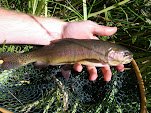
On Monday the weather was beautiful and I had about an hour to spare before work, so I grabbed my 2wt and headed off to a local Cutthroat pond. Upon arriving, the first real hatch of the season (a few Caddis, Midges and lots of Callibaetis Mayflies) were coming off and the fish were on to them. The first cast came up empty, but the next two were quite rewarding and provided me with two Coastal Cutthroat on the opposite ends of the spectrum, one silver and one gold.

The first fish, a golden-bronze buck in full spawning regalia

One picture doesn't do this fish justice, so here is another shot.

The second fish, a chrome bright fish that had likely recently tasted saltwater.

I ended up landing three fish total and missing another four, so all in all it wasn't a bad trip for a quickie.

Wednesday, April 1, 2009

First outing with the new Scott S4

After getting off work at the Fly Shop on Sunday, Blake called me up and said that he needed me to come over to his place. I said no problem and headed over. When I got there he showed me a brand new Scott S4 9'6" 6 weight fly rod, a perfect rod for the Puget Sound. I asked him if he had gotten himself a new rod and he said "no it's yours," as thanks for the help getting the new fly shop up and running. I don't think words can even express how shocked and excited I was and all that I can say is THANKS Blake!!! 

I when I got home, I headed straight out to the front yard to test the rod out and was in awe at how light it was and the fact that I could cast my fly line to the backing! My original plans for Monday morning had been to tie flies, but with this new rod I knew that I had to get out fishing and test it out. I called up my friend Luke who runs Blackwater fish replicas, and we made plans to head out to a local estuary in the morning. When I got up on Monday, the weather was windy and didn't look too fly friendly, but that wasn't going to stop us, so Luke and I made our way out to the estuary. The tide was high, but the beach ended up being sheltered from the wind, so we got to fishing. On the first cast using a Chum fry pattern I missed a good hit and on the third cast I got another bite. This time I got a solid hook up and had a nice fish on. The fish made a number of runs, cart wheeling leaps, and underwater spins in standard Coho fashion, but it was no match for my new rod and after the short battle I brought it to the net.
 
Not bad for the first fish on the new rod!!

For the next half hour the action was extremely fast paced, with Luke and I each hooking up every few casts with some fat feisty Coho that were gorging on out-migrating Chum fry.

Another nice Coho

However, as is typical, the good fishing was not going to last as a stiff North wind finally caught up with us numbing our fingers and making casting dangerous. Dangerous as in I caught a nice cone head fly with the back of my head... I got another fish and missed a few more before the relentless wind finally drove us from the beach.

The new rod...

I ended up bringing six Coho to hand and lost several others with Luke getting similar results, and even with the wind the new rod casted like a dream, so it was a great day in my book!

Sunday, March 22, 2009

Estuary Cutthroat and Coho

I had a few hours before I had to be to work on Wednesday and the weather and tide looked way to good to pass up, so I decided to head out the Puget Sound for some fishing. I picked a local beach that has several creeks feeding into it in hopes that I would find some Cutthroat waiting to intercept out-migrating juvenile Chum Salmon. When I got to the beach the current was flowing strong, but for the first fifteen minutes or so there was no sign of any fish. However, that soon changed as I made my way closer to one of the small creek mouths where Cutthroat could be seen jumping out of the water and busting bait on the surface. After a fly change I found a pattern that was to their liking and started getting into fish. The best fish that I got out of the group was a flawless 15" Cutthroat that grabbed my fly right at the rod tip before charging back out for deeper water.

A beautiful 15" Coastal Cutthroat on a Chum fry pattern

After landing the 15" Cutthroat, it was like somebody flipped a switch and the Cutthroat just vanished. I went for some time without seeing any sign of fish, before I noticed a disturbance on the surface about 100 yards down the beach to my right. On my first cast after reaching the spot, I hooked into a nice fish which ended up being a resident Coho Salmon. This fish was followed by another and another, and I was into some of the best Coho fishing that I have seen this season. The only problem was that at this point I was running low on time and after a couple more fish it was time to pull the plug on fishing and head off to work at the fly shop.

The Coho were joining in on the chum fry feast too

With my the success of my Wednesday outing, my friend Ryan and I decided to head out to another estuary that I had been meaning to fish for sometime, to see if there were any fish around.

The beach at the estuary

It didn't take long to figure out that there were indeed fish at this spot, as within the first minute on the water one shot out of the water. We started casting then take two steps down the beach, and Ryan who was in the front started getting hits but couldn't quite get the fish to stay on for very long. After covering a good stretch of beach with no fish to hand, we made our way over to a point off of the creek mouth and started to cover the water again. Within a couple minutes of stationing ourselves at this spot, a school of Coho moved in an started to slash Chum fry on the surface. I got a cast right into the middle of one of these groups of Coho and only had time to strip the fly a couple of times before I hooked into a decent fish. I quickly landed and released the fish, then got my fly back in the water and got another Coho.

 
A nice sized resident Coho

Next it was Ryan's turn to get into some fish and with the Coho actively working the a school of Chum fry right in front of us it didn't take long for him to get his first one. Or second for that matter...

Ryan with his first resident Coho on a fly

As the tide started to go out and the estuary drained, the Coho moved on and so did we. However, with the success that we had just had, Ryan and I decided to head out again on Friday, where the scene replayed itself with both of us getting into several more fish including a beefy 18" Coho. It seems that the fish have really keyed into the Chum fry migration, so the estuaries should be the place to be on the Sound for the next month...