About this blog

This blog is all about fly fishing for native trout. On it I cover trip reports, fishing tactics, conservation, the latest news about native trout species and much more. This site provides a companion to my web page Nativetroutflyfishing.com.

Gary

Saturday, July 11, 2009

Central Washington Redbands and Westslopes

This past Monday I had a free day to head over to the east slope of the Cascades in Washington to check out a few of my favorite streams. The only problem was that while the 4th of July weekend had shown Washington some of our nicest weather yet this year, by Monday another marine layer had found its way inland yet again. My friend Zach had been bugging me to show him this spot for a couple of years now, so I finally invited him to join me this year.

By the time that we reached the mountains the weather had broken down bit it was raining in earnest. However, as I had hoped when we arrived at the creek the Cascade Mountain rain-shadow was in effect and while we still had overcast skies it looked like we had left the rain behind. Upon laying eyes on the stream I was a little surprised to see how low the water was. Last year when I had fished it at this time of the year, it had been a raging torrent that was tough to cross in all but a few select places. This year it was a full foot lower, no doubt a direct effect of low snowpack and an unusually dry June. While I typically like fishing a dry and dropper combo, I have fished this creek enough to know that when its native Westslope Cutthroat are feeding, they are looking for food on the surface making the dropper more of a hassle then it is worth. As such I strung up my rod, tied on a size 12 Royal PMX and hit the water.
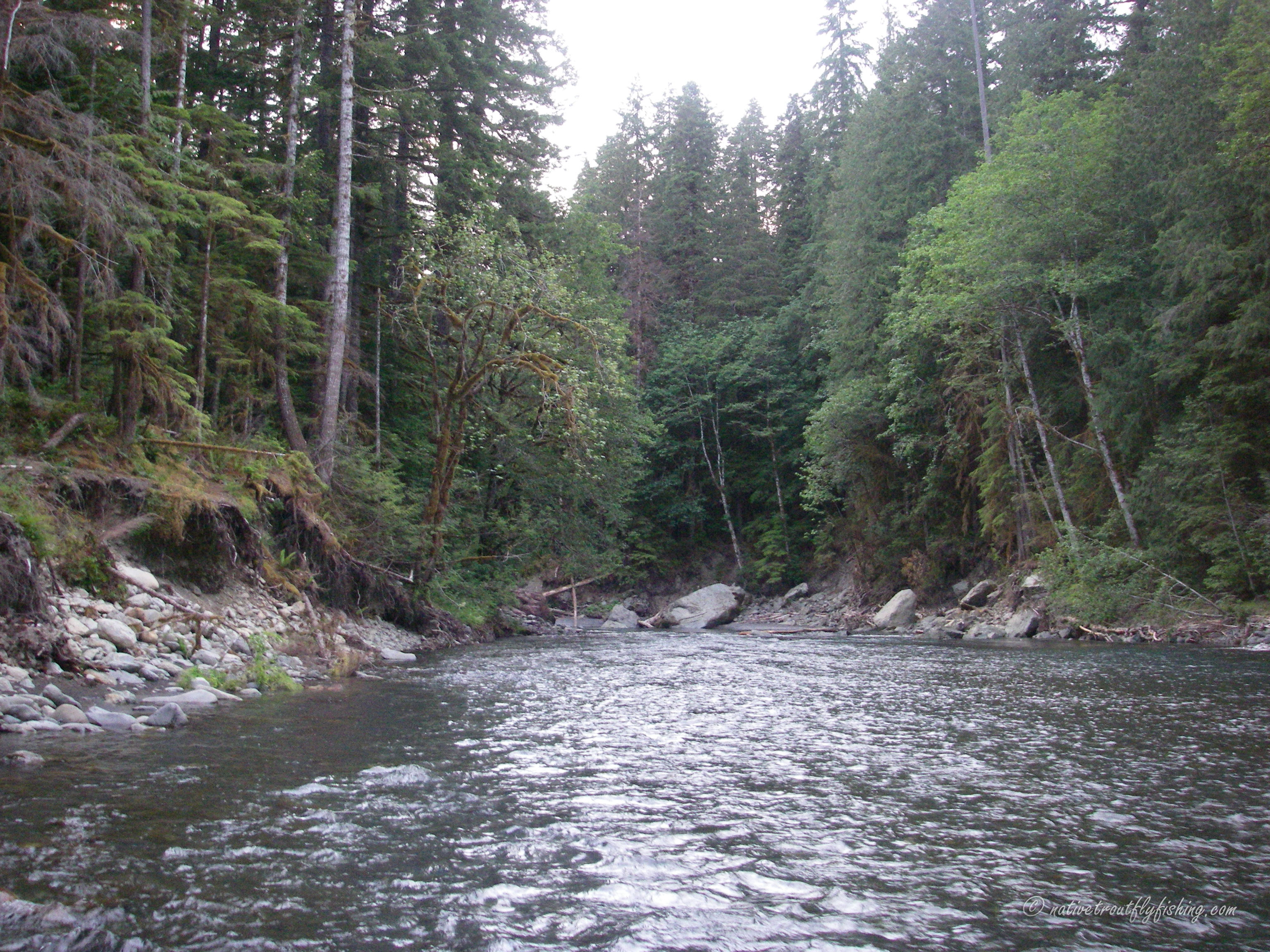
A grey day at the creek

The action started out fast and furious and my first cast rewarded me with a nice 8" Westslope Cutthroat that attacked my Royal PMX with reckless abandon. The next few hundred yards of the stream continued to yield good numbers of Cutthroat in the 5-9" range, which confidently rose to take our dries. After this stretch, things slowed down a bit and we had to search for the fish a little harder. Even so most likely looking spots yielded a riser or two.

A typical Westslope Cutthroat from the stream.


Zach with a native Westslope Cutthroat

Over the years I have found that the higher upstream that I go on this creek, the better the fishing gets. However, this year that was not the case and instead the fishing remained slow while the weather began to deteriorate even more. In fact this was the first time in three years that my favorite run on the upper creek didn't yield a single fish. On top of this Zach managed to find a stick that was sharp enough to punch a hole in the leg of his waders, making for rough going with the frigid water. I did hook one truly note-worthy fish in the upper part of the creek, that was at least 12" but shook loose shortly after engulfing my dry fly.

Looking downstream on an especially high gradient stretch of creek

After finding the upper part of the creek less productive than normal, Zach and I made the call to head back to the car and try out another stream that was a little further to the east. We did fish a few of the more prime lies on the way back downstream and managed to catch a few more beautiful little Westslopes before reaching the car and hitting the road again. 

We traveled down the Yakima River Valley for another half hour before turning up the creek valley and searching out a productive piece of water. Although it was rather windy, the weather was sunny and 70 and the water looked to be in perfect shape. The last time the I had fished this stream the trout were quite eager to take attractor flies, so I left the Royal PMX on but added a gold size 16 Lightning Bug as a dropper. As I was rigging up I started eyeballing a little pool behind a log jam and noticed a decent looking trout finning in the tailout. Definitely a good sign!! 

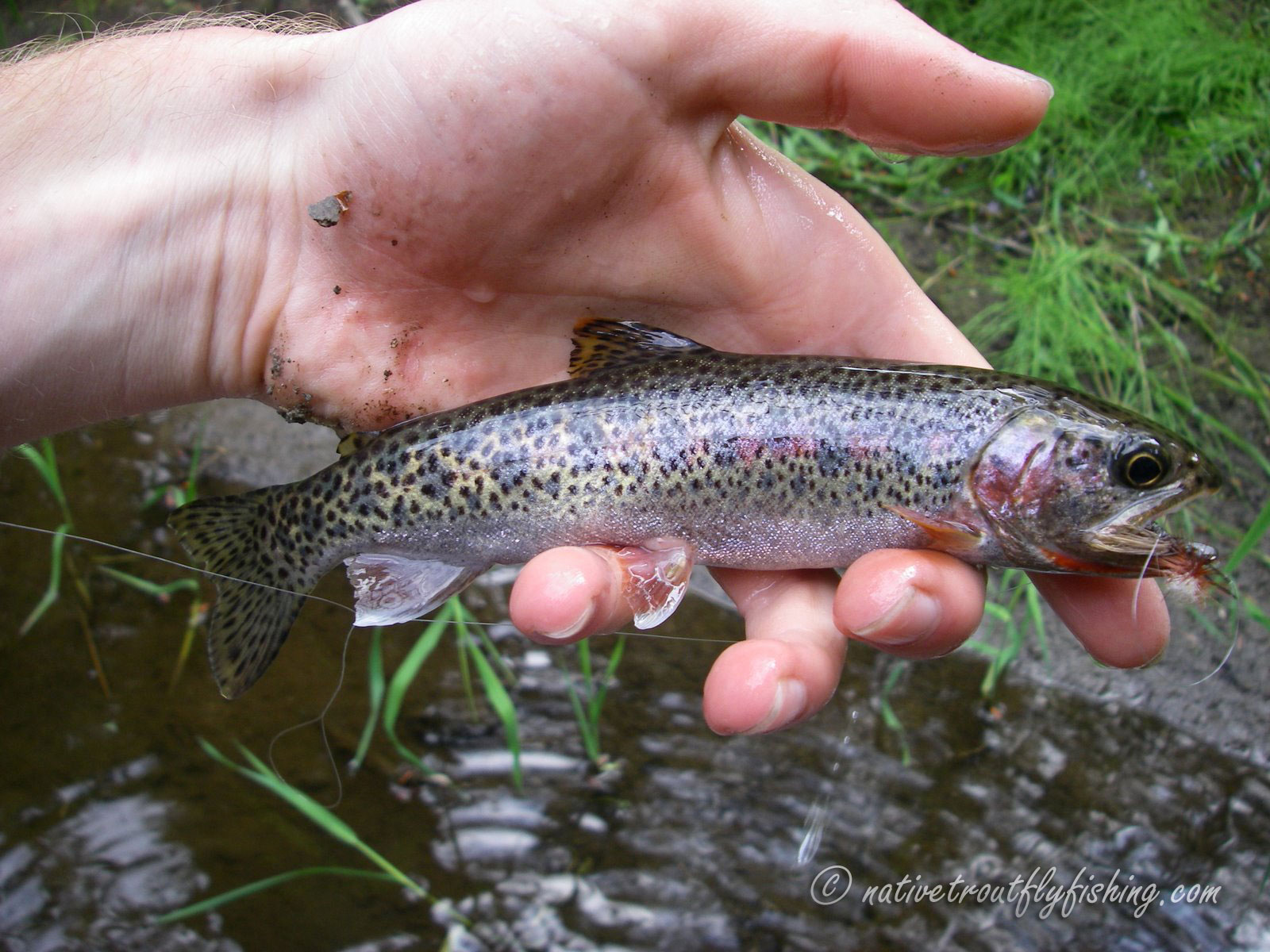
I wanted to plan my approach on this fish so instead of proceeding to the log jam I first checked out run downstream where I managed to rise, but missed a decent sized trout. After this it was on to the log jam where the fish was still hanging out right underneath some overhanging branches. I made my cast to the trout and line flew perfectly between the branches and the water landing just a few feet upstream of the fish, which confidently rose to meet it. I set the hook and the fish launched itself out of water and made a few small runs before I brought a beautiful Columbia Basin Redband to hand.

A beautiful Redband
I
 managed to get one more small trout out of this pool on my dropper, before I continued upstream to where Zach was fishing. When I found him he was just releasing a fish, which turned out to be his third. As we worked our way upstream, the fishing continued to be productive, with just about every pocket and likely looking spot producing one or two Redbands. In a particularly good pocket behind rock, I managed to catch five trout, with one taking my dry and the rest falling for the Lightning Bug dropper.

Zach working his fly along an especially fishy looking log jam.

The fishing continued to be consistent for Redbands averaging 6" to 8"as we continued upstream, until we came to a pool with a basalt cliff running along it. Zach took point on this spot and one his first cast a nice fish rose for his dry fly. He missed the riser, but got lucky and another trout had grabbed his Copper John dropper at the same time and he got a solid hook up. This ended up being the larger of the two fish and after a few seconds he managed to bring it to the net. Whether this fish was a Redband or Cut-bow was hard to say, as it had a vivid Cutthroat slash but the colors were distinctly those of a Redband. No matter what it was it was a fine trout at just short of 11". After Zach released his fish I got a try at the pool and hooked up with one trout for brief moment before it came loose.

The basalt cliff pool

Upstream of the pool the stream was much less productive for the next quarter mile and we only managed to rise and handful of fish. The reason for this became clear and as well rounded a bend we ran into a crew of WDFW fisheries biologists that had been electroshocking the creek to do a study on the diet of the trout. From what they had to say, Coho Salmon had been reintroduced back into the creek during the previous year and they were looking into the importance of Coho fry in the diet of the Redbands and Cutthroat that call this stretch of stream home. Some of the larger Redbands did have Coho fry in their diets, suggesting that a streamer might not be a bad idea next time.

After our brief conversation with the crew Zach and I headed back downstream, and I got another shot at the basalt cliff pool and this time managed to catch a 10" Redband on my dropper. We also fished a few of the other prime lies on the way to the car and picked up a couple more trout. However, at this point were more keen on getting back to the car so we could explore one more nearby stream.

A post release Redband

The next stream that we decided to fish was a headwater tributary of the last one and we were hoping that we might find a few Westslope Cutthroat up there. This stream took a little bit of hiking to get to, but after about 3/4 of a mile we reach the water and started fishing. We found tight condition small stream fishing at its finest and there were numerous deadfalls overhanging bushes waiting to intercept our flies. However, there were a few decent pools a here and there and as we moved upstream I caught a few Cutthroat and a Redband or two as well.

Stream #3

A Westslope Cutthroat on the Royal PMX

In a deep slot Zach caught a fish that he was pretty happy about, but really has no business in the creek, a Brook Trout. Outside of their native range, Brookies have been been problematic for native Cutthroat across the Western US, as they typically out compete Cutthroat in cooler headwater streams. My worries were put to ease a bit, as for the remaining half mile of the stream that we covered, we only encountered the native Cutthroat and Redbands, suggesting that the Brook Trout population may not be too well established.

Zach's Brook Trout

After fishing this stream we headed to one last stream to quickly it out. However, after driving to the end of the road and tromping around a mosquito infested meadow and not seeing the stream anywhere close by we decided that we had done enough fishing for one day.
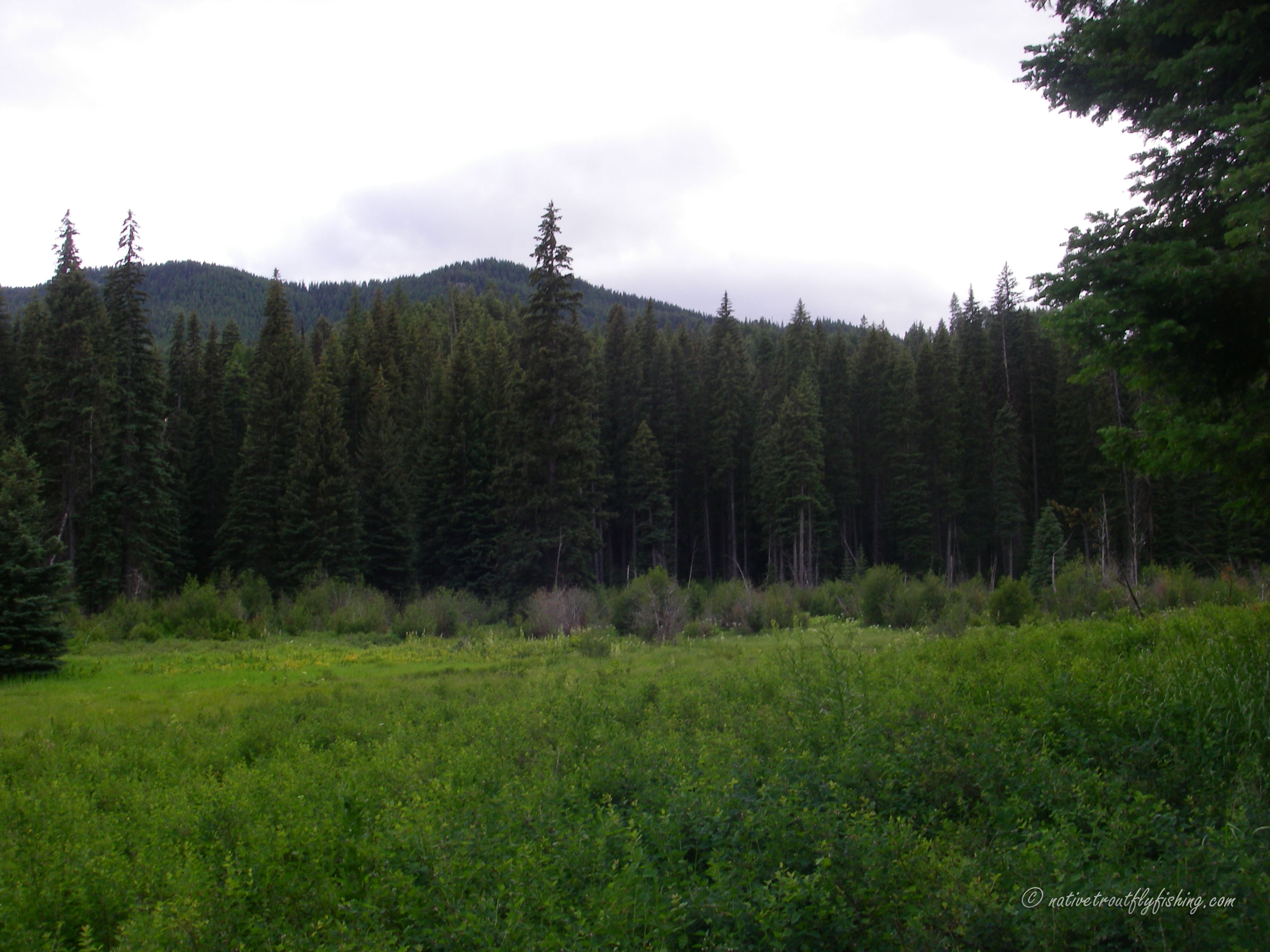
A view of the meadows

After a few more mosquito bites and little more trudging across the meadows, we hopped back in the car and made drive back down the valley and across the mountains to Gig Harbor. For Zach, this was an especially successful outing as he managed to catch three new species of trout. For me it was just nice to be out on the water looking for native trout in some beautiful country.

Saturday, June 20, 2009

The Evergreen State Salmonid Slam

Washington State has twelve species/ subspecies of native salmonids. Over the last weekend I caught my the twelfth and final species of native salmonid that I hadn't yet encountered in Washington State
Pacific Salmon

All five species of North American Pacific Salmon are native to Washington State.

Chinook Salmon: Puget Sound

Coho Salmon: Puget Sound

Chum Salmon: Puget Sound

Sockeye Salmon: Olympic Peninsula

Pink Salmon: Puget Sound

Rainbow Trout
Two subspecies of Rainbow/ Redband trout are native to the state of Washington.

Coastal Rainbow Trout: Olympic Peninsula

Columbia Basin Redband: Yakima River watershed

Cutthroat Trout
There are two subspecies of these fish native to Washington.

Coastal Cutthroat: Puget Sound

Westslope Cutthroat: Yakima River watershed

Char
A lot of fish in Washington like to come in twos and as such there are two species of Char native to Washington State, although genetic testing is typically needed to tell them apart. Southern Dolly Varden the rarer of the two are only found in the few isolated stream resident populations above barrier falls.

Bull Trout: Olympic Peninsula

Southern Dolly Varden: Olympic Peninsula

Other Salmonids
The only other salmonid native to Washington are the Mountain Whitefish, a close relative of trout, salmon and char.

Mountain Whitefish: Olympic Peninsula

Unfortunately unlike Wyoming and California, Washington does not have an official program to recognize anglers for catching the state's native salmonids. The next step of my quest in Washington would be to complete the Washington "Anadromous Challenge". In other words to catch all of the native salmonids in their anadromous form. To complete this I still need catch some Coastal Steelhead and Columbia Basin Redband Steelhead and sea-run Bull Trout. I will have to save that one for another time though....

Tuesday, June 16, 2009

An Olympic Surprise

Finding myself with a few free days, I made plans for an impromptu camping trip to the Olympic Mountains on Sunday and Monday with my dad and brother-in-law Mike. While just getting out and camping was a big part of the draw, the river flowing through the valley is what really had me interested. Especially since my last attempt at getting in some mountain stream fishing had failed so miserably.

Due to some prior obligations on Sunday, we got out of town later than I would have liked and didn't end up getting up to the campground until late-afternoon. After quickly setting up camp, Mike and I headed out to try some fishing. I had heard tell of some large Rainbows and Cutthroat in this drainage, as well as the off chance of running across a Bull Trout and as such I rigged us up with some flies that have treated me well on Olympic Mountain streams before. I was using a small streamer, while Mike put on a soft hackled Jumbo John.

We first tried out some pocket water downstream of our campsite, but had no luck. I knew about a couple of great looking holes upstream of the campground and decided that we should head up there next. I found a small gravel bar on the edge of some fast deep water and started fishing with a standard downstream swing, which I have found Olympic Rainbows to be very receptive too. On my second cast my line stopped mid swing and I instinctively set the hook. The second that I did so, I knew that I had a good fish on as my 6WT doubled over and line started peeling off of my reel. This was a down and dogged battle, with lots of head shakes and a few strong runs but no jumps. Not very typical for a Rainbow Trout...

As soon as I got the fish close I saw that I wasn't hooked up with a Rainbow, but instead there was a huge Bull Trout on the end of my line. I was shocked but extremely excited, as Bull trout were the only native species of salmonid that I have not caught in Washington State. Over the past five years I have made number of trips up to the Skagit River system, which is noted for its healthy population of these fish. However, I had never had any luck and here while fishing for Rainbow Trout I finally caught one. Thankfully Mike was right there to assist with netting the Bull and snapping a few photos.

The big Bull Trout

This was one heck of a nice Bull Trout too. The basket of my net is 16" and this fish had a half a net length on that, pegging it at right around 24".

Another shot of the Bull Trout showing off its spots and colors a little better

From here we headed downstream to another pool with a couple of downed old growth trees across it. At the head of the pool right under the logs I caught a small white fish, which I quickly released. Mike took a great looking seem near the back of the pool and after a couple of dozen casts, he got a perfect drift and a fish came out from under the logs and grabbed his fly. As Mike brought the fish in, the colors showed that it was a decent little bull trout at about 14". Unfortunately, as I went to net if for him the Bull Trout made one last bid for freedom and the barbless hook popped loose.

Mike fishing the pool along the log

After hooking up with the little Bull Trout, Mike decided to head back to camp while I went further upstream and try out some new water. I covered a good half mile of river before finding a great looking pool. However, after about a half an hour of fishing I only had one take so I decided to work my way back downstream.
Some good looking but fruitless water

A little ways downstream I was swinging my fly through the middle of a pool when I finally got another fish. My fly had completed its swing and I let it hang in the current for a while before stripping it in. One the second strip a fish grabbed my fly and when I brought it in I saw that I had another slightly larger Mountain Whitefish. With the light failing at this point I decided it was time to settle into camp for the evening, but made plans to explore some promising looking water downstream in the morning.

The Mountain Whitefish

The next morning I woke up at first light to a dizzily, foggy morning and made my way down river. I found a nice run, but couldn't effectively fish it from my side of the river, so I crossed the river then bush whacked through the old growth forest until I emerged on the gravel bar at the run. This was a classic Olympic Peninsula run, which looked like it should hold some Steelhead if only they were still in this river. There was a deep slot on the far bank with some nice large boulders that looked like prime holding water. Over the last few seasons I have found a great technique for Rainbows in this type of water, where I cast upstream and high-stick nymph the first part. As the line gets below me I though, toss a big upstream mend in the line and then allow the fly to swing across the deep slot until it gets below me. The strike can come at any part of this drift and it ensures that your fly is down on the bottom where it needs to be as the swing begins.

A good looking run

I don't know what was going on in this run. Every three or four casts I would feel a tug from a fish, but just couldn't hook up with anything. I covered the run twice using two different flies, but even with one fish that hit so hard it almost yanked the line out of my hand I couldn't get the hook to stick in anything. After this I headed down even further to a similar pool where the same thing seemed to be happening. I did get a few fish to hold on a little longer including a large Rainbow or Cutthroat, but they all still managed to shake loose before I got them in. This was the last pool that I had time for though and I was sure glad that Sunday had been such an amazing day because Monday was a bust.

Thursday, June 11, 2009

Rainout and redemption

Sometimes I wonder why I go to the lengths that I do to catch fish when there are so many options so close to home. Beyond that, sometimes I just flat out just wonder why I don't listen to my better judgment more often. This outing was definitely one of those times. 

Having the day off and with streams finally open, I decided that I wanted to try out a small stream up in the Cascades for some native Coastal Rainbow Trout. When I left home the weather was beautiful and all I could think of was casting my 2WT to some willing fish. However, mother nature had other plans...

As I drove through a mix of forest and fresh clear cuts and closed in on the stream I could see some dark clouds in the distance, but I figured that they would either be blown to the east or settle over the Cascade crest. However, as I got out of the car I heard the distant roar of thunder - not a great sign.

I had never fished this stream and originally was planning a bigger stream, but the creek caught my eye and I decided to investigate. My interest in this little creek was only increased by masses of size 10 brown mayflies flying around at the road crossing.

The creek as it flows through a little grove of alders

I rigged up and made my way upstream casting a dry and nymph dropper rig in every piece of likely looking holding water. It took about a 1/4 mile of vacant water before I finally found a great little pool and finally caught a small 6" Rainbow on my nymph. As I let this fish go the storm clouds I had seen rolled down the mountains and the rain started. I was far enough upstream that I wasn't going to turn around for a "little" rain as I figured it would most likely pass through the area quickly. So as the rain got increasingly worse I continued to fish and managed pick up another small Rainbow. I had just found a great pool with a downed tree across the middle and a decent sized fish in front of it, when the "little" bit of rain turned into a torrential downpour. The downpour effectively put all of the fish down, turned the previously clear creek into chocolate milk and completely drenching me within moments. By the time I got back to the car, the creek was up a foot and I felt like I had been on the losing end of a massive water war. Now completely soaked, I finally threw in the towel and made my way back home, with the rainstorm chasing me all of the way to the foothills of the Cascades ensuring that I wouldn't make any unscheduled stops to check out any more streams. Once back in the Puget Sound low lands it was still sunny and in the upper 70's and you never would have known that it was pouring in the mountains.

I got home and started unloading my soaking gear from the car, but when I got to my rod which was still rigged up from my hasty retreat from the Cascades, I decided that I might as well go try a small stream that is walking distance from home and see if I couldn't find a few fish. This was the part that made me really wonder why I drove all of the way up to the mountains for a couple small fish and a thorough soaking. On my first cast I was rewarded with a beautiful native Coastal Cutthroat in a creek that is as good as in my backyard.

Not to big beautiful and loads of fun on a light rod and dry flies

By no means did the action stop there either and for the next hour I covered the water with my dry fly, catching fish on most every cast.

Each of these pools were good for a fish or two.

The fish here started out very receptive to a dead drift, but as they started to shy away from that I began skating my fly and they went crazy for it again. I found that if I would strip it a few times then pause it a Cutthroat would dart out of the shadows and pounce on it at once.

Beautiful native Coastal Cutthroat

This was one of those times were the size of the fish didn't mean a thing. The coloration on these little Cutthroat was stunning and and the relaxation brought by small streams and small willing native trout has a value all of its own.

Thursday, June 4, 2009

Central Oregon Redbands

A few weeks ago I was invited on a trip to Sun River Oregon by my sister and I jumped on the opportunity. Sun River lies near the headwaters of the Deschutes River in central Oregon, placing it smack dab in the heart of Columbia Basin Redband country. As such, I was looking forward to getting back to a little stream fishing for native trout, especially since beyond fishing for steelhead I haven't had the opportunity since streams closed in Washington last fall.

Thursday May 28th 2009: I got off work at the fly shop at 6:00 PM and my sister and I were on the road by 7:00PM. We decided to drive as far as The Dalles the first night, as it would break the driving up a bit and put us within striking distance of the lower Deschutes River.

Friday May 29th 2009: We got off to a later start than what I would have liked, but by mid-morning we were in Maupin, Oregon where I got my fishing license and swung by The Deschutes Angler Fly Shop where I picked up a few flies and some very useful information on the current conditions. It sounded like if I was lucky I would get a couple of hours of dry fly action before the fish would go down and it would become a nymphing game. That worked for me, so from Maupin it was a straight shot to the Deschutes River to test out some new water and try my luck for some Columbia Basin Redbands.

The end of May on the Deschutes River is typically Salmonfly season, but based on what I had heard, the hatch had started early and was starting to taper down. As such I decided to rig up my 4wt with a double nymph rig to start things out. After a few minutes on the river though, it was evident that there were still plenty of Salmonflies around, and that the trout were still on to them. Splashy rises could be heard echoing up and down the river as the trout attacked the clumsy Salmonflies.

The banks were lined with Salmonflies...

After a couple minutes of not so successful nymphing I heard a rise not far downstream and stopped to see if I could locate the source. It didn't take long to figure out where it came from, as big Redband came up again and smashed a Salmonfly from under an over hanging bush downstream. I decided that I was going to go after this fish, so I changed to a Salmonfly variant of the BC Hopper. I tried to drift a cast underneath the tree from above, but the trout was holding in a back eddy making an upstream approach impossible, so I would have to get below him.

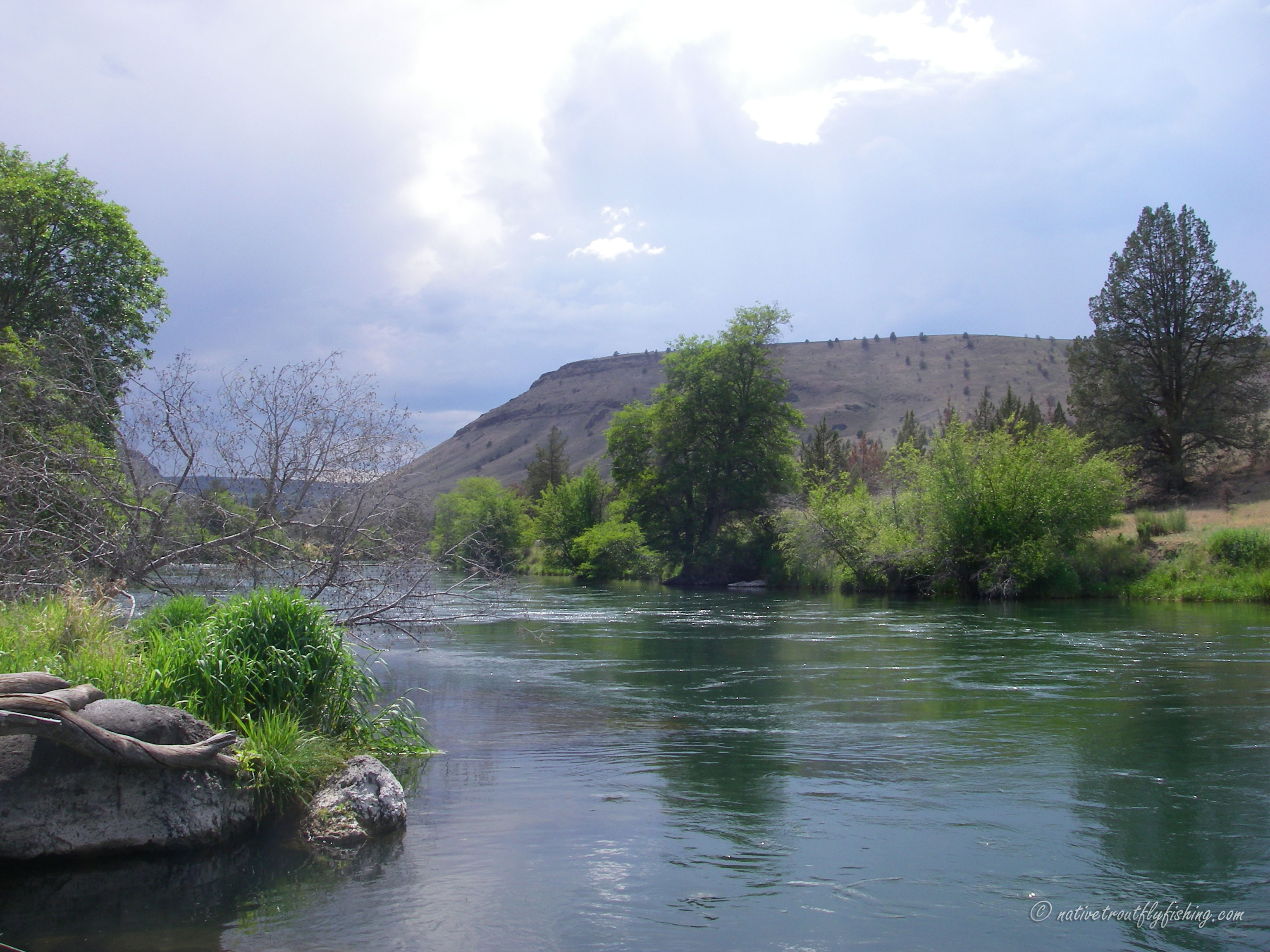
The Deschutes River

Once I got downstream I found a nice rock outcropping to stand on, which shortened my casting distance to about 20 to 25 feet. Even so this was not going to be an easy cast as the tree branches came down to within 6" of the surface of the river in places with only a couple of gaps to get my fly through. To make matters worse, the back eddy ended before it got to my position so I wouldn't be able to just drift my fly into position. I made my first cast tight to the water, but my fly was still riding a little bit high and hit a leaf as the loop of the line was unfolding. Miraculously the fly simply bounced off the leaf and landed smack dab in front of the trout, which was now tucked about four feet under the tree. The fly only had a couple of seconds to rest on the water before the trout exploded on it. Seeing this explosive take though I immediately set the hook and pulled the fly right out of the trout's mouth. I was pretty upset with myself at this point thinking that I had blown my chance at the Redband.

My next cast fell short of the big trout's position, but a second slightly smaller fish came up and rose to my fly. This time I was a little more patient and felt the fish for a second before the fly came shooting back at me. It took several fruitless casts before I got one underneath the tree in the big Redband's feeding lane. Apparently my first attempt at this fish hadn't spooked it as he came right back up the surface and smash my fly again. I gave a slight pause before setting the hook this time and felt my line go tight. I got a good head shake and then nothing...

This time it was definitely over, as the fish had felt my hook and wasn't going to come back again. However, within a couple minutes I saw another much smaller fish rise on the seem of the back eddy and put my fly in front of it. I saw the Redband on the side of the fish as it rose, but missed him. On my next cast I put my fly right back in the same spot and a fish rose to it and I finally got a solid hook up. I tried to move the fish out of the feeding lane quickly, but all the same it thrashing likely spooked the run. After a quick battle I brought the fish to my net and was shocked to see that it was not a trout but a Northern Pikeminnow, a native fish known as a voracious predator of juvenile salmon and steelhead.

The Salmonfly eating Pikeminnow

After a few more fruitless casts I moved downstream to try another stretch of the river. I found a few rising fish, but within a few minutes it was like somebody flipped a switch and the fish turned off to dries. It looked like the info that I had gotten from the fly shop was good, so I switched back to a nymphing set up and started working a seam along a drop off. I got a couple of strikes that I missed, before I got a solid hook up. I could tell what I had was decent sized, but it sure wasn't fighting very well. When I got the fish in I quickly became evident why...

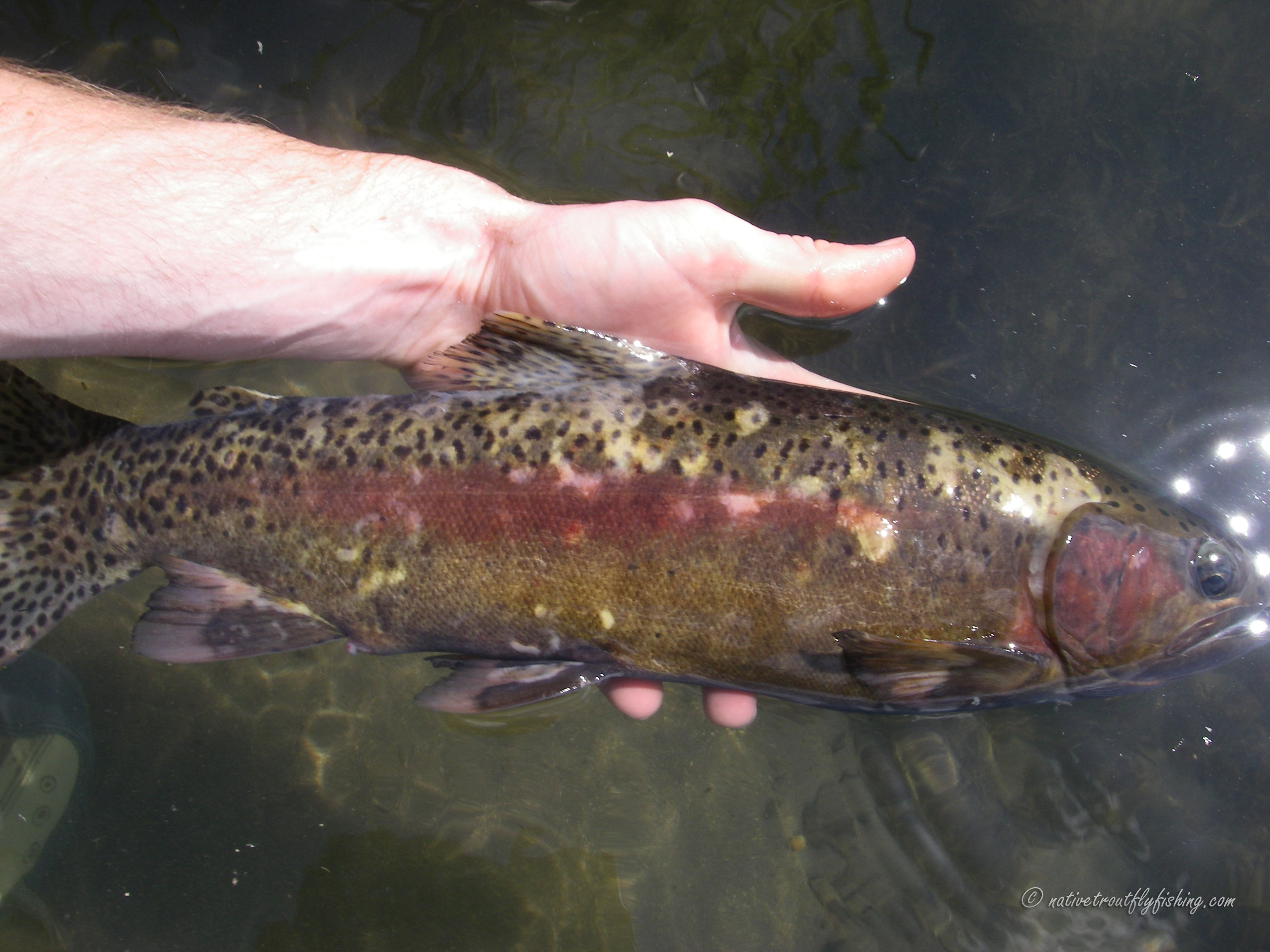
A big post-spawn Redband

When I got the fish to the net, it was a big post-spawn Redband that was in rough shape. I was amazing that this fish was feeding, as it didn't look long for the world, but I made sure to quick release it so if it is planning some miraculous recovery its chances will be a little better.

Just after releasing the fish a drift boat with two sheriffs pulled in next to me and they asked see my fishing license. I handed them my license and with everything in order they handed it back to me, asked me how fishing was and headed downstream. Two things happened though after being checked, the first was that the drift boat spooked all of the fish that I was working. The second was that a thunderstorm that had been lurking in the distance finally closed in on my position, telling me it was time to go. After wrapping up on the Deschutes it was back on the road to Sun River. Once there we checked into our hotel room, settled in for the rest of they evening and made plans for the next day.

Saturday May 30th 2009: I decided that I really wanted to try to catch some more Klamath Basin Redband Trout as their native range was only a couple of hours from Sun River it looked pretty doable as a day trip. From the research that I had done it looked like the there were some streams draining the southern slopes of Crater Lake that held these fish and as my sister had never been to Crater Lake what better way would there be to get there then cutting through Crater Lake National Park.

We got to Crater Lake around 10:30 AM and found it to be just as beautiful if not more so than I remember it the last time I was there. I had never gotten to see the lake with snow around it and it certainly added to the beauty. We spent about an hour hiking around the park admiring the beauty of the place before a rain squall moved in and we decided to get back on the road.

Crater Lake

The headwaters of a Klamath Basin Redband stream in Crater Lake National Park

One the way out of the Park we drove past the headwaters of a Redband stream that I had cut itself an amazing canyon through the volcanic soil. I would have liked to try some fishing down in that canyon, but from what I could see there were no safe ways to the bottom so we kept moving.

When we pulled into the first stream I had chosen to try out, the water was high and off color, but there was a great hatch of Brown Drakes coming off. Unfortunately, there was also a great hatch of Mosquitoes coming off as well. Mosquitoes usually don't bother me too much, so I rigged up and started fishing anyways. However, this spot was ridiculous and every time that I would stop to make a cast I got swarmed by hundreds of the little bloodsuckers. On a couple of occasions I killed a dozen of the little buggers with one swat on my arm. I will put up with a lot in the pursuit of native trout, but this crossed a line and for the first time in my life I was driven from a stream by mosquitoes.

The mosquito creek

With my defeat on the mosquito creek, I set my sights on a spring creek a little further down the valley. When I arrived at the spring creek the water was a bit high and off color due to runoff from some of its snow driven tributaries. With the low visibility I decided to start out with a flashy Woolly Bugger to try to get down to the fish. However, after cover a sizable stretch of the stream without so much as a bump I decided that it was time to switch things up.

The spring creek

While walking along the bank I finally spotted a rising fish in a back eddy. It was unclear what this fish was feeding on, but every time that the sun was blocked by a cloud it would invariably rise a few times before things got bright again. As there were a few caddis around I put on a small Caddis Emerger and made a few casts to it. Nothing. Next I tried a double nymph rig. Nothing. With the Brown Drake hatch on the creek earlier, I followed this up with a Mayfly Dun and Emerger. Still nothing. I even resorted to try some midges, but again the picky fish was not interested. Finally I went back to a nymph, trying a small Copper John and finally I had a grab, but didn't hook up. After that, I didn't see the fish rise again and with the frustration that it had caused and an encroaching thunderstorm it was time to call it a day.

Me getting frustrated with a super picky trout

Sunday May 31st 2009: With my defeat on Saturday, I decided that it was time to regroup and get some information at one of the Sun River fly shops. I had been thinking about heading to a stream in the Oregon high desert and this is exactly where the guy at the fly shop suggested that I should try. So I picked up a few courtesy flies and hit the road for the desert.

Upon arriving at the river I found a stretch of good looking water with some nice pools and pocket water and a very promising looking side channel. I decided that I would use my 2 WT here as I had been itching to get some fish on it for a while. I started out with a double nymph rig, using a size 16 Pheasant Tail trailed by a size 20 Black and White Copper John. As I was rigging up my rod, I started watching the side channel and to my delight I could clearly see several decent trout holding in a pocket.

The river

I decided that I would start at the bottom of the side channel and work my way through it before trying the main channel. At the bottom of the channel I found decent little pool and after a few casts I hooked up with a fish but lost it. I missed a few more fish on the lower part of the side channel before heading upstream to where I had spotted the fish while rigging up. I found that the fish were still there, but the water was much shallower than I had originally thought, making a good drift difficult with the nymph rig. I still managed to hook up with a 16" trout that thrashed around scattering the rest of the fish before tossing my tiny nymph. With the fish in the pocket spooked I moved up to the top of the side channel where there was a nice deep piece of pocket water and I finally got a solid hook up with a Redband. After a short fight I brought the little 9" trout to my net, took a couple photos and sent it on its way.

A Columbia Basin Redband Trout

On my next cast I briefly hooked up with a much larger fish, but it spit my hook so I headed back down to the end of the channel again. This time I had a bit more luck and got two Redbands on back to back casts, both of which jumped several times and put of a considerable fight on my little 2WT.

A darkly colored Redband

From here I decided to head out to the main channel, so I added little weight and started covering the water. After a couple of casts my indicator shot down and a 20+ inch Redband rocketed out of the water. I had a solid hook up on this fish and he jumped several more times and made a few blistering runs out to the main channel before I was able to work him into the slower water. I got the fish directly below me and was slowly easing him back upstream when the combo of a 2WT, size 20 fly and 6x finally caught up with me. The fish shook its head at the wrong time and with a little pop my tippet snapped and the fish was gone. While it was disappointing to lose the fish, I had gotten the best part of it and won't forget that battle anytime soon.

The stretch where the big Redband was hanging out.

By this time the daily thunderstorm was starting to approach, so I knew that I didn't have much more time to fish so I headed upstream to try a couple of pools above where I hooked the big one. I found the first pool to be vacant, but in the second one I hooked up with a nice 16" fish which I had on for a minute or so before it managed to get out in the current and throw my fly. This was the final straw and with thunder rumbling in the distance it was time to head out.

Monday June 1st 2009: There wasn't going to be any time for fishing today as my it was time to head home. However, we did have a few minutes to at least drive over to the Fall River to scout it out for a future trip. The Fall River has to be one of the nicest looking streams that I have visited, with the feel crystal clear spring creek meandering through the pine forest.

Something to look forward to on the next trip

After the quick peek at the Fall River, it was back to Sun River to gather up our things and make the long drive back home.

Wednesday, May 27, 2009

High tide to High tide

This last week the Puget Sound had a series of extreme low tides. These tides, coupled with a string of nice weather that we have been experiencing made for some interesting fishing conditions. On Wednesday I was able to get out on the water to try both sides of the tide. In the morning I headed up to one of my favorite Cutthroat beaches with my friend Luke to try our luck on the outgoing tide. 

The tide was going from a 12 foot high to a minus 3.5 foot low tide, so we knew that the water was really going to be moving. We got on the water by 7:30 AM as the tide was just starting to ebb so there still wasn't much back cast room. However, there were already some Cutthroat working a school of baitfish off of a point, so Luke and I both put on baitfish imitations and got to work. The action was fast, but unfortunately it was mostly smolts that wanted to bite so we kept working our way down the beach in search of larger fish. Luke and I both managed to get a few nice takes, but didn't get any solid hookups so we decided to head back to the point and try another pass through. 

When we arrived back at the point, I changed to an experimental pattern and all of a sudden started getting hits almost every cast but no clean hook sets. Finally I got a nice tug, which was followed with the feeling of a head shank and I knew that I had a solid hook set. The Cutthroat fought hard, but within a minute or so I had a nice 15" Cutthroat in the net. The fish was chrome bright with a hint of yellow on its flanks. However, this fish this fish had its mind made up that it didn't want its photo taken and made a successful bid for freedom.

Next Luke and I decided that would try another stretch of this beach that is generally fairly productive for Cutthroat and Coho. This was the typical Puget Sound cast & take two steps type of beach, where fish may be spread out anywhere along the shoreline and you have to cover the water if you want to catch anything. We had covered a little over half of this stretch of beach with me only picking up a couple more smolts when Luke finally got a decent resident Coho at about 14". Right at the end of the stretch that we were covering, the beach goes out to a point and that was where I finally hooked up again. This fish had followed the fly almost all of the way up to the rod tip and as such it didn't have much line to play with so, after a very quick battle I brought it to the net.

My second decent Cutthroat of the day

It was close to 11:00 AM at this point and as I had to be to work at the fly shop at noon and the tide was getting a bit low it was time to call it quits.

I hadn't been planning on fishing the evening incoming tide, but I got a text from Zach saying that he needed to get out and fish and seeing as I had all of my gear on me, I decided - why not? I told him to meet me when I got off work and we went out to one of the many Gig Harbor area beaches. However, when we got to the beach we found the water completely covered with seaweed. I wasn't overly surprised as with the extremely low tides and nice weather seaweed gets exposed at low tide, dried out by the sun, then floats off on the incoming tide. Nevertheless, it made for much less than idea conditions. The fishing was nearly as productive as on the morning tide either and after an hour the only fish that I had caught as a small Cutthroat smolt. However, when the tide was nearly up we spotted some decent sized fish and worked them for a while, with me only getting one hard take before we were forced to move on to a beach that could be fished at high tide.

Zach working a cove where we could see a lot of baitfish activity

Fishing at this next beach wasn't much of an improvement, with the exception that there was no seaweed to be seen anywhere. We did spot one very large Cutthroat, lots of bait and Zach had a good take so this spot does show promise. Beyond that it was a great way to a end the day with the sun setting and the tide at the same height that I had found it in the morning. For my next outing I am off to Oregon to try my luck for some Redbands.

A great end to a great day

Sunday, May 17, 2009

A Terrible Trifecta

Yesterday we finally had some good weather, which change my plans from staying home to tie flies, to heading out to a local beach to try my luck instead. When I arrived at the beach the tide was low and just starting to move in, but there was no sign of fish. I began at a point that typically holds a fair number of Cutthroat, but all I found was seaweed on every cast. From here I headed down to a little Eel Grass cove where I finally spotted some fish down the beach. When I got the area where I saw the fish all that I found were a few schools of Chum fry and covered a few hundred yards of beach with only one bump before moving on to another point.

Low tide at the Eel Grass cove

Upon arriving at the point a school of 4" long Sand Lance shot past me and a 3-4lb fish broke the water scattering another big bait ball. This definitely looked like the right spot. I started out using a baitfish imitation and was getting a lot of shot strikes but no solid hook ups, so I switched to a Sea-run Bugger. On the first cast with this fly it got hammered and a minute or so later I brought a healthy 18" Coho to hand. After this I got one more really good tug before I started to only get a few short strikes here or there again prompting me switch to a Marabou Clouser Minnow. Sure enough this change up got the attention of the fish and on the first cast I caught another slightly smaller Coho (see below).

Species #1: Coho salmon

The cast after getting the Coho, my fly got crushed again but this time the fish shook itself loose. After a few fishless minutes I hooked up with another fish, which ended up being a small Coastal Cutthroat. At about this point I was surprised to see Clint and Jake show up in Clint's boat and when they pulled up it was like somebody flipped a light switch and the Coho and Cutthroat vanished.

Species #2: Coastal Cutthroat Trout

However, with the Cutthroat and Coho gone some roving Chinook decided to move in and not long before deciding to call it quits I managed to complete a task that I have only done a handful of times and got the Puget Sound Trifecta: a Coastal Cutthroat Trout, Coho Salmon, and Chinook Salmon. Clint and Jake were kind enough to give me a lift back to my car, but it seems that a good day can turn bad in a heart beat.

Species #3: Chinook Salmon

When I got back to my car I was in for a rude awakening as the first thing that caught my eye was a shattered front driver's side window. It was clear that somebody had riffled through my car even though I had nothing of value in sight. Unfortunately they also went through my trunk where they made off like bandits, stealing some spare waders, a gear bag, the tube for my new Scott rod a fly box full my lake patterns, which had over 200 flies in it. I had spent countless hours at the vise tying these flies and this was a sickening loss. To add insult to injury whoever broke into my car also siphoned over half of my gas while they were at it. The fishing may have been good on this outing, but it is one time that I really wish I would have just stayed home to tie flies instead.