About this blog

This blog is all about fly fishing for native trout. On it I cover trip reports, fishing tactics, conservation, the latest news about native trout species and much more. This site provides a companion to my web page Nativetroutflyfishing.com.

Gary

Monday, October 5, 2009

September in the Southwest: Part 3 Gila Trout

Day 6: Sunday September 6th 2009: The storm that we had seen hovering over the mountains yesterday had spread out across the valley overnight, making for cold wet conditions when we woke up in the morning. In the distance I could see some pretty gnarly rain clouds headed our way, but just beyond that was a vast expanse of blue sky. With the way that the wind was blowing it looked like both the rain and sun were going to find us, so Derek and I had the decision to either wait out the weather or to start right away and likely get soaked on the trail. We decided to wait and by 9:00 AM the rain finally hit us and for the next 45 minutes it poured in buckets. Then the rain finally died off and was replaced by dazzling sunlight and it was time to start hiking!

 
Off to a rainy start

The hike started out relatively flat, traveling through a land of Prickly Pear Cactus and scrub brush thickets, but before long we reached the ridge and started the long uphill climb. Given the terrain we were hiking through, there was very little in the way of shade on the climb up the countless switchbacks to the top of the ridge. However, around mid-day we made it to the "top" of the ridge, where pine trees seemed to have a better hold and provided us with a little protection from the sun.
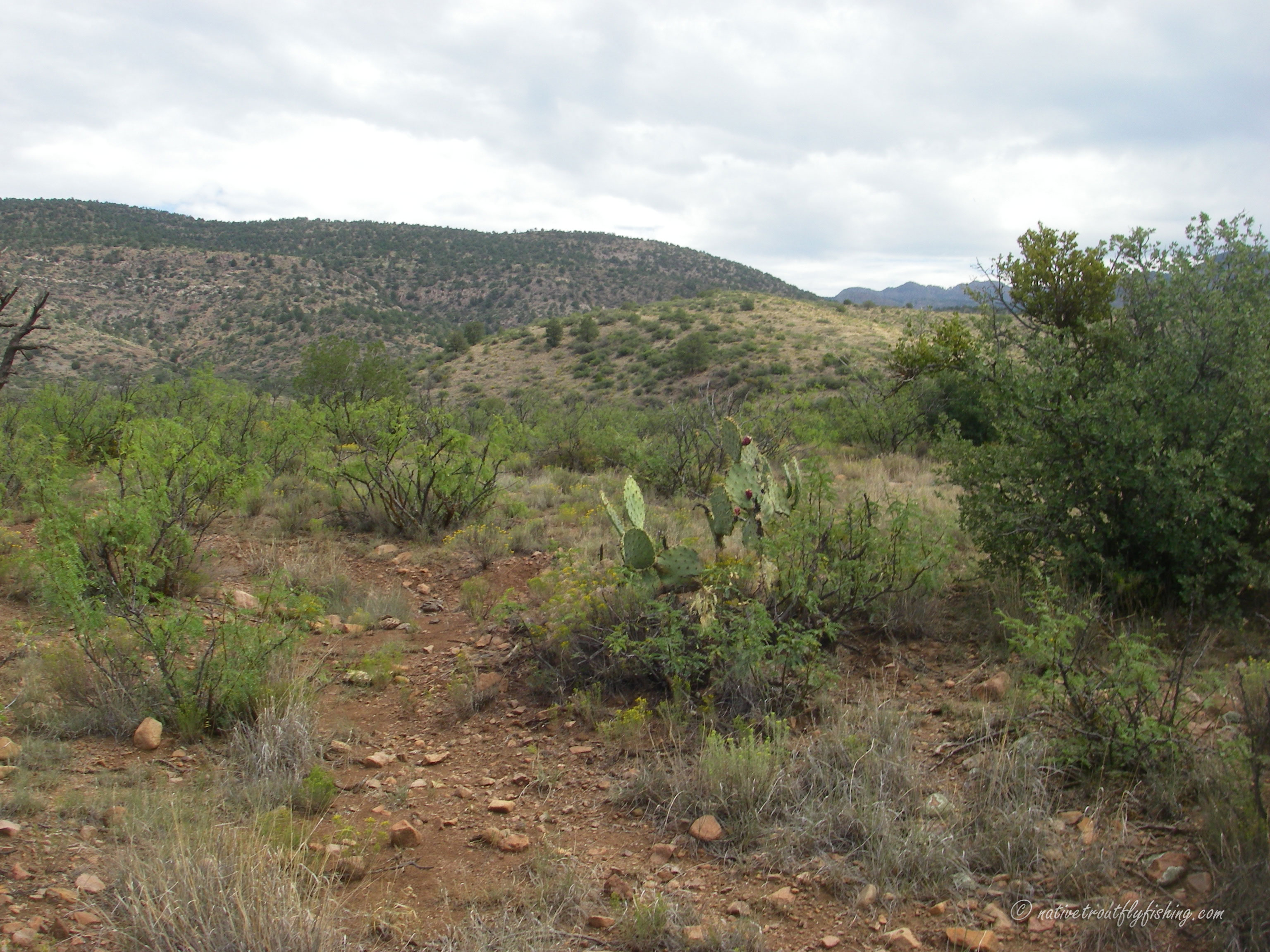
The Gila Wilderness Area

The "top" of the ridge was most definitely not the end of out uphill climb, as the trail wound along the backside of the ridge for several miles before beginning its decent into the canyon on the far side. The terrain up in the high country of the Mogollon Mountains made it easy to see why this region was designated as the first wilderness area in the nation. The combination of pine trees, cacti and rugged peaks made this some of the wildest country that I have ever encountered. The weather seemed to match the wild character of the land and where we were worrying about the unforgiving sun one minute, the boom of thunder in the distance gave us something else to worry about the next . As we rounded a bend a it became apparent that a thunderstorm was building in the distance and from what it looked like, we were heading straight into it. With a massive storm standing right in our path, we were a bit anxious to get to the creek, but the trail seemed to meander along on the top of the ridge for much longer than what we had hoped.

Ominous clouds... A great sight when you are miles into the back country

Finally we reached the rim of the canyon and started our decent to the creek. It was quickly evident that this side of the peak received much more precipitation, as the cacti started fading away and pines and oaks dominated. A little over half way down to the bottom of the canyon the storm finally caught up with us, but only long enough for us to get all of our gear waterproofed before the sun took over again. However, the clouds overhead made it evident that this was just a short break from the rain and that we should get the move on. When we reached the creek, the sun was still out and we quickly scrambled to find a decent place to set up camp. The tent had probably only been up for about ten minutes when the main storm front hit us and the down pour started. While the storm raged we took refuge in the tent and I prepped the fishing gear for when things finally calmed down.

After half an hour of rain, the sun finally won out again and this time it appeared that the worst had passed. As such, we grabbed an early dinner, got the fishing gear ready and headed down to the creek. It was immediately clear that we were in the right place, as after a quick scan of the creek, I had already spotted a couple dozen fish.

Can you spot the Gila trout??

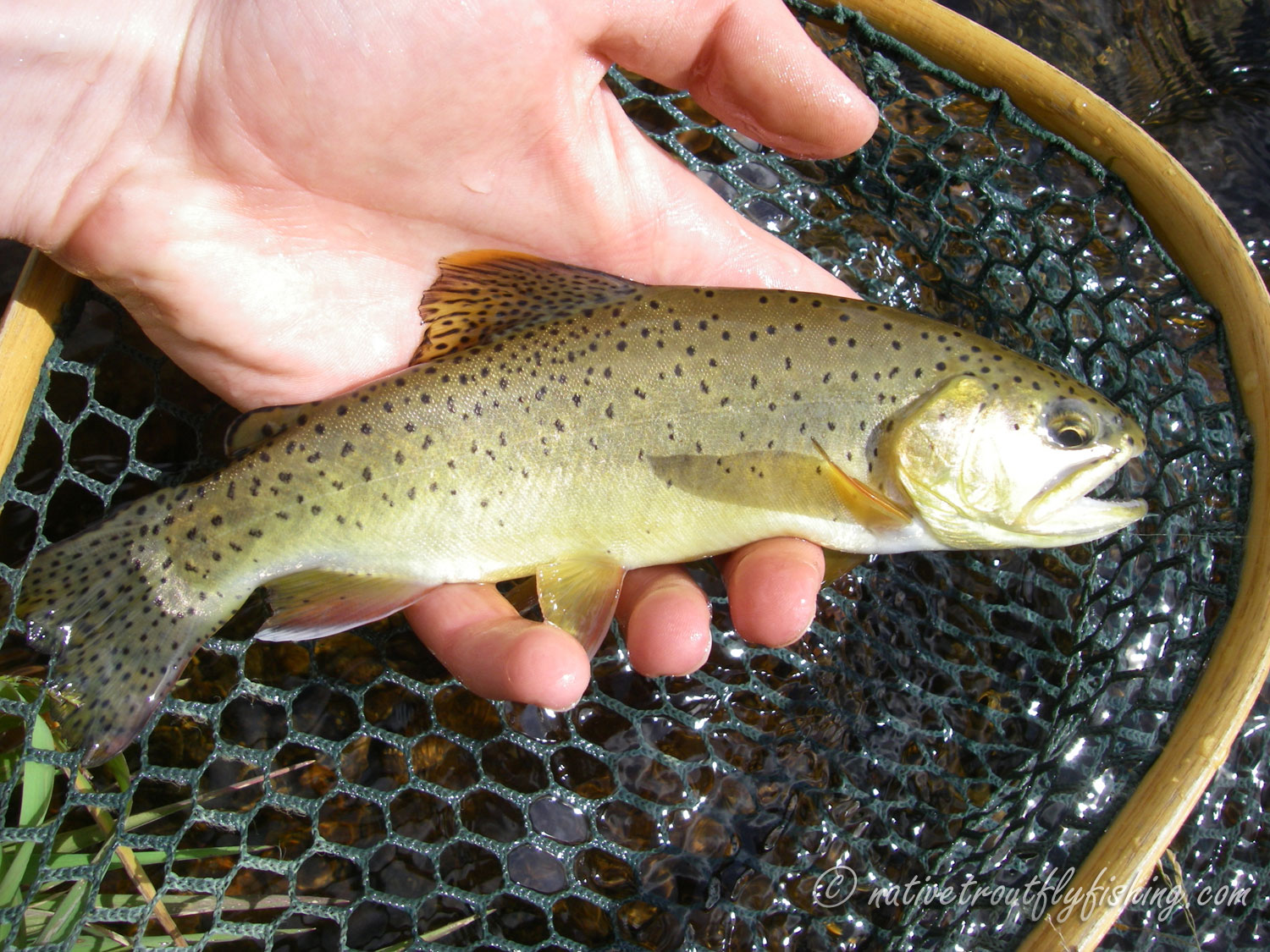
With the high numbers of fish visible I wasn't too surprise to be rewarded with my first Gila Trout on my first cast, or when my second cast was equally rewarding. All that I knew was that this was more then what I had been hoping for over the past six months of careful planning.

The reward for months of planning - the Gila Trout

With good numbers of trout in the creek I had Derek cover the first stretch, while I headed a few hundred yards upstream to look for fish. Once again it didn't take long to find the fish as the creek seemed if anything to be slightly overpopulated with Gila Trout ranging from 5" to 8". The water in the creek was fairly low and most of the pools seemed shallower than expected making a stealthy approach difficult at times. While I wouldn't quite go as far as calling these fish overly spooky, they definitely were on the cautious side and spooking the small fish that held in the shallow tail outs would put the larger fish at the head of a pool down or at least make them more difficult to catch. Before long Derek caught back up to me and we decided to just take turns fishing each pool as we headed upstream. Derek had no trouble getting into a few trout as we made our way up the creek, although all of the fish seemed to fall into the same 5" to 8" range.

Derek with a Gila Trout

I kept hoping that we would run into a few deeper pools that might hold some larger trout as we headed upstream, but the creek seemed to just maintain its character of pocket water and shallow pools. About 3/4 mile above our campsite we came across a log laying across the creek with a sizeable trout holding under it. I got a decent cast in just above the log and a nice 10" Gila Trout cruised out from under the cover and grabbed my fly. I got a good hook up on the fish, but as I went to net it, it tossed my fly. While I wasn't happy about losing this fish I made a mental note that I would have to return to try for it again in the morning. We continued working our way upstream, catching Gilas in just about every likely looking spot before the sun finally started to sink behind the ridge and it was time to head back to camp. We made it back to camp just before dark and grabbed a quick bite to eat before turning in for the night on what had been a long day of fishing and hiking.

Evening on the creek

Day 7: Monday September 7th 2009: We awoke to clear blue skies and a full day of exploring the canyon. After a quick breakfast, I had already made up my mind to head back upstream to get another shot at the 10" Gila that had managed to shake free. Derek decided that he wanted to check out the creek downstream of camp, so I started to make my way towards the spot where I lost the trout. Along the way I caught a few more Gilas in the 6-8" range, but nothing larger. Finally I arrived at the log and while I couldn't see any trout holding near it I knew that there had to be something there so I placed a cast right along the side of it and the "big" Gila came out and grabbed my fly again. I had it on for a couple of seconds before it got a good head shake and once again threw my fly. I was a bit frustrated at this point, but figured that the might have some neighbors and as it turned out I was right. While they weren't as big as the fish that I was to be unable to catch, I did get two trout at around 8" each, with one on my dry and the other taking my nymph dropper.

Not the big fish that I had hoped for but a none the less beautiful Gila Trout

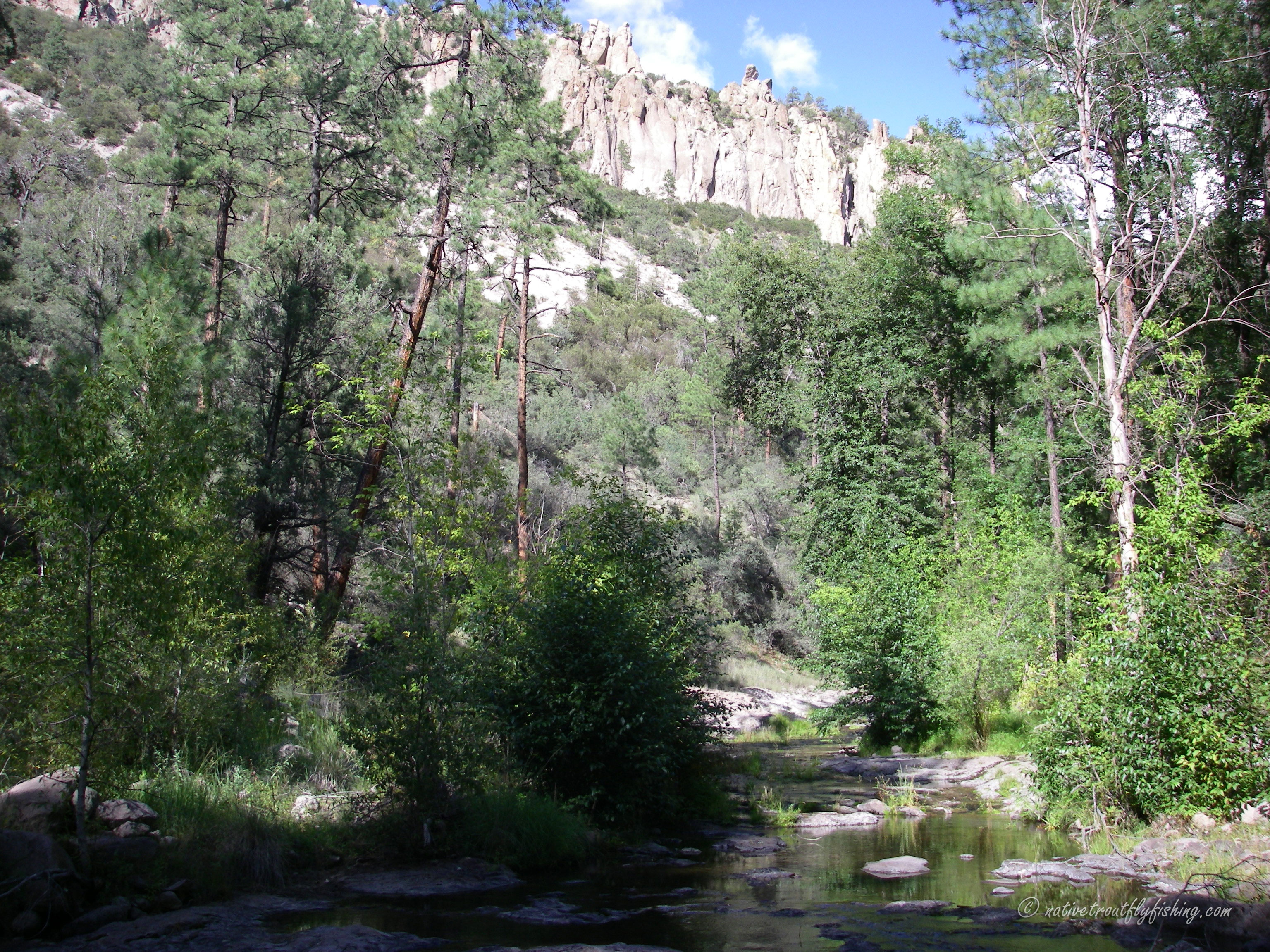
The creek near our campsite

After once again failing to catch the "big" Gila Trout, I decided to head downstream to see what Derek was up to. I found Derek not to far from our campsite and he was pretty excited about a couple of deep pools that he had found further downstream. About a quarter mile below our campsite the canyon walls closed in and sure enough formed a couple great looking about 10 foot deep pools that appeared to be loaded with trout.

The head of the upper pool - note the waterfall was about 8 feet tall.

Not only did these pools look like good fishing water, but they also looked perfect for some swimming. Of course fishing would have to come first though. I started out fishing my dry and dropper and caught a handful of fish, before I decided to try one of my favorite large pool/ beaver pond techniques of stripping a Zug Bug. This method proved to be just as effective as ever and on each cast a group of Gila Trout would appear behind my fly and follow it for a ways before one got brave enough to race forward and grab it. The fishing in the pools was great, but the only problem was that both pools had nearly shear cliffs dropping into them, which made getting down to the edge of the water to land fish very difficult. In the upper pool the best option was to lift the fish into a small pool above the waterfall to land them, but there were a couple of spots that I could get down to the water if necessary. In the lower pool it was lift the fish over the falls or nothing. I fished the pools for about a half an hour managed to catch a couple of fish in the 10" range, but both of these fish proved photo shy and got released a little quicker than planned.

After fishing it was time for a bit of swimming and relaxing to recover from the long trek into the creek. We didn't get to spend nearly as much time at the pool as I would have liked though, as after about a half hour of swimming the not so distant rumbling sound of thunder caught our attention and we had to head back to camp to make sure everything was rain proofed.

A rain ready camp

We hung around camp for a couple of hours to make sure that the storm was going to pass us over before I decided that I could safely head back down to the pools. I started out using the Zug Bug again, but only the smaller fish seemed to take notice of it. As such I decided to switch tactics a bit and put on a size 8 Jumbo John, which I figured should look like a bit more of a substantial meal to the bigger fish. Apparently it did, because on one of my first casts with it, two nice 12" Gilas raced out from under the rock ledge to grab my fly. One of the fish just barely out paced the other and absolutely crushed my fly. This fish fought rather hard for its size and put quite a bend in my 2wt. The only problem was landing it as this was the lower pool and there was no option but lifting the fish over the falls. This fish didn't want any of this and with one good headshake it tossed the hook when it was about half way up and disappeared back into the depths. I worked both pools with the Jumbo John for some time, but no matter what I did I couldn't get any of the bigger fish to take again.

As the sun started to fall a little lower in the sky I moved back up to the top pool and gave a dry fly a try again. Upon arriving at the pool I spotted a decent 10" Gila holding on the bottom and sporadically rising to take something off the surface. The question was what fly should I go with. I first tried one of my old standbys, the Royal PMX, but I had already harassed these fish with that fly plenty and they really didn't seem too interested. Next I tried a stimulator, BC Hopper, Elk Hair Caddis and a few may fly patterns, but only the smaller fish seemed to be willing to look at them. I looked through my fly box a few times and finally landed on a small beetle pattern that I had come up with about four years ago and never gotten around to testing out. I figured it was better late than never and tossed it in front of the 10"er. Sure enough it slowly rose to sip it off the surface. I held off of a second before setting the hook and got a solid connection. The fish jumped a few times, but there were only so many places that it could run in the pool and soon it was ready to bring to the net. Unlike the lower pool there was a nice ledge along the water where I was able to land and photograph this Gila Trout. At this point I figured that I had caught more than my fair share of these rare trout and as it was dinnertime I headed back to camp.

An underwater Gila Trout

Day 8: Tuesday September 8th 2009: Once again we awoke to clear skies and what looked like perfect weather for the hike out of the canyon. After breakfast and quickly breaking down camp, we were back on the trail. The hike out of the canyon was rather steep, but was much shorter than the climb to the top of the ridge on the other side so we made pretty good timing. Once at the top of the ridge we noticed that like each of the previous days a thunderstorm was brewing over the mountains and with the way that the wind was blowing it was clearly heading our direction fast.

Me at the top of the canyon on the hike out - note the dark clouds in the corner...

With a thunderstorm on our heels, we were now in of a hurry to get off of the ridge, as we didn't want to be caught in the middle of a storm with no shelter. Given our pace and the storm on our heels, I wasn't paying as much attention to the trail as I should have been and almost made a serious mistake. I was in front of Derek when all of a sudden I heard a buzzing rattling noise right next to me. I could see that the route in front of me was clear, so I ran forward as fast as I could while Derek froze where he was. When I looked back I could see a huge Rattlesnake (at least four feet long) was coiled up within a foot of where I had just been. Derek gave the snake a wide breadth and after this close call we were a bit more cautious and jumpy for the rest of the hike, although luckily this would be our only encounter with a snake on the way out.
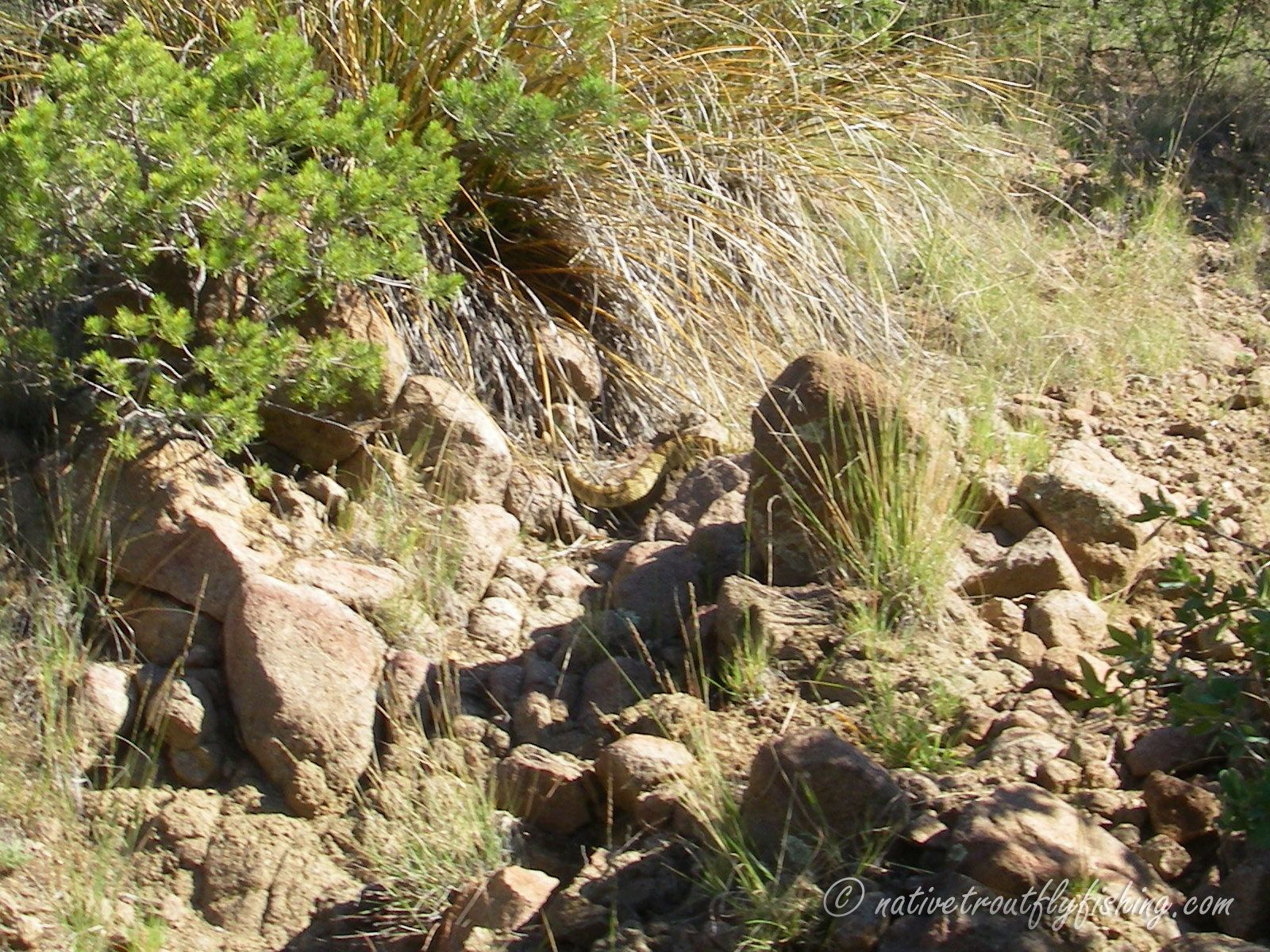
The big rattler - I walked just past him on the other side of the big rock - WAY TO CLOSE!!!

By the time that we reached the other side other side other ridge, it was evident that it was raining where we had been camping and the storm was still headed our way. As such we were quite happy to beat the storm to the car a get on the road again.

The storm rolling over the ridge

After hitting the road, we made the six-hour drive to Sante Fe, NM where we grabbed a great dinner and hotel for the night to recoup from the long hike and get ready to target the last fish of the trip the next day.

Sunday, October 4, 2009

September in the Southwest: Part 2 Apache Trout

Day 3: Thursday September 3rd 2009: Although I am not a huge fan of highly urbanized areas, we got just what we needed out of our stay in Las Vegas; some recovery time. Also Derek had never been to Vegas so the stop also gave us some time to take in the sights. With the daytime high being around 105 degrees F though, most of the sight seeing was reserved for the evening and night when things became more bearable.

The fountain show at the Belagio in Las Vegas, NV

Day 4: Friday September 4th 2009: This was another driving day as we had to do a diagonal across the state of Arizona to reach the White Mountains and the Apache Trout's native waters. Since we were already going to be sitting in the car for most of the day Derek and I decided to make a stop at the Grand Canyon National Park on the way, after all it would only add a couple more hours to our trip. I had been to the north rim of the Grand Canyon a few years ago and while each side has its own charm, the view from south rim was much more impressive. Whereas with the north rim you look out across a side canyon, with the south rim you can look straight down into the main canyon several thousand feet below.

The Grand Canyon

After our quick stop at the canyon, we got on the road once again and made our way across Arizona. As we began to close in on the White Mountains a massive thunderstorm formed on the horizon and it would follow us the rest of the way across the state. We arrived in the White Mountains shortly after dark and thanks to a few wrong turns we didn't end up finding our way to the stream until around 10 PM. Being that the storm was still raging outside we opted to just sleep in the car instead of setting up our tent in the rain.

Day 5: Saturday September 5th 2009: We woke up in the morning to clear blue skies and found ourselves in a beautiful board meadow valley surrounded by gently slopping Spruce and Aspen clad peaks. Right through the middle of this picturesque valley flowed the slowly meandering stream that was said to hold the Apache Tout that we were looking for. I was pretty anxious to get to fishing, so after a quick breakfast I rigged up the rods and we hit the water. Although though I could probably diversify my fly choices more, I decided to start out with my old standby a Royal PMX and Copper John dropper, while Derek went with a Hotbutt Elk Hair Caddis. We decided that we would work our way upstream towards the headwaters of the creek and upon approaching the stream I could see several schools of Apache Trout fry holding in the shallows. A good sign!

Early morning in Apache Trout country

The first few pools were relatively shallow and showed no sign of catchable sized trout, however not far upstream I came to a promising looking pool with a cut bank and overhanging grass. I tossed my flies upstream tight against the bank and almost immediately an Apache Trout darted out from the cover and attacked my nymph. I set the hook and got a few decent headshakes before the fish tossed my size 18 Copper John. There probably wasn't anything that I could have done to change the outcome of this situation, however losing the first fish of a new species always hurts. This wasn't helped by the fact for the next mile of stream Derek and I only got three of four takes between the two of us. Part of the problem was that the necessary habitat just wasn't there, as it seemed that every decent looking piece of water was about half of the depth that it needed to be. We came to a point where a small tributary flowed into the creek and although everything about this spot looked great it was as devoid of trout as the rest of the stream. However, just upstream I found a tiny pocket with an undercut bank and sure enough when I tossed my fly in a trout materialized from under the bank and grabbed my nymph. I got a good hookset this time and although it tried as it might to shake my fly I managed to bring the beautiful Apache Trout to the net after a quick battle.

My first Apache Trout

There is always something special about catching a new type of trout, but when compared with other trout that I have encountered the Apache Trout are one of the more unique and beautiful fish that I have seen. Beyond their odd coloration and spotting pattern, for their size Apache Trout are very deep bodied and also have a thicker caudal peduncle than other fish that I have caught. The only hard part of catching such as unique fish is that there are only a few moments in which the admire it before it is time to set it loose and watch it swim away.

Not long after releasing my first Apache Trout the ominous sound of thunder echoed across the valley and clouds began to form in what had been a clear blue sky. Even with a thunderstorm brewing in the mountains around us, we continued to work our way up the creek and before long I found another decent looking piece of water and I was rewarded with another slightly smaller Apache Trout that this time took my took my dry fly. After catching this smallish Apache Trout, I found large pool that looked very fishy so I decided to try one of my favorite slow water techniques of swinging and stripping a nymph through the current. I decided to go with another old standby fly the Zug Bug, and on my first cast a big (~13") Apache Trout darted out from an undercut bank and attacked my fly. Unfortunately I wasn't able to get a good hookset and the fish felt my hook meaning that I had missed my chance for catching anything in this spot.

Apache Trout waters

I fished the Zug Bug through the next few pools, but this method is best employed when fishing downstream in relatively deep pools and soon I once again found that a change of tactics were in order. This prompted me to go back to my dry and dropper rig and with a few casts of this change, I found another ideal piece of water and sure enough tight against the bank there was another large Apache Trout. I managed to place my flies within a few inches of the bank and the trout emerged from its hiding place to grab my dry fly. From the fight it was obvious that I was hooked into a decent fish as it was putting a good bend in my fly rod. However, as with most small stream trout this fish really didn't have any where to go and I was able to being it to my net. At around 13" this was quite an impressive fish for a stream this size.

My big Apache Trout

After getting this fish I decided that I would try to help Derek get into an Apache as well, as he had still yet to catch one. From the looks of the weather and the ominous sound of thunder in the distance it didn't look like we had a lot of time left on our hands before the weather turned on us. So playing the part of "guide," I spent the next half an hour working getting the cob webs out of his casting and pointing towards some likely looking lies where I expected to find some Apache Trout. Before long we found a good looking section of creek and he placed his cast just where it needed to be and a nice Apache Trout rose to it. I told him to set the hook, but unfortunately his reaction timing was a little off and he only connected with the fish for a second before it spit the hook and darted for cover. It was starting to rain and get downright nasty outside and since we had wandered upstream a solid mile and a half to two miles we decided that we better start to work our way back to the car. Of course we would be fishing a few likely looking spots on the way. About half of the way back to were the small tributary added its flow the to the stream we came upon a nice pocket and Derek finally got a beautiful Apache Trout.
 
Derek with his first Apache Trout

After releasing his Apache Trout, the weather told us that our time on this stream had come to an end so we hurried back to the car. Right about the time that we hit the road again it started raining in earnest and by this I mean it started POURING! With a good fifteen or twenty miles of dirt roads I was a bit anxious to get on the move before driving conditions got to hostile and with good reason as a couple miles out, the roads started to look more like muddy creeks themselves. However, after a bit of soggy driving and a lot of hydroplaning the storm started to lift and we were in the clear again, with our next stop being on the edge of the Gila Wilderness in New Mexico. 

As we entered New Mexico the Spruce and Pine forest of the White Mountains thinned and the countryside open up, becoming more arid dominated by small scrub Pines, Yucca plants and Cacti. Along the way we ran into a few periodic thunderstorms, but storms these were nothing compared to the massive wall of black clouds hanging over the Mogollon Mountains where we would be starting our hike. By late-afternoon we found our way to the trailhead along a rough but reasonably well maintained forest service road and started to get our gear ready. We had initially planned on starting our hike as soon as we arrived, but the weather quickly changed our minds as it was clearly rather stormy in the mountains we would be heading into.

Storm clouds barring our route into the creek


Some trailhead friends

With conditions less than ideal, we decided to set up camp at the trailhead and cross our fingers that the weather would improve in the morning.

Saturday, October 3, 2009

September in the Southwest: Part 1 Paiute Cutthroat

For the last few years I have felt that the array of salmonids represented on my website was strikingly incomplete due to the absence several fish. The two particular missing fish that I felt left the largest void were the Apache and Gila Trout found in the Southwestern US. Since I began my native trout quest it has been a practice of mine to target several species on a single trip to get the biggest bang for my buck. However, the Gila trout have long been closed to fishing due to being listed as endangered under the ESA (Endangered Species Act). This meant that I would either have to make a trip just for the Apache Trout and a second trip when the Gila Trout were opened to fishing, or put fishing for Apache Trout off and just wait to just make one single trip for both fish. I chose the second option and finally the Gila Trout were downlisted to threatened in 2007 and shortly after several streams were opened to fishing. Last year I planned out a trip for these two fish, however in the end life got in the way and I was forced to put things on hold for a year. This ended up not being all that bad of a thing as the state of New Mexico expanded the number of streams that were open to fishing for Gila trout and one of these new streams looked extremely promising.

Thus I began to plan another trip for this year. One of the first things that I did when planning this trip was look at what other types of trout were missing from my list of North American salmonids and see if there was any possibility of targeting them at the same time as the Gila and Apache Trout. Two trout came to mind in California, the Paiute Cutthroat and the Eagle Lake Rainbow Trout. However, fishing for fly fishing Eagle Lake Rainbow Trout isn't is known to be best from late October through December when the fish move into the shallows, so I ruled it out. The Paiute Cutthroat on the other hand was my last missing subspecies of Cutthroat, but is closed to fishing in its native waters. However, outside of its native range was another story. For sometime I have known about a couple of extremely remote refuge populations that California Fish and Game had established to ensure that this trout would not fade into extinction. While both populations require long cross country hikes to reach, one looked like it could be done as a long day hike and might fit into my plans well. To round things off I decided to also target a large spotted strain of Rio Grande Cutthroat only found in the Pecos River drainage in New Mexico.

This was what I decided during September of 2008 and it gave me one full year to do research on these four fish; where I would find them and how I would go about making everything work to get to them. The shear logistics of this trip were maddening. Early on I asked my cousin Derek if he would want to join me and while he isn't the biggest on fishing, he thought it sounded fun so he was in. With Derek in I started to look into possible streams to fish and gathered info on them from a wide range of sources: other anglers, fisheries reports, biologists, online forums, etc. I also had to decide between driving and flying, which really came down to distances involved and money. If I flew I would save some time, but still have lots of driving. Plus I would have to find a central location as due to the distances between each fish, there would also likely be a lot of back tracking anywhere I went. The pros and cons of flying just didn't line up, so I decided driving was the way to go. Timing was the next big issue. Normally I choose to do my fishing trips during mid-summer, however that is monsoon season in the Southwest so fall or late summer would be a better choice. I also found out from the owner of the fly shop I work at that the fly fishing retailers show was during mid-September in Denver and since he said he would like me to go with him I decided to build the trip around that.

Day 1: Tuesday September 1st 2009: Fast forward several months and many of hours of planning and it was finally time to head out. We hit the road at 4:00 AM on what would be a full day of driving to reach the trailhead into the Paiute Cutthroat stream. All in all it was a pretty uneventful day with us reaching our campsite outside of Mammoth Lakes, CA a little before 8:00 PM. Prior to hitting the hay, Derek and I got our backpacks all set so that we wouldn't have to mess with them in the morning. 

Day 2: Wednesday September 2nd 2009: From all of the people that I had talked to about this hike, I heard that it was pretty much and all day affair to get in and out of the creek. Due to this I came up with the "brilliant" idea that we should hit the trail before the sun came up to gain some time. As such for the second day in a row Derek and I got up at 4:00 AM and guided by our headlamps and my "trusty" GPS unit we hit the trail. Before leaving home I programmed our route into my GPS and set an alarm to go off if we went off course. Unfortunately this was my first time using the alarm feature and apparently the alarm didn't go off. At about a two miles in I noticed that we had missed a fork in the tail somewhere and were now about a 1/2 mile to the east of where we should be. We had the choice between following the trail back to where we should have turned off or a shorter cross-country trip in the dark. We opted for the cross-country route, which while shorter ended up being a hands and knees scramble up a very steep thorny slope and a climb over a cliff face. I have no idea if we actually gained anytime with this route, but it did get us back onto to the right trail.

Pre-dawn on the trail

By the time that the sun actually started rising over the mountains, we were about half way up the peak that we had to cross to reach the creek. With the added light, the views of the surrounding mountains were stunning and things started warming up making tee-shirts a much better choice than the sweatshirts that we had started out wearing.

Early morning in the high Sierras

The trail up the mountain was an endless series of switchbacks and when things looked to be leveling off for a few minutes it proved to be nothing more than a false summit. After this brief flat section there was another brutal series of switchbacks before we finally reached the true top of the saddle. By the time that we finally reached the dry creek bed where we would start the cross-country leg of our trip it was already well into the morning so we decided to take a break for breakfast before continuing on.

Looking down the creek valley at the start of the cross country stretch

The cross country trek started out fairly straight forward roughly following the dry creek bed downhill through a mix of pine and fir forest, but before long things started getting a bit more complex. While in the forested section the gradient was fairly mellow, but before long we came to a huge slab of granite where the creek fell into a fairly deep and shear faced canyon. We were forced to clamber down a few pretty gnarly cliffs before we finally made our way out across a more level section of granite. We had probably been hiking across this slab of granite for about a half hour when I spotted what I thought for about a second was a big black dog. Of course my next thought was what in the world would a dog be doing way out here and I realized that it was a Black Bear. We watched as he minded his own business and clambered across the rock face in the opposite direction. Before continuing on we made sure to make a bit of noise in case he wasn't alone, but we never saw any sign of another bear.

A Black Bear on the way into the creek

Working my way across the backcountry

After our bear sighting we made our way to the end of the granite slab where once again we had to do some more scurrying down the cliffs, after which our way was barred by a wall of scrub brush. Another rough scramble through the bushes finally put us at the creek. While I had guessed this was the stretch of the creek that might hold these rare trout, I didn't know for sure so I started sneaking up to the pools to try to sight any fish. In the first pool I didn't see anything, but in the one below it I spotted several small trout holding in the current. Pay dirt!!
A Paiute Cutthroat holding in the creek

A nice pool on the creek

Knowing that we were in the right place we rigged up our rods, me going with a dry /dropper combo and Derek going with just a dry. I headed up to the first pool where I had spotted the trout while Derek headed downstream. Although these fish were hard to get to, they definitely were not difficult to catch and within a couple of casts I watched as one of the Cutthroat grabbed my nymph. After a short battle I brought my first Paiute Cutthroat to hand and although it was not very large, this spotless trout lived up to their reputation as one of the most beautiful fish in North America.

What we came for pure Paiute Cutthroat Trout

My first Paiute Cutthroat was quickly followed by another, which took the dry this time and after this I worked into to a rhythm of catching five or so cutthroat from each pool before moving downstream to sample some new water. Although the fish were quite numerous, they all seemed to be in the 5"-7" range and seemed to have very little fear of people. At first I started out trying to keep as low of a profile as possible and sneaking up on the fish. However, before long I started to notice that even when the fish saw me they would continue to hold their position instead of fleeing like most trout do. This was likely a testament of the remote nature of the creek and how few people fish it, and it sure made fishing a lot easier.

The creek

An underwater shot of a Paiute Cutthroat

We fished the creek until around lunchtime at which point we decided that we had caught plenty of trout and unless we wanted to be hiking out in the dark we should probably start working our way back. In some ways the hike out of the creek was easier and in others it was much more difficult. The thing that made it easier was that we now had a pretty good idea of the most efficient way back out to the trail and could avoid most of the cliffs. What made it harder was that we were already worn out from the hike in and the trek back to the trail was about as steep as it gets.

The "easy" way out of the creek

The fishless headwaters of the creek

After a brutal couple of hours of uphill bushwhacking out of the creek valley, we finally reached the trail and top of the mountain at around 2 PM. From here it was almost all down hill back to trailhead, so we made great timing for the next few miles until we reached the last uphill stretch between us and the car.

Derek on the hike down the mountain

Although the last hill probably wasn't all that steep, we were beat at this point and as such it was a very slow go. Knowing that it was all downhill to the car once we got to the top though, kept us going and at around 4:15 PM we finally emerged at the trailhead. After completing the hike Derek and I grabbed a bit of dinner and hopped in the car for a six hour drive to Las Vegas, where we would have a day to recover before heading back out on the road.

Friday, October 2, 2009

Can the Big Hole Grayling be saved??

The headwaters of the Missouri River in Montana were once home to thriving populations of fluvial Arctic Grayling, far from the core of their native range. However, after years of habitat destruction and non-native fish introductions the Arctic Grayling has vanished from many Montana watersheds. One of the last strongholds of these fish is in the Big Hole drainage, but even here their populations are in sharp decline. One of the biggest issues in the watershed has been the over use of water for irrigation resulting in low flows and high water temperatures. Now the question is can fluvial Grayling in the Big Hole River be saved.

The Arctic Grayling

One of my good friends Jonathan Stumpf spent much of his time at grad school in Montana looking into the issues that are currently threatening the Big Hole Grayling, with the prospect of extinction unless action is taken soon. His story was recently covered in New West Travel and Outdoors and does a great job of showing what is standing in the way of a successful recovery for these rare fish. Please take the time to read through his article at: http://www.newwest.net/topic/article/can_conservation_and_collaboration_save_the_big_hole_grayling/C41/L41/

Friday, September 18, 2009

A day in the high Cascades

I am still working on writing up a post on my Southwest trip as there is a lot to talk about with almost two weeks on the road. Since I am still a few days away from finishing that post, I figured that I might as well cover my most recent adventure first. Shortly after getting back from my long trip to the Southwest I got a call from my buddy Ryan wanting to know if I would like to go hiking near Mt. Rainier National Park. Even though this was really more of a hiking trip I threw my 2wt in my pack for good measure as there were some Brook Trout where we were heading. I usually am not huge on fishing for non-native trout, but as I said the fishing was a bonus on this trip.

We arrived at the trailhead at around 9:30 AM and began our 3.5 mile trek into a couple of small lakes that lie along the crest of the Cascade Mountains. It was a crisp morning in the mountains and the slopes were just starting to show the first traces of autumn. The lakes lie in a small glacial cirque and within an hour or so we were looking down upon the lakes.

A view of the larger of the two lakes from the ridge

It was about a mile down into the bowl that the lakes are situated in and upon arriving at the bottom we decided to head to the smaller of the two lakes to have lunch and maybe try a few casts. Other than a periodic breeze the lake was glassy calm with not so much as a dimple on the surface to indicate that there were any fish around. Even so after lunch I rigged up my rod with a small Thin Mint Bugger, found a decent looking point with a steep drop off and started fishing. I proceeded to worked my way around about a quarter of the lake, trying several different flies and casting to some great looking structure but never saw a sign of any fish. With the lack of fish activity in this lake I decided to head over to the next lake to try my luck. However, there was a small stream between the lakes that I thought that I might as well check out first.

The stream between the lakes

At this point I had a Zug Bug nymph on and upon approaching the stream I could see a number of small Brookies holding in the current. A definite improvement in comparison to the lake. I picked the largest fish that I could see and tossed my fly in front of it. My fly barely had time to sink a few inches before the Brook Trout rushed forward and engulfed it. Even though this was one of the larger fish that I could see in the creek, it was by no means a large trout and as such it was no match for my 2wt. After catching this fish I continued to work my way downstream towards the other lake catching several other Brookies as I went, some smaller and some larger than the first one.

A small but beautiful Brook Trout

Once I reached the next lake the same exact scenario as with the first lake replayed itself. No hits, no rising fish, nothing. As such I didn't spend much more time fishing and we decided to get back on the trail and hike out again. The hike out of the cirque was a bit steep, but once we reached the top it was an easy downhill jaunt across and alpine meadows with stunning views of Mount Rainier and the surrounding peaks.

Mount Rainier on the hike out of the lake

Friday, August 14, 2009

Time to think pink

The Pink Salmon is a rather odd little fish. These fish, the smallest of the North American Pacific Salmon have a two year life cycle and this has led distinctive odd and even year spawning runs. It is believed that these two distinct spawning runs are a relict of a long isolation between Pink Salmon populations at the northern and southern parts of their range during the last ice age. Today in the northern part of their range, i.e. Alaska and northern British Columbia the even year run timing dominates, while the odd year dominates in the southern part of their range i.e. southern British Columbia and Washington State. 2009 being an odd year, it is Pink Salmon time in western Washington and not only that, but we are having one of the best returns since the 1960's. With around six million fish projected to be returning to the Puget Sound and close to one million fish to the Puyallup River near Tacoma alone.

Although Pinks have a poor reputation with anglers due to their poor quality as a food fish, there are a number of things to like about them. First off is that just about all of those 6 million fish are wild and native fish instead of hatchery fish. Second is that they are probably the most fly friendly of the Pacific Salmon and are a blast on a 6 weight rod.

With this many fish coming back the Sound, naturally I have been trying to get as much fishing in for them I can while they are around. Yesterday, Clint and I got out on his boat to see if we couldn't find a few of these salmon. Luckily they aren't to hard to find if you know where to look. We decided to start at a spot where we had heard tell of good numbers of pink holding and as it turned out, there were extremely good numbers of fish holding there! In fact it only took me three casts to catch my first fish, an average 4lb Pink.

A bright Pink Salmon taken on a baitfish pattern.

Pinks don't fight nearly as well as Coho, and while they seem to have perfected the underwater roll that Coho love to use against me so much, they have a much more down, deep and dogged fighting style. In other words they aren't much for acrobatics, but this doesn't mean that they aren't powerful fish. Actually it is quite the contrary, and a few minutes after the first fish, I hooked into another very large and hot fish. This Pink went straight into my backing, not once but three times. Each time I would bring it in within sight of the boat before it would go ballistic and take off again. However, on the third run the fish gave me a big head shake and threw my fly. Not long after this I got another Pink, followed by another one and then Clint finally got one too.


Clint hooked up with a decent fish

Clint with an average Pink Salmon

While we were truly on good numbers of fish, with twenty fish visible jumping or fining on the surface at any giving time, the number of hook ups was not quite up to parr. We both tried several different flies and a wide variety of stripping speeds, but continued to only get sporadic hook ups. Then I finally landed on the hot fly of the day, something that should have been a natural choice. A cerise and pink Marabou Clouser. Talk about instant gratification, I tied this fly on, cast it out, made a couple of short erratic strips and bam I had a fish on. On the next cast the situation repeated itself. Then Clint who was also now using this fly got a fish as well.

Being that this is fishing through just when we figured things out the fish moved on and we had to go find another school. We spent about a half hour searching and getting a few hook ups before we really got into the fish again. My first two casts on this school resulted in two very nice male pinks at five and seven pounds. However, just when we found the fish again we ran out of time to fish and had to reluctantly call it a day.
Me with a nice male Pink Salmon

A big male Pink starting to show its dorsal hump.

Thursday, August 13, 2009

Salmon way out west

This year Washington State is receiving some truly decent salmon runs and over the past few weeks I had been hearing an awful lot of good reports about fishing at Neah Bay through the grapevine so I figured that I ought to check things out for myself. Over this past week my dad, my brother-in-law Mike and I found the time to make a trip out this small Makah Indian fishing village on the wild and rugged northwest tip of the state, to see if we couldn't get ourselves into a few salmon. We left on Tuesday, but got off to a bit of a slow start and pulled into the small town of Sekiu in the evening.

Conditions looked decent so we decided that we would rent a boat for a few hours to try our luck. However, things can change quickly on the Strait of Juan de Fuca and the combination of wind and tide changes made conditions less than ideal. We still put in a couple of hours on the water, but the only thing that we had to show for our time was one Spiny Dogfish caught by my dad. We didn't feel too bad when we made the decision to head back in, as out of the forty some other boats we only saw one or two very small salmon caught. In any case Wednesday was to be the fishing day and this evening outing was really just a little bit of "bonus time" on the water.  After getting off the water we headed up the highway toward Neah Bay to find a campsite for the night and fell asleep to the sound of waves crashing against the coastline.

We got up early the next morning all rearing to go and get some salmon. We headed to the Big Salmon Resort in Neah Bay, where I had called a few days prior to reserve one of their rental boats. As we walked into the resort there was somebody at the counter in the process of trying to rent our boat. It seemed we got there just in the nick of time to keep our reservation for the morning, but they had apparently already double booked the boat and rented it out for the afternoon. This meant that we would have to be back into the harbor at mid-day and put a serious damper on our plans.

With the whole reservation fiasco behind us, we headed down too the docks and loaded all of our gear into the boat, which was beat up little skiff with a 15hp motor on it. For what we were doing it would serve our needs though. The weather to start things out wasn't bad with overcast skies, no wind and calm seas. As was we made our way out of the bay I rigged up the rods while my dad handled the boat and Mike took in the scenery. I rigged each of them of up with gear rods, but I would be using my trusty 8wt fly rod, which I decided to setup with a Baity Baitfish (great herring imitation) tied onto a 30 foot of 300 grain sink tip. We started off trolling and within a few minutes I hooked up with a nice salmon, which made a few good runs but was no match for the 8wt. When I got the fish in it turned out to be a nice about 5lb wild Chinook, which I promptly released before getting my line back in the water. However, the one thing to consider in this wild corner of the state is the ever changing weather and by the time I got my fish in a fog bank rolled in and forced closer to shore. The main problem with the fog isn't so much of not knowing what way to go, there is GPS for that. It is that you don't know who else is out there and it is no fun to have a freighter that you can hear but not see bearing down on you. However, there was plenty to keep us busy in along the rocky shoreline and within a couple of minutes Mike caught a nice Black Rockfish.

Mike's first fish of the trip a Black Rockfish a.k.a. Sea Bass

For the next couple of hours we hugged the coast, fishing along the kelp beds and rocky drop-offs and catching several species of bottom fish, including several Cabezon, Rockfish, a Lingcod and even a small Halibut. In a couple of the coves that we fished we also had some Grey Whales for company. These giants of the deep were feeding on krill right inside the kelp beds themselves.

 
It is a little hard to see but there is a Grey whale in this photo. Look for the plume where it was blowing air.

By mid-morning the fog finally lifted a bit and we were able to head out to the deeper water behind Tatoosh Island to try for some salmon again if only we could find them. Luckily for us this did not take long at all. My line had been in water for 30 seconds tops when a fish absolutely crushed my fly. This was a strong fish and within seconds it was into my backing and doing cartwheels while it was at it. After a heated battle I brought this robust 8lb wild Coho to the boat, released it and got back to it. Thankfully this fish wasn't a fluke either and the fishing continued to be red hot and within a couple minutes my dad and brother-in-law doubled up, with one fish being another wild Coho and the other being a nice hatchery fish.

My dad with a nice hatchery Coho bound for the BBQ, while Mike's wild fish sneaks a peek before being released.

Looking towards the foggy Cape Flattery and Tatoosh Island

While my dad picked up a hatchery fish here, we ended up having a very hard time getting many hatchery fish as the wild fish were outnumbering them about 10 to 1. Good news for Washington's depleted wild runs! Next it was my turn again and I got myself another nice wild Coho on my Herring pattern.

A wild Coho salmon ready for release.

For the next hour the fishing continued much of the same, with us trolling through a small patch of vacant water before running into another school, which would usually result in at least a double hookup if not a triple. The Baity Baitfish seemed to be outshining to the bait by a bit and before long my dad and Mike had run out of bait and so I threw on a couple of flies for them rigged up about four feet behind their 3 oz. weights. This setup was worked great and started producing fish for them right away.

Mike with a nice Coho on the fly

While the fishing was flat out amazing and we had long since lost track of how many fish that we had caught, we were quickly running out of time thanks to the double booked boat reservation. We made the call to troll back until the fishing died or we ran of time. The first option didn't seem to likely as within a couple of minutes I tied into another nice Coho, which turned out to be a hatchery fish. 

A nice hatchery Coho on the Baity Baitfish

However, the game ending blow was coming but from an unexpected source. Shortly after I got my hatchery Coho, Mike hooked into a very nice fish. From the second this fish grabbed his fly it didn't stop. I saw the fish thrash on the surface at about 100 yards behind us, then a few seconds later I heard a pop and saw a shocked Mike and an empty spool on his reel. My best guess would be that this was a big Chinook but we will never know for sure. From what I could tell it was a minimum of twenty pounds and was quite the fish to be capable of a spooling. I any case we made the call not to continue fishing and made it back to the dock right at the end of our allotted time.

A shot of the coastline on the way back to the bay