About this blog

This blog is all about fly fishing for native trout. On it I cover trip reports, fishing tactics, conservation, the latest news about native trout species and much more. This site provides a companion to my web page Nativetroutflyfishing.com.

Gary

Monday, September 20, 2010

A Yellowstone Quicky

This past week I was invited to tag along on a quick trip over to the Yellowstone area with my sister and brother-in-law and as my schedule allowed the time for this, a few days later I was on the road. I got off work at 5:00 PM on Monday and the next day at about the same time after some red eye driving, we were in Jackson Wyoming and on the doorstep of some of the greatest trout streams in North America. Like my last trip to the Rockies, this officially wasn't a fishing trip, but once again it is hard to go to the Yellowstone area and not at least wet a line. I originally planned to sneak off and fish some of the waters around Jackson on the first day, but our arrival was greeted by a massive thunderstorm so I decided to hold off for the next day. On Wednesday the second day of the trip, we had a full day to spend in the park, but most of it was to be spent seeing the sights and doing touristy stuff. Of course anyone doing this has to stop at Old Faithful. Unlike my past few trips to the park our timing was off this time so with an hour or so to blow we decide to grab some lunch first. After an enjoyable lunch, the geyser was ready to blow and while this was probably my tenth time seeing Old Faithful go off, it still remains an amazing thing to behold.

 
Old Faithful

From Old Faithful we worked our way north into Yellowstone Cutthroat country where I was hoping to get a chance to pursue some of these beautiful native trout.

 
The wide open expanses of northern Yellowstone

However, the Cutthroat weren't the only reason that we were working our way to this part of the park either. Wildlife viewing was a little slim in the rest of the park this time and in my experience the Lamar Valley has more animals than any other part of the park. So for my brother-in-law who hadn't been to the park since he was a kid this was the perfect place to go. There were some skeptics in the car about this though and so I wagered a pizza for dinner that we would see at least two herds of bison in the valley. Of course this was a bet that took me less then five minutes to win... When we finally got to the stream that I was hoping to fish, I was amazed to see that my favorite spot was free and better yet there were no cars pulled off to fish for at least a mile above or below it! I rigged up my 4wt with hopper dropper set up and headed down to the water. Unfortunately, for me my favorite spot had also changed around a bit since last time I had been there, so it took me a while to find some fishy water.

The stream

While searching for the perfect pool, I managed to rise a couple of fish to the hopper and had some take downs on the dropper, but didn't feel that it was quite getting their attention enough. This meant a change was in order so I re-rigged with an ever dependable Royal PMX, my favorite dry and a size 18 Lightning Bug as a dropper. Shortly after the re-rig, I finally located that perfect spot on a side channel with a great deep cut bank on one side and figured that it was as good of a spot as any for a Cutthroat to hang out. Sure enough two casts in my dry went down as a good sized Cutthroat had grabbed my dropper. The fish had some size to it, but Yellowstone Cutthroat aren't known for being the world's best fighting trout and after a bit of thrashing and running I was able to bring the beautiful 16" native Cutthroat to hand.

A native Yellowstone Cutthroat

After a quick photo the fish darted back into its home pool and I head back up the top of the pool again. Two casts later another fish gulped my dry fly and within a a couple minutes I had another beautiful Yellowstone Cutthroat to hand.

Another beautiful Yellowstone Cutthroat

With that fish, the light started falling and it was time to make our way out of the park, fighting our way through the bison jams along the way. The next day my fishing time was even more limited, so I headed to an old standby spot down in the Tetons to try for some Snake River Fine Spotted Cutthroat. Along the way the views were outstanding and we even found a few more bison as well.

The Tetons

The creek with Grand Teton in the background

The stream was as low as I have ever seen it, but the fishing was fast paced as ever. The only problem was the size of the fish was much smaller than what I am typically used to at this spot. I have never been one to get to worried about catching small fish though and these Cutthroat were all beautiful and better yet native.

A beautiful albeit small Fine Spotted Cutthroat

That being said, bigger fish definitely are nice, so I continued to cover the water through a pocket water stretch hoping for something a little larger. I did get a couple of lookers and one larger fish to flash at my nymph, but before long my time was up. Even so I got some beautiful trout in some of the most beautiful country in North America so it was great outing by my standards.

A small Snake River Fine Spotted Cutthroat in its habitat

That stream was my last chance to fish on the trip, but that was fine by me as it isn't everyday I get to hangout in the Rockies. I am now back home again with my sights set on Coho and Coastal Cutthroat in the saltwater.

Tuesday, September 14, 2010

Ups and downs on the Sound

Fall on the Puget Sound is a special time, with Coastal Cutthroat at their grabbiest, migratory salmon returning and the best saltwater dry fly fishing of the year. This dry fly action all revolves around the annual emergence of termites from the driftwood that liters the Puget Sound's shoreline.

The forgotten hatch

The fly

When things come together with this hatch you can get both sea-run Cutthroat and resident Coho Salmon going nuts feeding on these big insects on the surface. The dead drift works great, but twitching or skating flies also works and will get some great extremely aggressive takes. Some of the key ingredients to this hatch though include timing, weather and tide.

The other day I made it out in hopes that I could put the pieces together and the Cutthroat would be looking up. I got the timing factor right, it was about two hours before dark when the termites start to fly, and flying they were. I got half of the weather right, termites are most likely to emerge from the driftwood on sunny evenings, but a slight breeze helps to knock a few of the weak fliers into the water for the waiting trout. This evening though the water was glass.

Termites were a flying

The other factor, probably the most important one out of the bunch was the tide and that was the one that didn't line up. High slack water... Not so ideal and as such it just ended up being a beautiful evening to practice some casting on the beach.

A great time to be on the water

This is not the end of the story though, with the stars not aligning for me, as I decided to give things another go in the morning with my buddy Colton. The tides were much more ideal, even if it wasn't dry fly time. So I put on my favorite subsurface attractor pattern and gave things a go. The first hour was especially slow, then I noticed a couple of fish jump just down the beach from and things began to change. Within a few casts I hooked a fish that came in quickly and ended up being a little 8" resident Coho. This fish was by far outclassed by my 6wt rod, but makes for a great sign for this next season's salmon fishery.

The very next cast I hooked another fish, but this time the odds flipped around on me and it was my 6wt that was outclassed. After a few nips the fish slammed my fly and I was locked into battle with a 7lb migratory Coho. However, good things rarely last long and this was one battle I wasn't going to win. The fish immediately did an under the water roll then charged me, ending the battle with a leap out of the water 10 feet off of my rod tip and launching my fly right back at me. To say the least I was a bit disappointed after this loss, this is the fifth Coho I have locked into and lost this year on the salt and was by far the largest. As this is just the beginning of the season and hopefully this is just a sign that things are picking up. That was at least what I had to keep telling myself as I tried to keep my head on straight and kept casting. And what do you know it, this thinking was rewarded! It wasn't another big Coho, but instead the fish that I had come here to target a beautiful 14" heavily spotted Cutthroat. After that fish though, things once again slowed down and it was time to get of the beach.

A beautiful consolation prize Cutthroat

At the moment, I just arrived in Wyoming so the next report will be from Yellowstone and the Tetons. Hopefully the Cutthroat over here will be willing to bite and help keep my mind off those big Coho until I get back!

Monday, September 6, 2010

Olympic trout round two

August 31st marked the end of the season on several of my favorite trout streams on the Olympic Peninsula, so last week I made a point to make one last trip out there before the closure. For further incentive buddy Colton was already camping out at the river so it was an easy call to make the drive out to the mountains. In this particular river, while the trout are not known for their size, they are known to be very willing risers and that is always a good thing in my book. Also being that this stream was made catch and release only last season, the population started to rebound making it a great little stream.

 
Colton fishing a tail out

We started fishing on the lower part of the river and within a few casts we were getting into fish. With an average size f about 7" they weren't going to win any awards for size, but what they lacked in that department they made up for in beauty.

The average dry fly eating Rainbow

This stretch represented water that I had already fished on a previous trip and I was anxious to try things out a little higher up in the drainage on this trip. This was in part due to my desire to see some new water, but also largely because of rumors of some bigger fish higher up. So after covering about a 1/4 mile of river and catching more than our fair share of Rainbows it was time to relocate.

The "river" a bit further upstream

Upstream the river was much more "creek-like" in size, but the fishing was if possible much faster paced than below. Each likely pocket was good for a trout or two and some of the pools and runs were just packed with fish. The size was a little bit bigger on average with a few more 8-9" fish popping up here and there, but nothing like the rumors I had heard of fish to 16". That was until we got to a hole just above a bit log jam, where some evidence of some bigger trout finally surfaced. After only a couple of drifts, a thick about 15" fish came up and did a head to tail rise on my fly. Unfortunately, I was a bit to slow on the trigger and I missed it. To make matters worse, I got two more shots at it and blew those too. After missing the big guy, we continued upstream where I got another surprise, this time in the form of a Brook Trout that likely dropped down from one of the alpine lakes that feed into the upper reaches.

A Brookie surprise

We fished upstream a bit more, but after a few more holes figured that we would save some water for the next trip. Of course I was also anxious to try my luck at the big guy again on our way back down. However, only its smaller next door neighbors were home. Oh well maybe next time....

Sunday, September 5, 2010

Back to the Olympics

Although I made several trips out to the Olympic Peninsula for trout early in the season this year, I haven't done nearly as much as I would have liked. Pretty much what happened is that this year the already short season for these streams was made even shorter by unusually high flows during June and July. In fact in has only been within the last few weeks that some of the streams have even become considerable options.

Unfishable conditions not so long ago on one of the Olympic streams

However, with the streams now lower, clearer and readily wadeable, things have became a bit more predictable. With the season winding down and conditions right, my buddy Colton and I headed out to one of my favorite underrated Olympic streams.

The river... Slightly more fishable...

We hiked into my favorite run and found the river in perfect condition. Although this stream no longer supports viable Steelhead runs, the fish still have Steelhead genetics in them and as such similar tactics are quite effective. I started out swinging soft hackle nymphs on my 2wt and it didn't take long to get some results. With my first cast resulting in a spunky 10" Rainbow that slammed the fly as I was stripping back in. A few casts later it was Colton's turn.

Colton hooked up

We worked our way down the run the same way I would if I were steelheading, placing a cast, letting the fly swing across the current, then taking a couple steps downstream and repeating the process. Once we got to the end of the tail out, we repeated he process, this time using dead drifted dries and picking up the fish that we had missed swinging. The fish weren't huge, with most being in the 6" to 8" range, but all of them were well fed and scrappy fighters. Not to say that there weren't bigger ones too and the prospect of catching something over 12" was enough to keep us going.

An average Rainbow

We worked a string of about four runs that are close together by either swinging or casting dries until we were satisfied that we had caught enough fish for one day.

Tuesday, August 31, 2010

In the shadow of glaciers

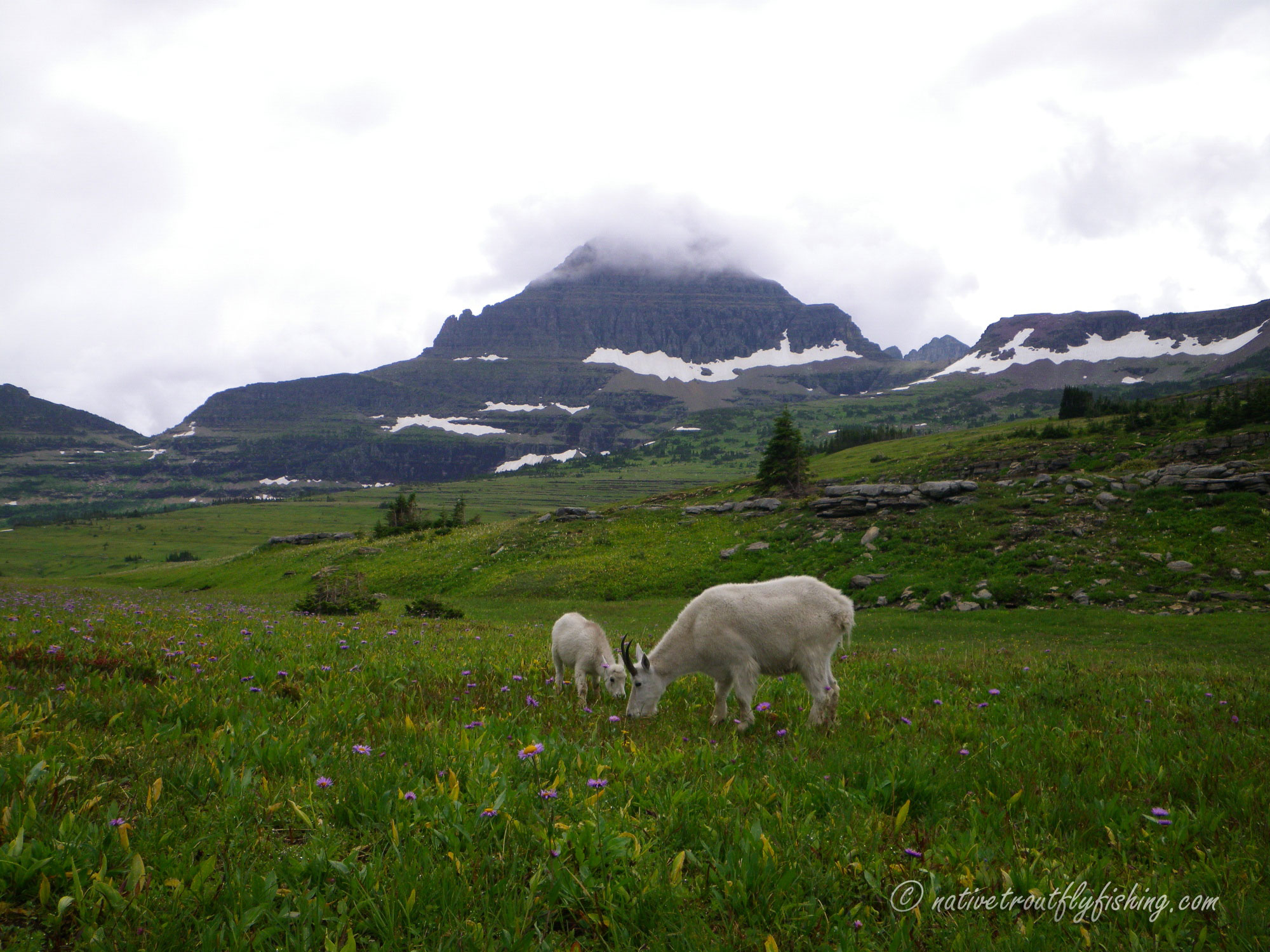
This past week I had sometime off and took a little bit of a mini-vacation so my cousin Derek to the Rockies. Officially this trip was more of a vacation/ camping trip than fishing trip, but really what fly fisherman can stand traveling to Montana and not wetting a line. On the third day of the trip we decided to make a little jaunt into Glacier National Park to do a bit of sight seeing, hiking and of course fishing. What we didn't plan on was that this would also be a day with free admission to the park, resulting in the masses descending upon this alpine wonderland. With plenty of company in tow, we made the winding drive up the Going to the Sun Road first and did the hike into Hidden Lake at the top of Logan Pass. Like usual there was plenty of company on the trail, but not all of them were people...

Some high country locals enjoying the meadows

As with the previous time I made the trip to Glacier, I didn't bring fly with me on the hike to Hidden Lake and ended up kicking myself all of the way back down the trail.

Hidden Lake... Maybe I will fish it next time.

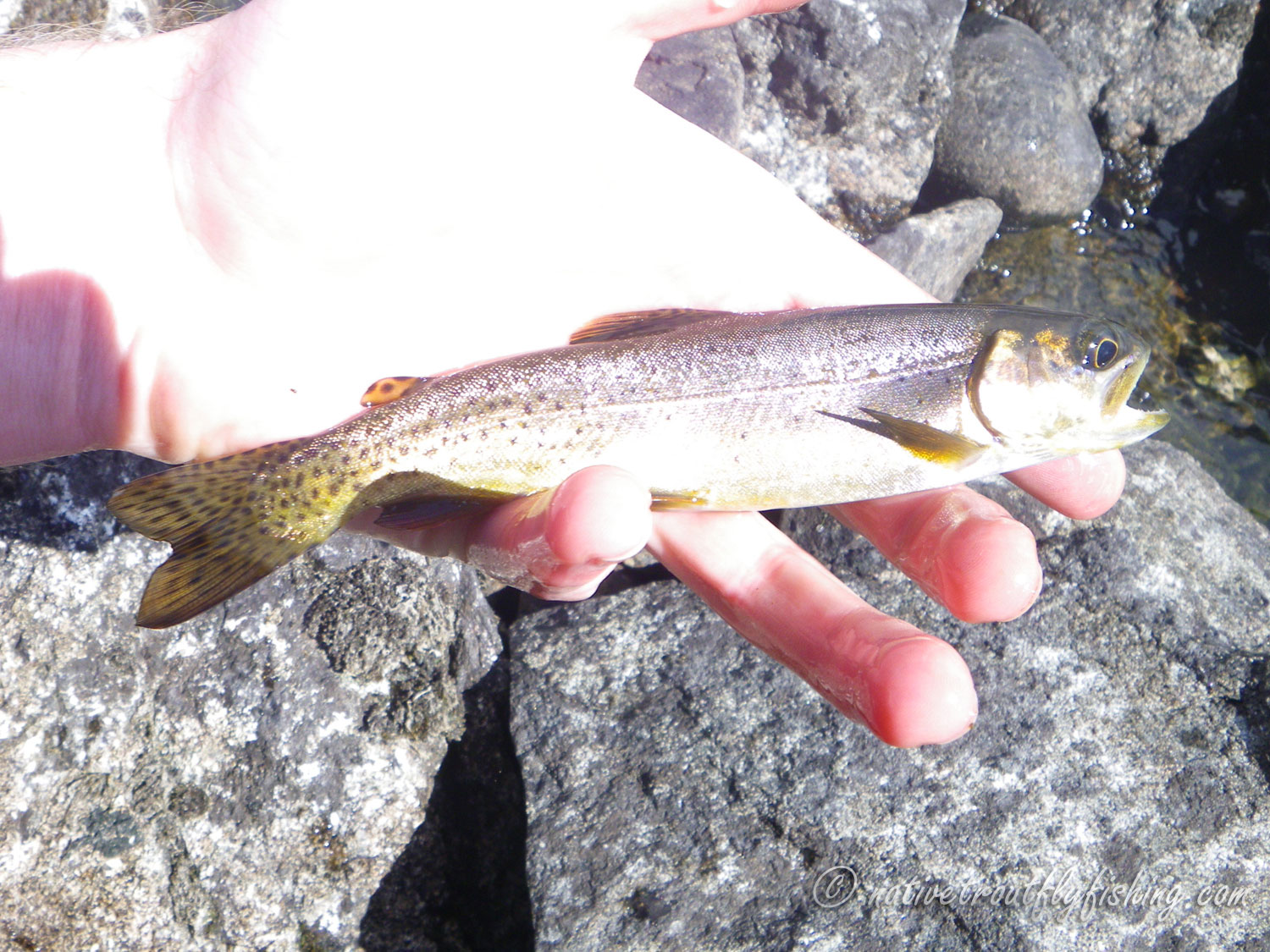
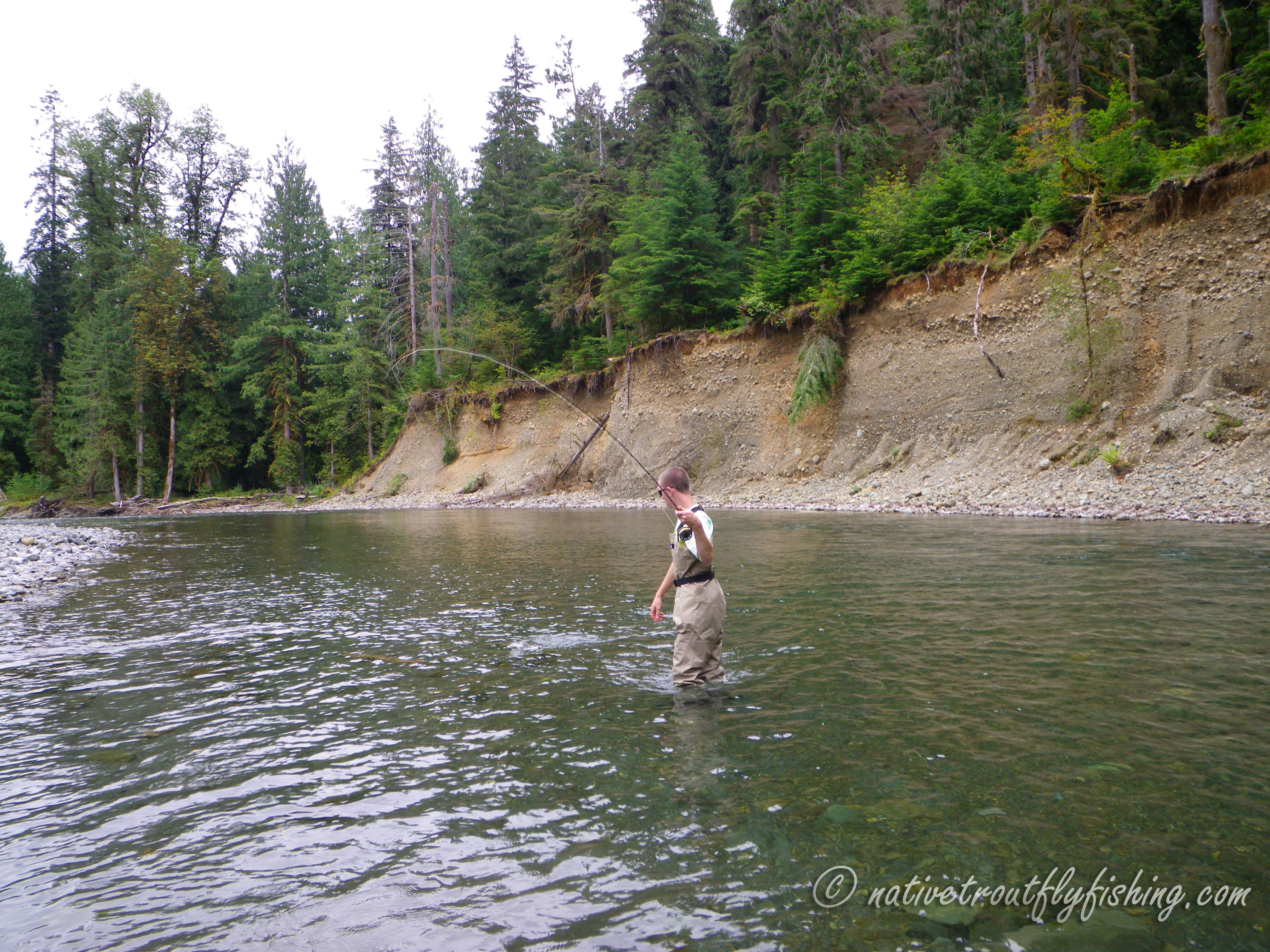
On the way back out of the park we found a nice stretch of a stream that holds native Westslope Cutthroat and figured that it was as good of a place as any to do a bit of fishing. We rigged up with some bushy attractor dry flies and once on the water we were almost instantly into fish. Most of these fish were on the smallish size, but all of them were beautiful and lots of fun on the little 1wt that I have become accustomed to fishing in such places.

A small but native Westslope Cutthroat

Of course this was one of those places were the fishing was less about catching fish and more just about being on the water in one of the most dramatic landscapes on the planet. Needless to say the it was hard to keep my eyes on my dry fly at all times as this was one of those places where you can't forget to look up from the water once and a while and just marvel at your surroundings. This meant more than a few missed fish...

Breath taking comes to mind...

Still there were plenty of fish around including a few nice, albeit photo-shy ones...

A beautiful but not so photogenic Cutthroat...

After a few hours on the water and with the light fading it was time to cruise on out of the park and continue traveling across "big sky" country.

One last look at the rugged Northern Rockies of Montana

Thursday, August 5, 2010

The drier side of things

One thing that can be said about living in Western Washington is that the weather can be a bit trying. We really don't get the extremes like other places, but the wet and dreary winter weather often refuses to give up its grip even when "summer" arrives. While it hasn't been all that rainy this summer, it has been cool and cloudy and there comes a point when some warmer weather starts to sound really good. With that being said, a campout on the drier side of the state was long over due for me.

The stream

The stream that I chose to camp on drains the Cascades a bit further east than most of the other nearby watersheds and as such tends to be a bit more productive. Another plus is that this drainage is that it is inhabited primarily with native species, including Redbands, Westslope Cutthroat, Bull Trout, as well as anadromous species such as Chinook and Coho Salmon and diversity like that is always welcomed. It didn't take long for the creek to prove that it is more productive than most of the other nearby streams either, as just about every spot that looked fishy would hold several trout. As with my previous visits to this creek my catch was made up completely of the native Redbands. Most of these fish weren't overly large, but they had a real thing for dry flies and were scrappy fighters on a 1wt. With one of these fish in particular I thought I would lose it as it charged straight at a boulder, however instead of trying to use it to shake loose it decided to just jump right over it.

A spunky little Redband

As evening came on I decided to try my luck a bit further downstream then where I have been before and finally found some of the Cutthroat. It seemed that while the Redbands preferred the faster water toward to upper parts of the runs, the Cutthroat were hanging out in the slower water from mid-run down to the tail outs. Still the ratio of Redbands to Cutthroat remained about 15 to 1, but with how fast the action was I still started seeing a good few Westslopes.

A beautiful Westslope Cutthroat

The diversity of the Westslope Cutthroat in Washington always does amaze me. The fish in this drainage were all fairly silvery with spotting typical of what you would expect in Montana or Idaho, where as in the higher altitude streams they tend to be more brilliantly colored and more heavily spot. Likely this variation is a product of their environment, life histories and isolation, with this drainage being larger and more open to migration and most of the higher streams being small and fragmented.
As the light began to fade, I headed back upstream fishing the best water on the way and picking up a few more trout with each stop. I also got a little surprise on my way up when a wild and native Chinook Salmon parr grabbed my fly. It was good to see this chunky little guy, as Chinook have suffered major declines throughout the Columbia Basin.

A healthy little Chinook Salmon

A great way to end the day

It was a great day on the water, with a healthy dose of summer weather thrown in and plenty of fish to be had. However, it is always nice to get back to camp in the evening to just relax, reflect on the day and enjoy nature.

Sunday, August 1, 2010

Winging it

I am always on the lookout for that perfect mountain stream. No matter how nice of a stream I find in know that there has to be another one out there waiting for me. A few days ago I made the run up to the Cascades with the full intention of checking out a stream that had been on my ever growing "to fish" list. However, as has been known to happen with me I over shot my destination by a few miles and ended up somewhere entirely different. My first thought was to just turn around go with the original plan, but it just happened that my first opportunity to turn around was at a creek crossing. Of course I had to take a look at this random creek before turning around and I really liked what I saw! With that I had a new plan and grabbed my 1wt and headed down to the water.

The creek

It seems that about 50-75% of the creeks in the Washington Cascades that look good and have such easy access end up being hardly worth the effort. This was not one of those. On my first cast the shadow of a trout rose from the depths of the small pool and slammed my dry. Being my first cast and with me doubting the fishiness of the creek, this rise caught me totally off guard and I missed the fish. However, on the next cast I was a bit more prepared and ended up bringing a beautiful little Rainbow to hand. This pool produced five or six more smallish trout, before I decided that it was time to go investigate some of the upstream pools.

That ended up being a much more difficult prospect than I originally thought, as the creek got hemmed in by a canyon pretty quickly. However, with a bit of cliff climbing I found a beautiful deep pool that screamed trout. My first few casts came up blank, before I noticed a nice sized trout working a foam line along the cliff a few feet in front of me. It took a couple of casts, but I finally caught its attention and the trout came up and gulped my dry. This trout had a lot of spirit and put up a good battle on the 1wt before finally coming to hand.

A beautifully colored Rainbow Trout

The coloration of this fish immediately struck me as compared to native Coastal Rainbow Trout that I am used to, this fish was much more vibrantly colored and looked much more like McCloud River Redband, making me wonder about the stocking history of the watershed. Additionally, ever now and again I would encounter a very clear Cuttbow hybrid. After the Redband like fish, I managed to get one more similarly size fish out of the same spot, this time on my dropper, but that was all that this hole would give up so I decided to move on. The terrain made in impossible to head upstream, so instead I went back down and found another very fishy pool.

The pool

Where I had to work for the fish in the pool upstream, this pool was packed with willing trout and provided me with a good half an hour of fun before the bite went off. The vast majority of these fish were Rainbows, although a handful of the appeared to be Coastal Cutthroat or hybrids.

A Cuttbow with an appetite for a Royal PMX

After covering this pool I decided to go with a change of pace and headed to a nearby larger piece of water. This river is one of the few Washington Cascade streams that still has a full fledged old growth forest along its banks and is truly wild still. No dams, no development, no clear cuts, everything is just as it is supposed to be. However, even with this being the case this river in not known for particularly strong trout populations and is touted as a tough fishery. In the hour and a half that I fish this stream, it proved that point as one silver bullet of a Coastal Rainbow was all that I could manage to find.

One wild Washington river

A typical silvery native Coastal Rainbow Trout

On the way home from the trip I decided to make a quick visit to one of Washington's more notable landmarks for a quick stroll in the high country before finishing my drive.

Mighty Mt. Rainier