About this blog

This blog is all about fly fishing for native trout. On it I cover trip reports, fishing tactics, conservation, the latest news about native trout species and much more. This site provides a companion to my web page Nativetroutflyfishing.com.

Gary

Thursday, June 30, 2022

Oregon Coastal Cutthroat

At the beginning of April I decide to make a major career shift and after 11 years with the Washington Department of Fish and Wildlife, I accepted a position as the Science Advisor for the Trout Unlimited's Wild Steelhead Imitative. June, I found myself in Reedsport Oregon for a weeklong work retreat. While we put in long hours during the day, the evenings were reserved for team building time (i.e. fishing time!!). 

Since the retreat was taking place during the off-season for steelhead (too late for winters and too early for summers), we had opted to do our part for the Umpqua River steelhead and instead targeted Striped Bass for a few days. The Striped Bass population on the Umpqua River have experienced a recent boom and are currently considered on of the leading threats to wild steelhead in the basin, especially the summer-run population which was at critically low abundance in 2021.  As such suppressing the non-native striper population is through angling is one of the strategies that ODFW is suggesting to aid the struggling native summer steelhead population.
The Umpqua River estuary

We fished stripers on a variety of top water poppers, flies and swimbaits. The fishing never quite it the "red hot" level, most likely due to the cooler to normal spring. However, we did get into some decent fish and hopefully saved a few steelhead smolts in the process. For more details the our post about Stripers and our retreat on the Wild Steelheaders United blog.

A solid Striped Bass caught on top water

The last day of the retreat, the weather was predicted to be much rougher and my coworkers and I decided to change things up a bit and try some small stream fishing for Coastal Cutthroat. Based on research I had down there was a stream a short distance away holding a robust population of both resident and sea-run fish and as such we decided to head there.

A beautiful day for smalls stream fishing

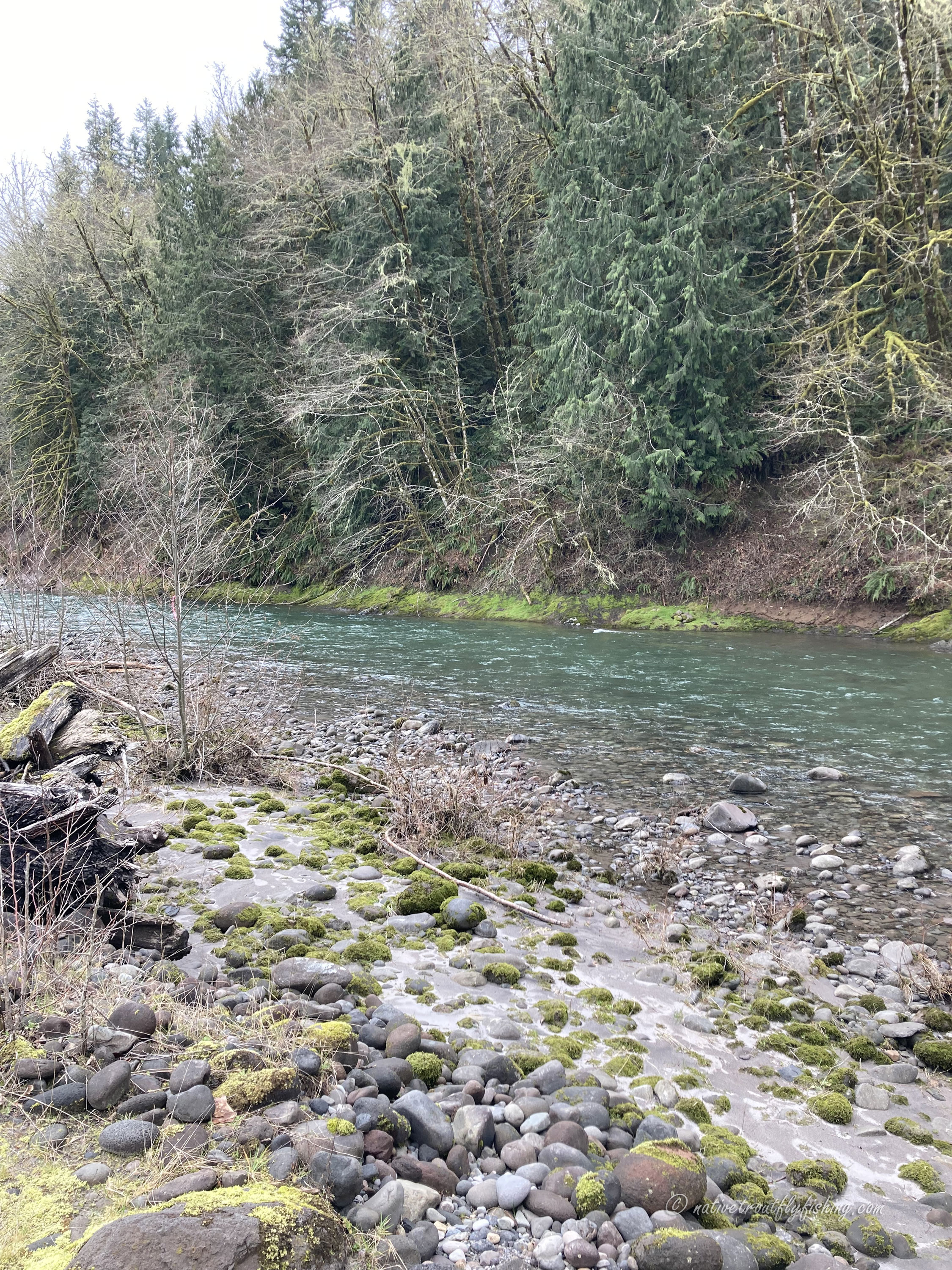
The stream flow through a beautiful canyon with mature stands of Douglas Fir, Western Hemlock and Red Cedar, with the wild Rhododendron in full bloom. Given the small size of the stream, I decided to go with my trusty 2wt and rigged up with a #12 Royal PMX and a #16 Blowtorch nymph dropper (new fly for me). While my coworkers headed upstream, I started off at a deep hole below some cascades not far downstream of where we parked. It was immediately apparent as soon I a got in the water that this stream was healthy and full of life, with crayfish, newts and small fish inhabiting the shallows. Additionally, the Cutthroat population appeared to be quite healthy as well and my second cast produced a bright 10" sea-run fish with its cutthroat slash just starting to reappear on the nymph. 

A bright sea-run Coastal Cutthroat

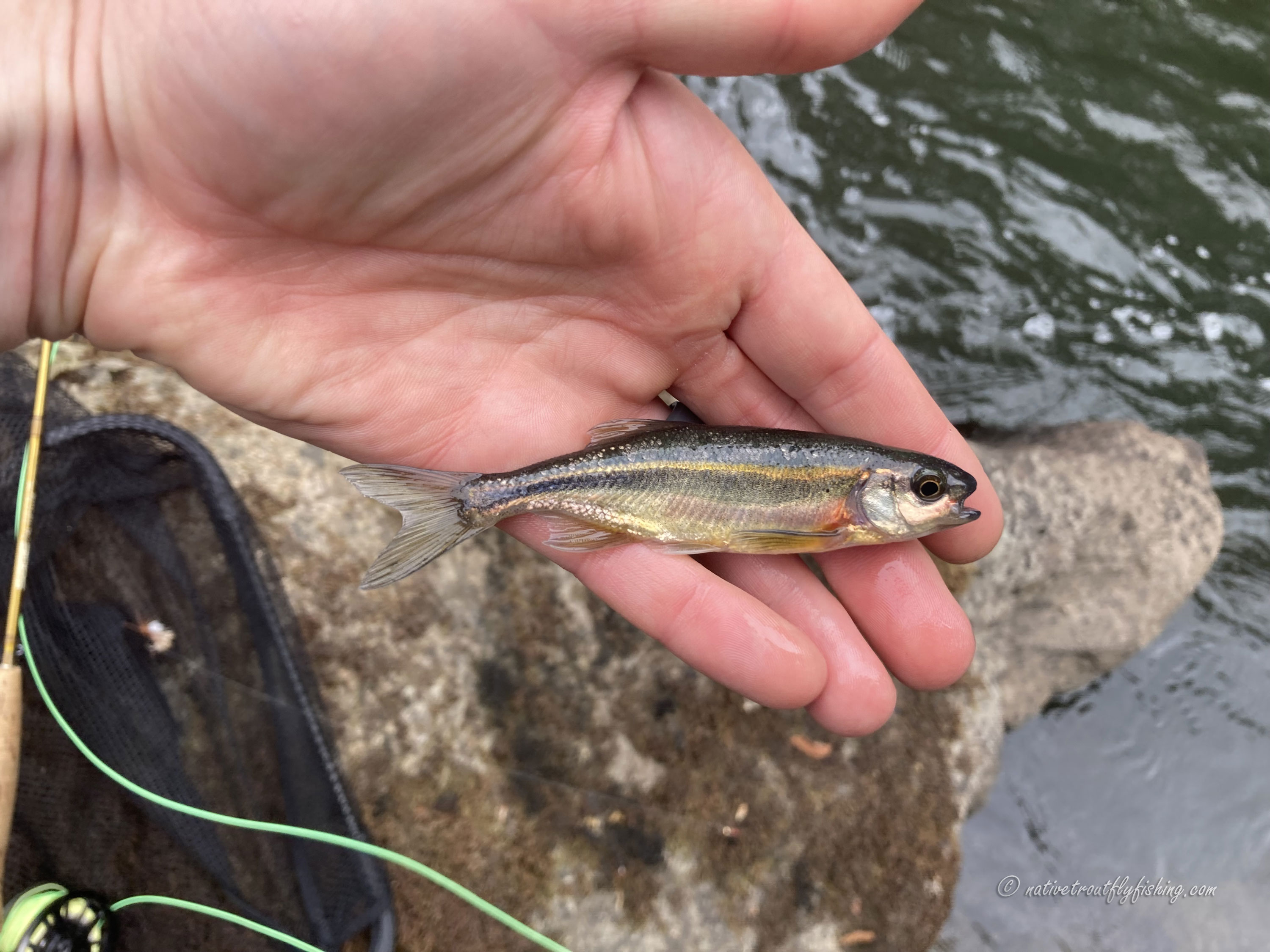
I managed to get one or two smaller Cutthroat and caught a small dace (possibly an Umpqua Dace?) before I decided some exploring further downstream. 

A small dace

With this I headed down the road to look for some more good water. While I saw plenty of good water, the problem was getting to it, as the riparian zone was a dense ticket Red Alder, Big Leaf Maple and Salmonberry bushes and occasional briars of invasive blackberries. However, I finally found a deer trail and was able to get back on the water. The first piece of water that I started on was a nice run with a log across riffle at the top end. While the run didn't produce any results, the fast water and pocket just upstream of the log looked like good holding water. Sure enough on my second cast, a big Cutthroat (~15") rose to my dry fly and doubled my 2wt over. Unfortunately with the current speed I didn't get a good hook set and after a little thrashing on the surface my fly popped loose. Several more casts with the dry/ dropper rig didn't entice the fish to return, so I switched to a small streamer. This did get a few vicious strikes from under the log, but nothing hooked up, so I switched back to my dry/ dropper and continued on my way upstream.

Quality Cutthroat holding water

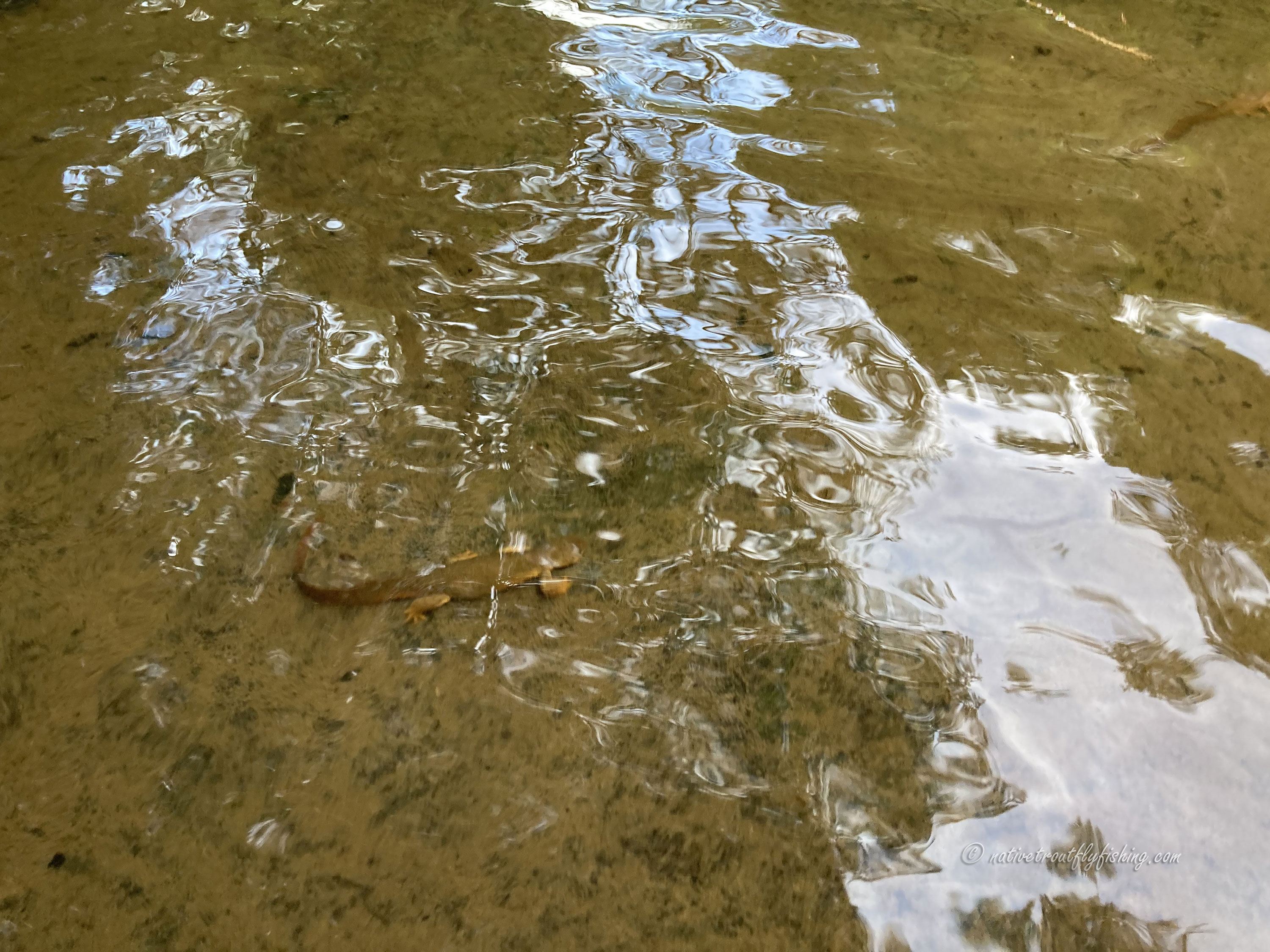
A newt in the stream margins

The next run upstream had a perfect fishy looking riffle that swept along a large boulder. The first few casts didn't get the attention of any trout, but by fully covering the water I got a nice rise and hooked into a solid fish. This fish gave my 2wt a good workout, but this time I had a solid hookset and was able to bring the beautiful 12" native cutthroat hand after a short fight.

My big native Coastal Cutthroat

Upstream of this spot, the stream picked up gradient quickly and the abundance of trout also increased. While, most of the fish were cookie cutter 6-8" juveniles, I was able to dredge up another bright 10" sea-run on my dropper in a deeper pocket right below the hole where I got my first fish of the day. As I had covered all of the water up to the hole that I started out on, I found a path back up to the road and was able to meet up with my coworkers.

Another sea-run Coastal Cutthroat

After each having success working our initial patch of water we decided to head up the road a bit and try another location. However, after spending another 45 minutes here the habitat seemed subpar and we each had only found a couple of small Cutthroat or juvenile Coho. At this point the weather was degrading on us we decided to head back into town.

A juvenile native Coho Salmon

My coworker Alexei working a good run


A beautiful day on the water

This trip was a great kick to summer, with a productive week of work, time to get to know my new coworkers and some great fishing while we were at it. The summer trout season is now in full swing and next week I am off to the Lahontan and Bonneville Basins to hunt for Cutthroat, with a report to follow soon after!

Saturday, June 4, 2022

A winter steelhead season in review: Part 2

With the poor returns of steelhead along the Washington coast, the season ended up being shorter than expected with an emergency closures kicking in on many streams at the beginning of March. While it was disappointing to see many of my favorite watersheds close early, it provided extra protection to the fish and also gave me the incentive I needed to check out some new waters that were open still.

My first trip out after the closure was short outing where I really didn't expect to hook anything but wanted to get my daughter Valerie out on the river for a brief introduction to winter steelheading. As there had recently been some good rain, I knew that the river was going to be high but dropping.

A promising little stream. 

As the goal of this trip was to get Valerie out on the river, we spent just as much time looking for exploring as we did casting. As usual, a handful of casts was not enough to attract any steelhead, but it was just enough for a fun morning on the river.
A fun day on the river

After my short trip to the river with my daughter, I set out to find some time to get out and explore the river some more as soon as possible. As it worked I out, I was able to pull away again the next week with my buddy Jonathan for a full day of solid fishing. Conditions we set for a repeat of the last trip, with a recent rain resulting in the river being quite high and dropping, with good clarity and weather.

We decided to start our day off high up in the watershed and then work our way downstream hitting any likely spots as we went. With the river being high still, find slower holding water proved chanllenging and the first half of the day was completely unproductive. However, around lunch time we came to a spot above the river where we could see a pod of at least half a dozen fish. Jonathan and I took turns fishing to them, but not matter our offering the fish showed no sign of interest. As we were never able to get an overly clear view of the fish, it is entirely possible that they were whitefish, which could explain the lack of interest.
A beautiful day to be on the water

With a slow day so far, Jonathan and I decided to try one or two more spot before relocating to another stream. One of these spots proved to be the most promising of the day and featured a deep pool at the top end and a solid run at the bottom. While the top end looked great for indicator fishing, the run looked like a great spot to swing a fly and was a great excuse to dust of my switch rod. Unfortunately, with the extra flow my switch rod just didn't have the backbone to quite get to the most likely pocket in the tailout. However, Jonathan was able to good land a cast in it and sure enough hooked into a nice fish. While it seemed as though he had gotten a good hook set, it must not have been good enough as after a few headshakes and a roll on the surface the fish was able to shake loose.
Prospecting for steelhead

After trying one last spot with no sign of steelhead, we decided to relocate to another nearby stream we both wanted to check out. At this point we only had a few hours of daylight left so we figured that this was going to be more of a scouting operation than anything. What immediately caught our attention with this stream, was the beauty. While high like the other river, it was a perfect steelhead green color and bordered by lush forests with a few old growth trees still remaining. Better yet there appeared to be a good amount of quality holding water as well even at the high flows. 

We tried several nice runs before the sun started to fade, indicating that the next run would be our last. I started out at the top of the run, while Jonathan took the bottom. It turned our the bottom of the run was the place to be. While I was working a nice seam at the head of the run, I noticed Jonathan appeared to be snagged on something until the "snag" started to move and I realized he had a fish on. I hurriedly reeled in and made my way down to Jonathan and after a few minutes of a rather mellow battle he brought the fish in and I was able to tail a beautiful bright hen for him.
Jonathan's bright native steelhead

After Jonathan got his fish, daylight was really not on our side and we decided it would be time to hit the road in about ten minutes if we wanted to avoid walking out in the dark. For the last ten minutes, I took the lower part of the run and had one very fishy take down, but after flogging the water for a few more minutes the weren't any other signs of fish and it was time to get on the road.
A beautiful end to a get day on the water

While the 2022 winter steelhead season was certainly a rough one with fish abundance and closures, I have a hard time complaining to much with my angling experience as it also got me out on some new water, that I may not have checked out otherwise and am excited to explore further next season.

Sunday, May 15, 2022

A winter steelhead season in review: Part 1

I have been a bit behind on getting this post out, this is primarily due to life being more chaotic than usual over the last few months. The main driver has been a major career shift as I moved on from my role at the Washington Department of Fish and Wildlife and started a new position as the Steelhead Science Advisor with Trout Unlimited. While winter has long since past, I still wanted to get this two part series of posts out before the summer trout fishing season really sets in.

 The 2021/2022 winter steelhead season in Washington was an odd one. The season started out among the rainiest in reach memory but was followed by an unusually dry spell in the middle of the season. However, this was not the most abnormal part, as the season also saw some of the lowest returns of steelhead on record in the Pacific Northwest. While issues in freshwater certainly played a role in the low returns, such a broad scale decline point to over arching issues, with poor ocean conditions being the primary driver. The lower returns along the Washington coast led to complete closures in some watersheds and early closures in most others. Between the low returns and a shoulder injury from my fall outing for Chum, I was on the water significantly less than previous years. However, with the poor returns I also figured that this year wouldn't be a horrible one to scout out a few streams that I had been planning check out for sometime now.

My first  scouting trip was a near complete failure. The first stream that I checked out was a mix of highly degraded habitat and private property, which made it easy to cross it off my list of waters to revisit. The next stream I had been meaning to scout was not far away but upon arriving at the logging road gate, there were three cars already there. As this stream was not large by any means I did not think that it could handle any additional pressure so I decided to call it a day, but made a note to return and take a look on my next trip to the area.

A couple weeks after my failed scouting operation both my buddy Chris and I were able to line up a mid-week day to get out on one of my favorite rivers. As the trip approached, the both the weather and the flows looked great so we were in business.  We arrived at the river before the sun was up with air temps in the low 20's promising cold fingers and iced guides. Chris had driven and had the honor of the first cast. While steelhead are typically known as the fish of a thousand casts, today it ended up being the fish of a single cast, as half way through his drift he got a solid take and hooked up. Chris's fish fought well and even attracted the attention of another steelhead that rolled while he was fighting it. However, after a few minutes he was able to bring it into the shallows and I successfully tailed it.
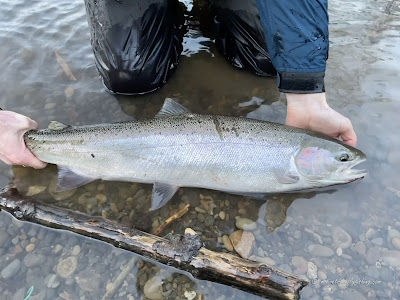
Chris' one cast wonder- a beautiful wild hen. Frozen fingers for me...

After warming my now numb fingers for a moment, the next cast was mine and sure enough the fish we saw roll was still there and was just as grabby as Chris' hen and I got a solid hookup on my first cast as well. This fish proved to be quite powerful and after battling it for a couple of minutes in the where I hooked it, it decided to head straight for a log right at the top of the run. Unfortunately, I could get the fish to turn before reached the log and it managed to break me off. It was hard to be two upset though, as with an unprecedented two fish hooked on two casts the day was off to a good start.

A crisp morning on the river

We decided to try moving down river first, but the next couple hours on the river didn't produce anything other than frozen guides and numb fingers. This lack of activity encouraged us to try another part of the river. While hiking upstream to the next piece of water, we briefly stopped at a bluff overlooking the river and could see a steelhead holding near a log jam that was every bit of 20lbs. It looked like there was a good crossing just upstream, so I decided that I would stay up on the bank and sight while Chris tried casting to it. On the first cast, the fish moved and looked at Chris' offering, but after that showed no interest in anything he tossed at it. While it certainly would have be amazing to see Chris get this fish, it was an absolute pleasure to simply spend some time watching and how it reacted to Chris' presentations. However, I couldn't spend all day watching it and with its disinterest in what Chris had to offer, it was time for us to move on again. 
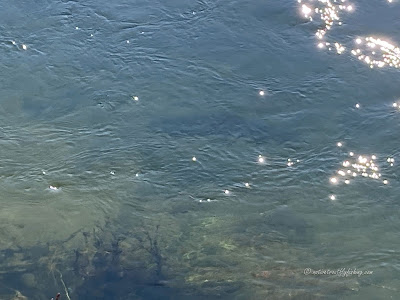
The shadow in the deep

Not far upstream, we came upon some of the best looking water of the day with a series of deep runs along a rock face. At the first of these we spooked a river otter that had been actively fishing so we decided to save fishing there for our downstream journey. The next run didn't produce anything, but in the uppermost run I got a good drift along a rock ledge resulting in a solid hook up. While this fish was much smaller and did not have the power of the one that had broken me off, it was quite acrobatic and put up a solid fight before coming to hand.
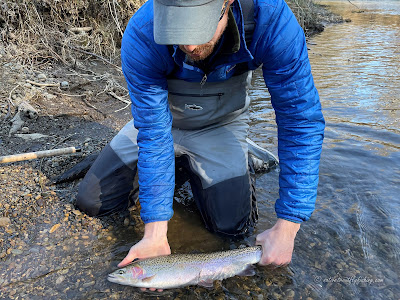
My first steelhead of 2022 - a small wild buck

While I was fighting this fish, we spotted another angler working his way downstream and didn't want to cut him off, so we started also started working our way back downstream. By this time the run that the otter had been fishing had been given a nice long rest, so we were hopeful there might be some fish around. Sure enough after just a few casts Chris hooked into one. This fish lacked to spunk of the previous steelhead and after a short battle we were able to land what turned out to be an early kelt.
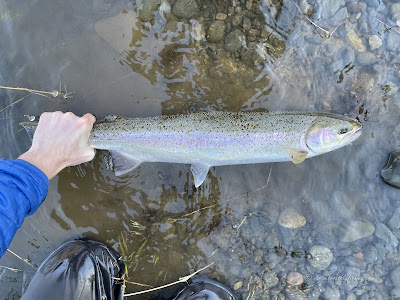
An early season wild kelt

The rest of the journey downstream was uneventful and the big fish from earlier had moved on, so we decided to drive up to one more spot further upstream. This location had two likely steelhead lies, with Chris taking the upper one and me taking the lower one. I had barely gotten in position to cast, when I heard Chris shouting that he had a fish on. The bucket that Chris had hooked the fish in was rather small and the fish didn't want to move into shallow water so it took a stay deep, brute strength approach. However, with limited room to run it wasn't long before Chris got the fish to budge and I was able to tail it. The fish was a beautiful buck, that unfortunately looked as though it had been poorly handled by a previous angler, as it had noticeable wear on its back and side (likely pulled up on shore). This wear is likely to make this fish more susceptible to fungus and other pathogens during the arduous spawning period and is a reminder handle these fish with as much care as possible. By the time we had landed the fish, another angler had moved in below us and after a few more casts to make sure there were anymore fish holding in front of us, we decided that it was time to start working our way towards home. 

Chris' wild buck steelhead

After wrapping up, Chris and I had a little time left on the day so we decided to scout out the over crowded stream from my previous trip. This time there were no cars and the blue bird day made for a nice walk into the stream. We only spent a couple hours at this stream and didn't hook any fish but the water was absolutely gorgeous and I certainly plan to return next season to explore some more.
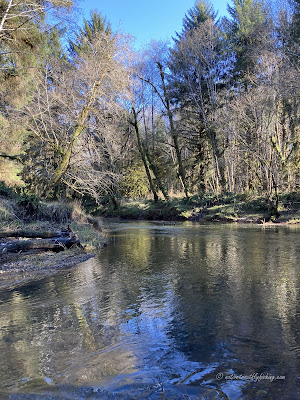
The beautiful new stream that I plan on spending some more time on next season

Monday, January 31, 2022

Western Native Trout Challenge


The Western Native Trout Initiative (WNTI) was founded in 2006 to support the conservation of native trout across the Western United States. In 2019, the WNTI launched Western Native Trout Challenge with several different tiers (Master, Advance and Expert) that award anglers for catching up to 18 varieties of native trout across 12 western states. 92% of proceeds from the program go to supporting habitat /conservation projects with direct benefits for native trout across the west, providing anglers with a fun way to make a difference for these fish.

I had not initially planned on attempting the challenge as I had already caught most of the fish recognize by the challenge prior to 2019. However, after a year of native trout hunting it turned out that I had enough trout to submit for the Expert level, in which an angler needs to catch 6 varieties of native trout across 4 states. Since I had qualified for the program  I decided I might as well go for it. 

See my qualifying fish below:

Eagle Lake Rainbow Trout - California

"Interior Redband Trout" - Oregon

Coastal Cutthroat Trout - Washington

Bull Trout - Idaho

Westslope Cutthroat Trout - Idaho

Rio Grande Cutthroat Trout - New Mexico

Upon submitting photographs of their qualifying fish, anglers receive different rewards depending on the level of the program completed. I completed the "Expert Caster" level, which comes with a certificate and a hat, with the first 100 completers getting a unique "First 100" hat. 

My Expert Caster Certificate and "First 100" hat.

All in all, the Western Native Trout Challenge is a great program, that supports crucial conservation projects across the west. If you are interested in taking part in the challenge, you can sign up here.

Tuesday, November 30, 2021

Rainy season Chum Salmon

After my outing with Steve in August, I learned that he still had yet to catch two species of Pacific salmon: Chum and Coho. When I mentioned to him that both of these species can usually be found in good numbers during the fall in Washington, he started planning another trip and as it turned out both of our schedules lined up at the end of October. However, as we got closer to the trip, one complication arose - the weather.

While most years early fall is actually a pretty nice time of the year in western Washington, this year is a La Niña year. Meaning wetter than normal weather and has it ever been wet, with more than double the normal rain during October. This meant that when Steve arrived, pretty much every river was nearing flood stage and as such our only option was to try our luck in the saltwater.

This however, was also going to be a long shot as we were just coming off a major rain and most salmon will pass right through the estuaries and into the rivers following a good rain and it usually takes several days for them to stack up again. Despite this, we were good to put in our best shot at finding some fish. Our first spot that we checked out was the mouth of a small stream that has a modest Chum run, but will often draw in large numbers Chum Salmon sniffing for their natal waters as they head deeper into Puget Sound. I have had excellent success at this spot in the past during the same time of year, but have also found in vacant of Chum on other occasions.  Unfortunately this time it was the latter situation, as there were some post spawn Chum in the creek, but we only saw a couple roll in the estuary during the two hours that we tried our luck.

First spot of the day - no fish...

For me this spot was a bit of a litmus test for the day and as there were almost no salmon there, I knew that we were going to have a hard time finding any fish. Luckily for Steve, there was on sure-fire spot in front of a local hatchery that we could try, but would would have to put up with some crowds to do so. Being that it was a weekday, luckily the crowds were not as bad as they could be and given the number of Chum trying to get back, the hatchery trap was closed, meaning that there was quite the captive audience of Chum waiting for us. By crossing the creek mouth, we were able to get away from the crowds a bit, but with the tide rising so we would only have an hour or two before we had to relocate. I started out with chartreuse comet, while Steve was using a spinning rod with an orange vibrax spinner. With the Chum held up in front of us, it didn't take long for us to tie into some fish and I started things off by bringing a decent hen to hand after just a few of casts. Steve had several fish on that popped off, but finally got a solid connection and after a few minutes brought a bright female chum to shore as well, checking another species off his list.

Steve's first Chum Salmon

After Steve's fish, we noted that the tide was coming up faster than we anticipated and we knew that we were running short on time. However we figured we had a few cast left, and before long I managed to hook into another, slightly larger Chum. After several good runs and a bit of tug of war I was able to bring this one to hand as well. I turned out to be a decent buck this time, but with that fish it was time for us to get across the creek and head to another beach.

My buck Chum

As we had checked the Chum off we decided that we would grab lunch, then head for a beach that had a reasonable chance of having some Coho around. We gave this beach a couple of hours, during which we had a handful of Chum swim by, but had no grabs and saw no Coho jumpers and as things didn't show any sign of improving we decided to move on.

Beach #3 - no fish...

Since it didn't seem likely that we would find any adult Coho in the saltwater still, I figured our best bet might be to look for some smaller resident Coho and possibly some sea-run Cutthroat. However, at this point the tide was really up, which made things challenging. We ended up trying two more spots but still saw now sign of fish and as our daylight was starting to fail we opted to call it a day, having at least gone 1 for 2. Hopefully we can get a Coho for Steve next time. 

Unfortunately, a side affect of this trip and doing too many of double haul casts, was that I woke up the next day with a serious kink in my shoulder that refused to go away. After after putting up with it for a couple weeks a I learned that I either sprained or tore a muscle in my rotator cuff on my left side so there won't be any fishing for me any time soon (at least it is the off season...).

While I may not be able to go fishing, I have still at least been able to get out fish watching a couple of times at a local creek. The Chum runs to this creek are among the best in years and it has been a fun place to enjoy watching these fish and just to be in the great outdoors with my family.

The local Chum creek
Chum Salmon on a spawning flat

A Chum Salmon spawning pair

Thursday, October 28, 2021

Fall Salmon Spawn

With the start of fall, the leaves are changing colors and the first major rains of the season have hit western Washington. With that rain, the salmon have started to ascend the rivers in earnest and for those that know where to look, there are a number under the radar trout fisheries that really come alive once the salmon start spawning that under the right conditions can rival fisheries in Alaska. 

I recently, Chris and I had a day free to visit one of these fisheries and it seemed that our timing was spot on. When we arrived at the river, the first thing we saw was a pair of Chum Salmon sitting on a redd, telling us that the trout should be looking for eggs. Despite several pairs of Chum Salmon spawning above the first run that we tried, we failed to find any fish. However, just upstream of this the river braided into three channels and two of these were stacked with spawning salmon. Chris took one side and I took the other side. At the top of the side channel that I choose there was a fast riffle that dropped into a nice pocket. A classic spawning season holding water, providing a steady supply of eggs from spawning fish upstream, but being too fast for salmon to want to hold in the same water. I positioned myself just upstream of this slot and on the first drift, my egg imitation had barely gone over the lip of the pool when my indicator shot under the surface. Upon setting the hook, I could tell that this trout was no push over and unfortunately for me this was not going to be an easy spot to land a fish as both sides of the pocket we brushy meaning I would have to get the fish to come upstream. This led to a series of tug of wars with a fish that I got a good look at several times and could tell was well over 20". Despite a decent hook set, I just could not get this fish up over the lip of the pool and after a few minutes the trout finally won the battle and threw the hook.

Spawning Chum Salmon

Chris's side channel had only produced one small fish and as my fish had certainly spooked anything holding in the pool we decided to continue upstream, especially as we both knew there was some great water ahead of us. Not to far upstream Chris spotted a nice Rainbow that was holding in shallow water not far from some spawners. While took a few casts, Chris was able to get a good drift and as able to bring a nice 18" Rainbow to hand.

A spawned out Chum Salmon
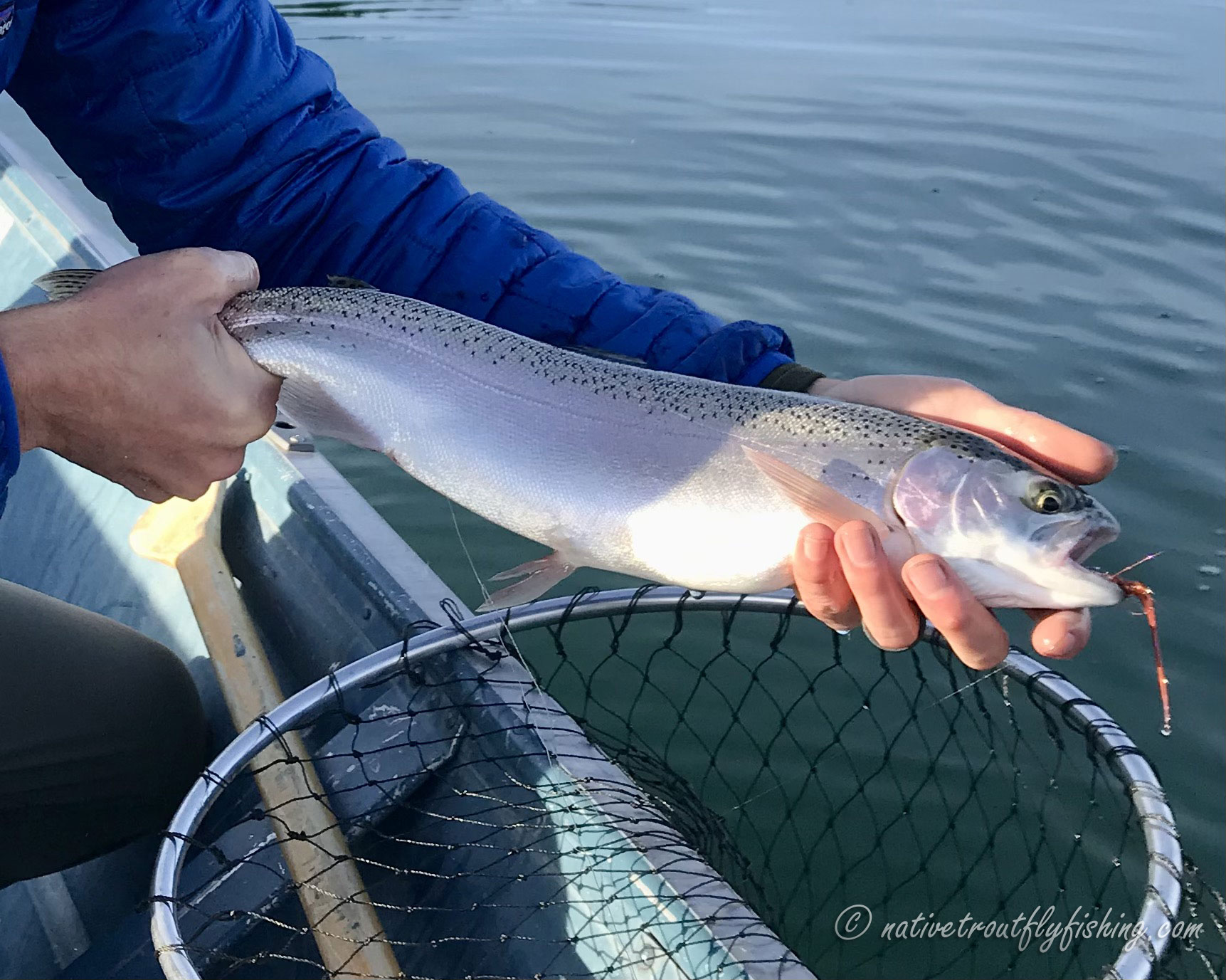
A nice native Coastal Rainbow Trout

The next spot upstream was a slow moving trench that screamed sea-run Cutthroat water, but instead Chris got another similarly sized Rainbow, while I got a nice Pink Salmon on a streamer.

A Pink Salmon on a black sclupin pattern

The next two runs upstream were some of the best water we saw all day, but oddly seemed to be devoid of large fish and only held a few smolt sized fish. This may have been due to the spawners here being predominately Pink Salmon, which trout seem to avoid and also appear to select against eating Pink eggs compared to other species. We did find one little riffle with a pair of Chinook spawning at the top and this was where we ran into some Coastal Cutthroat, with Chris picking up a couple of nice fish.

A particularly spotty Cutthroat

After this, we decided that it was time to head back downstream as the best luck we had so far had been right near where we started. In area where Chris had gotten his first Rainbow, both Chris and I managed to pick up a nice Coastal Cutthroat. Additionally, as the side channel I had started at had gotten a nice rest, I got another shot at it and this time was able to pick up a decent albeit much smaller Rainbow, which this time I successfully got over the lip of the pool and landed. 

An egg eating Coastal Cutthroat

A bright native Cutthroat

Downstream of here, Chris and I picked up a handful of decent fish before coming to the best looking water of the day where a tributary entered the river forming a deep trench. It was here that I again hooked into another big Rainbow. This fish took several long runs almost making it into the backing before was able to turn it and bring it to shore where Chris netted it. While not quite as big as the one that I had hooked earlier in the day this 20" Rainbow definitely made the trip for me and was a great way to finish off the day.

My big egg eating Rainbow
A fat native Coastal Rainbow Trout, a great way to end the day

Tuesday, September 28, 2021

End of August Adventure

A couple of years ago, while reading up on the Redband Trout of the Northern Great Basin, I found a genetics study that indicated that beyond the Great Basin Redbands, there was also an ancestral form of Redband Trout found in a tributary of the Deschutes River, that is unique enough to warrant being considered a distinct subspecies. These fish are the White River Redband Trout and have been isolated upstream of a barrier falls for thousands of years. Due to this isolation, they have more in common with Fort Rock Redbands than what the do with the Redbands in the Deschutes River. While I was able to make a trip to the White River a couple years ago, I was limited on time and only managed to catch a couple of Redbands on that first trip. Due to this I have had plans to make it back to the White River watershed ever since. After discussing the White River Redband with one of my friends and fellow native trout enthusiast Steve, it looked like our schedules would line up at the end of August, so we made plans for a trip. In addition to White River Redbands, Steve had yet to catch an anadromous Coastal Cutthroat so we also hoped to check that off his list as well.

Friday August 27th 2021: Steve flew in the previous night and I was up bright and early and picked Steve up at his hotel at 5:30AM bound for a small stream in the White River watershed. It was a gray and drizzly drive through the western Cascade Mountains, but as soon as we crossed the crest of the mountains, the sun came out, the clouds broke and we were greeted with a breath taking view of Mount Hood.
Clear skies over Mt. Hood - bare of snow after a dry summer

The quickest route to the stream was off a forest service road off the slopes of Mt. Hood, however after following the road for several miles we were greeted with a barricade blocking our way due to a wildfire. This came as a pretty big surprise to me as I had checked the forest service's webpage for current conditions and there had been no mention road closures in the area. With our first route in blocked, we set out to find a way around, unfortunately the next two forest service roads were also closed and we ended up having to drive an extra hour around to get to the stream. Luckily the fire had no impact the creek we were going to all and upon arriving the creek looked perfect. 
The Creek

I rigged up with my 1wt and a dry - dropper combo, while Steve went with a dry fly on a tenkara rod. While I had struggled to find fish on my last trip to the watershed, this time my research hit the mark and within a few casts we had both risen fish. I started out downstream, while Steve went upstream and after working downstream a ways had caught a half dozen 6-8" Redbands, primarily on the dropper. While the fish that I had gotten on my previous trip were rather pale, these fish had darker tones, with a much more pronounced redband. Given quick fishing, I checked in with Steve, who had also managed to get some decent Redbands. 
A small White River Redband

Steve was still working a good stretch of water, so I hiked a bit further upstream until I found a promising stretch of the stream. As I was a bit further from the road here, the size of the fish seemed to have gone up a few inches and the fish also started rising to dry flies a bit more consistently. After fishing for while, I found a larger pool that had good cover, from an over hanging tree. I managed to get a bow and arrow cast up and under the branches and was rewarded with a nice rise and a solid hookup. This fish was a bit bigger than the others I had hooked and really made my 1wt work, but after a short while a landed a close to 12" Redband. A monster for this stream.

My big fish of the day a beautifully colored Redband.

After getting this big fish, I worked my way upstream until I connected with the trail and headed back down to where Steve was. Steve had also managed to get some nice Redbands, and as we had a 3.5 hour drive back wanted to try for some sea-run Cutthroat we hit the road again. 

After getting back to the Olympia area, we headed for a local beach where we hopped to catch the end of the tide. Unfortunately, the wind was up and after and after an hour of fishing the good tide was running out and we still hadn't seen any sign of fish so we decided to call it a day and regroup in the morning.

Saturday August 28th 2021: After a success for day fishing for Redbands, we hoped that today we would be able to find a few Coastal Cutthroat and Coastal Rainbow Trout on one of my favorite rivers. The plan was to fish a combination of egg imitations and streamers and hopefully find a few fish that were starting to think about spawning salmon. Like the previous day we got an early start and upon reaching the river, it seemed that there may be a complication. Odd years in Washington are Pink Salmon run years. Most of the time this doesn't have too much of an impact on trout fishing, but apparently this river was experiencing a particularly strong Pink Salmon run this year. 
Lots of pinks (every dark shape is a salmon)

Typically during conditions like this, I find the trout concentrated in the faster riffles, but this time with how thick the pinks were, even nymphing primarily produced Pinks, although I did get one smaller Rainbow to grab an egg imitation. This did end up working in Steve's favor however, as he had not caught a Pink prior to this and given the conditions one could not help but catch a Pink checking yet another species off his list. The only sea-run Cutthroat that we saw was holding in a tailout behind several thousand Pinks, which we too aggressive to allow us to successfully get a cast to it. Given that Steve still hadn't caught his Cutthroat, we headed to my back up stream for the day, a small creek on our way home. 
A Pink Salmon caught nymphing

A small but native Coastal Rainbow Trout

The stretch of stream were going to try was only a few hundred yards upstream of the saltwater and sea-run Coastal Cutthroat will commonly dip into these lower reaches during high tide so I figured it was as good of a bet as anything. As Steve was the one looking for the fish, I let him do the fishing and sure enough at our first hole we spotted some Cutthroat and on his first cast he landed a bright fish fresh out of the saltwater. We fished for another 30 minutes or so and Steve got one larger fish and had a couple other grabs before it was time to call it a day. We managed to check three fish off of Steve's list while seeing some beautiful water, not a bad way to spend a couple of days!