About this blog

This blog is all about fly fishing for native trout. On it I cover trip reports, fishing tactics, conservation, the latest news about native trout species and much more. This site provides a companion to my web page Nativetroutflyfishing.com.

Gary

Monday, September 25, 2023

Colorado Adventure Part 4: Colorado River Cutthroat Contingencies

My original plans for this day had been to fish a high elevation stream that had come highly recommended, but required a rough gravel road with pass at nearly 12,500 to reach. Unfortunately, this plan was upended right before I left when I friend sent me a picture of a snow drift still blocking the pass, that was highly unlikely to melt out before would be trying to access the area. As such, I was forced to look elsewhere to try to find some Colorado River Cutthroat. While most think of the Colorado River Cutthroat as occupying vast parts of Wyoming, Utah and Colorado, there are two distinct lineages of these fish, representing separate subspecies (Green River Cutthroat and Colorado River Cutthroat). The blue lineage which I had caught the previous day (see here), is found in the Green, White and Yampa River drainages of Colorado, Utah and Wyoming. While the true Colorado River Cutthroat or green lineage was historically native to the upper Colorado, Gunnison and Dolores watersheds of Colorado and a small part of Utah. In addition to their native range, Green River Cutthroat, primarily from Trappers Lake were stocked extensively throughout the range of the Colorado River Cutthroat and as a result of that and other factors Colorado River Cutthroat currently only occupy around 3% of their native range. I had once believed that I had caught this fish on a previous trip, but genetics revealed that the population I had caught them from were in fact introduced Green River Cutthroat and while the Hayden Creek Cutthroat also checked the box, I really wanted to catch some of these fish west of the continental divide. However, the mix of nonnative Green River populations and relatively low number of true Colorado River Cutthroat populations meant that my options were quite limited, but after a fair bit of digging I landed on a stream in the sage brush country in the northern part of the upper Colorado River watershed that was reported to have a decent population of Cutthroat.

Sunday August 27th: While I had settled into my tent under a cloudless starry sky , in the middle of the night my sleep was interrupted by the crack thunder. This was followed by more, which got progressively closer until the storm was nearly on top of me and it started pouring. With the tent extremely exposed and the thunderstorm growing closer by the moment I decided to relocate and for the second night in a row took refuge in the car while a storm raged on outside.

After yet another less than restful night, I was up early and by 7:00 AM I was heading over to the creek with my rod in hand. Unfortunately, what I found when I reached the creek did not look promising. For one thing the creek was much smaller than I had expected, although certainly large enough to hold fish. Most troubling though, the creek was silted in with little in the way of any potential holding water and on top of that it was extremely off color after the thunderstorm the previous night.

Not very promising...

Despite the less than promising conditions, I decided to give the creek a fair shot before writing it over and start prospecting any of the deep holes I could find. However after covering nearly a mile of stream until I ran into a private property boundary and the only signs of life I had seen were several cows standing in the creek adding to the silt issues.

The source of the problem - cows

While there may have been a viable Cutthroat population further upstream, there was no access through the private property to the forest service lands above and the stretch I was on was a complete bust, This meant it was back to the drawing board. Fortunately, while I was looking up this stream I had noted a few other spots as backup streams and with a full day ahead of me I quickly headed back to the car, broke camp and hit the road once more. I landed on heading west towards the edge of the desert on the Colorado plateau, where there was a group of several streams reported to hold pure populations of Colorado River Cutthroat not too far off I-70.

Cruising through Glenwood Canyon heading west

By 10:30AM I was pulling off the interstate and cruising up the road towards the first of my back up streams, but when I was just 2 miles short of the stream I ran into a major hang up the road was gated with no public accessed due to natural gas extraction in the area. While I may not be able to reach the tributary where a pure population of Colorado River Cutthroat was supposed to resided, I did find access to the mainstem of the creek just downstream of the gate and decided to give it a quick try.

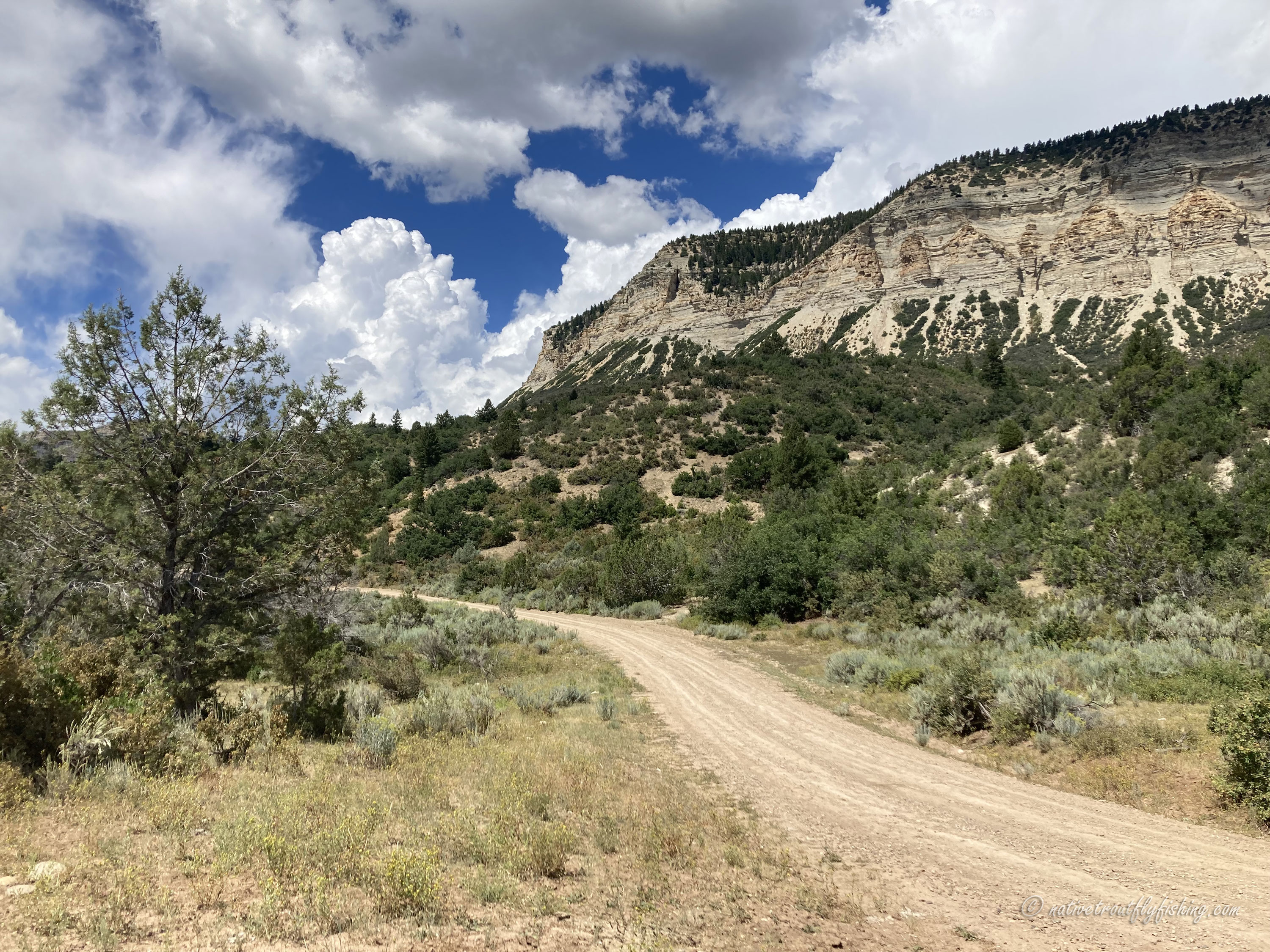
The country at stream #2

The water on the stream looked great, seemed to be cool enough, but after covering a 1/4 mile I hadn't seen the slightest sign of trout and with the day ticking by I decided to cut my losses once again and head for another nearby stream. Based on the research I had done, this stream was reported to hold 151 to 400 pure Colorado River Cutthroat per mile and I had high hopes as I drove up the gravel road and pulled off at one of the stretches of public land to try my luck. Unfortunately, upon reaching the stream, it did not look like great Cutthroat water, with little holding water, warm water and substantial mats of algae. However, in my excursions for desert trout, I have certainly found fish in worse habitat, so I decided to see if I couldn't at least find some deeper pools that might hold a fish or two.

Stream #3

With that I pushed on upstream, but just like the last two creeks even when I did find some decent holding water I didn't see the slightest sign of fish and figured that I needed to push on further upstream, where I might find some cooler water.

On the road again

Unfortunately, this was easier said than done and after driving several miles further up the road, I once again ran into a gate (with plenty of no trespassing signs) that I couldn't see on the satellite imagery, which blocked the path between me and the public lands further upstream. Having driven all the way out here, I wasn't quite ready to throw in the towel and on my drive up to the dead end I had seen a pull off above a canyon stretch of the stream that just might hold some cooler water and the Cutthroat I was looking for. It was a good scramble down into the canyon, but once again luck was not on my side and the creek in the stretch somehow was even more choked with algae. I still quickly covered a bit of water to see what I could find, but things did not improve, the few deeper holes I found again were devoid of fish with the added and the combo of the heat and the sound of thunder in the distance I convinced that it was time to cut my loses.

Stream #3 - second spot, somehow even worse than the first spot

At this point, the afternoon was already progressing and three streams in I was running out of viable backup options. There were one or two other streams in the area, but the thunderstorm was really starting to set in and given the last two streams did not pan out, it seemed like I needed to change strategy if I wanted to salvage the day. 

At least it was beautiful country

With that I got back on the road once again, and this time decided to try a higher elevation stream on the edge of the continental divide. The last three streams that I had tried all had detailed information on how many trout per mile, presence of nonnatives and hybridization. Information that was proved wrong (at least during the summer months) with the absence of any trout. I would be going in relatively blind on this next stream, as it had almost none of that information. In fact all I had to go off of was a map showing highlighted streams for green and blue lineage populations (no stream names) that best I could tell indicated indicated I should find the trout I was looking for in this next location. It is also worth noting that this same map also indicated that the last three streams should have held these trout as well. After just under three more hours on the road, I pulled off the highway headed for my next stream, but once again I was greeted by a sight that had become all too common over the course of the day - another gate! 

This gate was not going to stop me

Luckily this time, I was much closer to the creek and this gate (on public land at least) simply meant that I was going to get a bit more leg work in than what I had expected. At the first sight of water, I made a beeline for the creek and immediately started working the water. While the water was certainly cold enough,quality holding spots seemed to be few and far between and I didn't see any signs of trout until a came to the best looking pool I had seen all day.

Finally some good looking water

Upon reaching this pool I first tried the outfall sure enough I rose and briefly hooked into a trout, but it popped off after just a few seconds. While I couldn't tell whether or not it was a Cutthroat, it was certainly more life than I had seen all day. I tried a few more casts to make sure that the fish wasn't going to come back, then moved on to the main course and placed a cast in the tailout of the pool. While nobody came out to inspect my fly on the cast in the tailout, I extend my next cast to the mid section of the pool and after my fly drifted just a few feet, I watched a fish slowly rise to intercept it. I waited for the fish to turn, set the hook and finally had a solid hook up on a trout. The fight got a bit dicey as the fish neared the tangled mess of wood at the back of the pool, but I managed to keep the trout from hanging up and breathed a sigh of relief as I netted a gorgeous Colorado River Cutthroat!

Mission accomplished! This fish made all the miles on the road well worth it!

This Cutthroat as an absolute flawless gem, with a vibrant orange belly that popped on the pale yellow background but after a few fleeting moments of quite reverence, it was time to turn it loose and watch it slide back into the depths of the pool. As that fish hadn't disturbed the head of the pool, that was where I put my next cast and sure enough another fish rose to take my fly and a few moments later I landed another slightly smaller Colorado River Cutthroat.

My second Colorado River Cutthroat of the day

After that first pool, it was a long walk to the next piece of holding water and only the best water seemed to hold any fish but I started picking up a few Cutthroat here and there as I worked my way upstream. Before long the valley opened up into wide meadows and it was in one of these meadows as I was working my way upstream, that some movement caught my attention and I was surprised to see a porcupine munching on some leaves just above the water line. This little guy didn't seem to be the slightest bit concerned about my presence and after a few moments of observation I left it alone and pushed on upstream.

A streamside Porcupine

Before long I came to another decent pool and after I got a good cast in I watched as a nice Cutthroat dart from hiding and intercepted my dropper. I always find that watching the take, just makes it that much more memorable, and after a few moments I was able to net an exceptionally nice Cutthroat for the stream. 
My fish of the day - a beautiful golden-bronze 12" male Cutthroat

After I released this fish, the restless nights, all of the driving and hiking was starting to catch up with me and I decided at the next meadow I would call it quits. On the way I found one more Cutthroat in another pool and the creek shortly after the creek lost the flow of a tributary and got significantly smaller supporting my decision to call it on this long day.
 
The creek in the meadow stretch

While it had been a rough day, in the end I got to see some beautiful country and found the fish that I was looking for making it hard to complain. After working my way a good mile upstream of where I had started, it was a relief to have an easy trek out on the abandoned road and with nobody else around it was nice to slowly work my way back to the car I admired the beauty of the high Rockies.

The Colorado high country on the hike out

At this point I had now caught 4 out of the five fish that I was after on the trip and decided that I could really use a good nights sleep so I opted to head for Dillon Colorado and grab a hotel for the night. After several days on the road, it felt amazing to grab a hot meal, clean up and then enjoy a post thunderstorm soak in a hot tub with a view of the Rocky Mountains at the sunset.

A great way to end the evening!

With one last day left, my targets were set on the Greenback Cutthroat, the final subspecies of Cutthroat that I needed to catch the next day. As I was flying out the next afternoon, I just had to cross my fingers that the next day was going to go much smoother than this one had.

Saturday, September 23, 2023

Colorado Adventure Part 3: Blue lining for Green River Cutthroat

Saturday August 26th:  While I had been successful at finding the Hayden Creek Cutthroat in the morning, the first stream not producing any fish had certainly put me behind schedule and I had many more miles to cover on the day (for the previous post see here). 

My next target was set on the Green River Cutthroat (also known as blue lineage Colorado River Cutthroat) in the Yampa watershed of northern Colorado. This fish had been a late addition to the trip as it wasn't particularly close to any of the others I was targeting, but during my research, I stumbled across a relatively large watershed that was supposed to have pure strain fish that still expressed a migratory life history. This really caught my interest as fluvial (river migratory) populations of Green River Cutthroat have become quite rare in Colorado and can produce some exceptionally nice fish. However, digging in further I could find almost nothing else out about the watershed - nothing on the fishing and not even any trail reports on the hike in. Normally this might make me redirect my efforts towards a more well known or better documented population, but my gut told me that this stream was a sleeper and I stuck to it. 

My intention had been to reach the stream by 2:00 PM, but after the morning delays and cutting across half the state I didn’t pull into the trailhead until a little after 4:00 PM. Luckily, the drive had been smooth, the weather was great and the parking lot at the trailhead was completely empty.

The the valley at the trailhead

With my rod still rigged from the morning, it only took me a few moments to get all my gear together and hit the trail. Before starting the hike, I signed in at the trailhead log book, and it was pretty clear why there was so little information on this area, as the last group of hikers had been here over a week prior and less than a dozen people had visited all summer. 

The trail in through the lush Aspen meadows

Compared to other parts of the state that were starting to show signs of a long summer, it was amazing just how green and lush everything was in this remote corner of the Rockies. The trail wove through meadows and groves of Aspens as it slowly gained elevation and progressed up the valley towards the stream I was looking to fish. 

Serviceberries along the trail

With all the greenery, I wasn't too surprised when I noticed ripe serviceberries, thimbleberries and raspberries along the trail, which made for a sweet snack as I caught my breath after a particularly steep muddy stretch of trail. Despite how bountiful the surroundings were, I saw few signs of wildlife, with the exception of a small woodpecker working an old Aspen tree.

A woodpecker working a dead Aspen

With the limited daylight, I wasn't hiking in too far and just over a mile in from the trailhead I spotted a rough side trail the looked like it headed for the river and started following. After just a few yards into the bushes, the trail faded away, but I decided to push on and cut my own course towards the stream. The stretch of water that I was angling for was just a flat just upstream of a small canyon, that had looked particularly good from the satellite imagery but I emerged from the woods I had apparently cut in too early and found myself standing on a cliff fifty feet above the water. Luckily, not far upstream I could see the flat I was heading for after a little more bush whacking I found an incline where I could scramble and slide down to the water.

A meadow stretch on the stream

When I reached the stream, it was still running quite fast, with little holding water, but just a couple of corners upstream it leveled off a bit as it followed through a beautiful meadow reach. I slowly worked my way upstream casting towards the far bank hoping to find a Cutthroat looking for some terrestrials, but didn't find anything until I reached the top of the run. The riffle at the top of the run looked particularly fishy and after a half dozen drifts, my dry shot under as I hooked into a decent trout on my dropper. This trout put a good bend in my 1WT and got in a few nice jumps before it finally tired and I slid the beautiful native Cutthroat into the net.

First fish on the stream, a beautiful Green River Cutthroat

After releasing that first fish, I couldn't find any more willing takers in the riffle, but just upstream in a side channel I rose another fish, but this time instead of a Cutthroat it was small Brook Trout. While I had hoped that this stream would only hold native Green River Cutthroat, given the size of the stream and the extensive stocking history of Brook Trout across Colorado, I wasn't too surprised to find them here as well. While certainly a beautiful fish, Brook Trout are also a fierce competitor of native Cutthroat Trout and cast doubt on the future persistence of Cutthroat across much of their range.

Invasive Brook Trout, beautiful fish, but not what I wanted to see

With light already starting to fade, I pushed on upstream and soon came to an excellent looking pool. I started by prospecting the inside seam, which seemed oddly devoid of life but as I worked my fly into the slower water I rose a fish and after a quick battle I landed another smaller Cutthroat.
Another Green River Cutthroat

Looking upstream towards a particularly productive piece of water

As I was releasing my first fish from the hole, I watched another fish that appeared to be larger rise right next to a log sticking out of the water. I noted this for my next cast and sure enough as my fly drifted by the log a nice trout rose to meet it. This was a decent sized trout and as soon as I set the hook my 1WT doubled over and shortly after a 14" - 15” trout came shooting out of the water. The fish was largely in control of the fight and chose to run downstream into the next stretch of flat water, but after a few minutes it finally started to tire and I was able to slide it into the net. This fish was exactly what I had been looking for, a beautiful brightly colored clearly migratory Green River Cutthroat.

Surely the fish of the day, a brightly colored male fluvial Cutthroat

After releasing the big Cutthroat, the hole went on to produce another half dozen Cutthroat and a couple Brook Trout before things turned off and it was time to push on further upstream.

Another Brookie that ended up being my biggest of the day

As I worked my way upstream, each piece of quality holding water seemed to hold a fish and fortunately the Cutthroat still seemed to be the dominant fish in the stream, out number the brook trout approximately 3 to 1. After covering about a half mile of water the sun was starting to get low in the sky and when I came to a spot with a clearing that would provide easy access to the trail I decided to fish one last run before heading out.

The last spot of the day - note the seam behind the log

This last pool had a nice back eddy behind a log and on my first cast I watched a nice Cutthroat materialize from the depths and slide over to grab my dropper. Once hooked, the fish immediately headed for the log, but fortunately did not hang up and when it came back downstream I was ready with the net. This was another gorgeous Green River Cutthroat, with vibrant yellows and an orange belly, that the low light the pictures just didn’t do justice. 

A great fish to end the day on

While I figured that this fish was likely the sole inhabitant of the pool, I had to verify it with several more casts before finally calling it quits and heading for the clearing. The clearing ended up being a much more challenging route back to the trail than I had expected, as it was extremely steep, muddy below the vegetation and was littered with dense patches of stinging nettles. However, after several minutes of hard scrambling, sliding and with my legs burning from nettles I finally reached the top and was back on the trail again.

On the trail again

The hike out was all downhill making it a breeze and before I knew it I was back at the trailhead again. With my next spot under two hours away, I opted to chase the last bit of daylight hit the road once again to reach my next spot by nightfall.

Evening over the Flattops of northern Colorado

Finger Rock on the drive towards the next stream

As the last light of the day was fading, I finally turned off the highway and made my way towards my next stream - a meandering meadow creek that was reported to hold 151 to 400 Colorado River Cutthroat (green lineage) per mile. The satellite imagery made it look like this this stream was going to be a ton of fun with hoppers, but as it was pitch dark by the time I arrived that would have to wait for the next day to scout it out and instead I focused my attention on setting up a quick camp for the night.

Sunday, September 10, 2023

Colorado Adventure Part 2: Hayden Creek Cutthroat

Saturday August 26th: My second day of hunting for native trout in Colorado dawned to soggy overcast conditions after an extremely restless night of sleep in the car (see here for part one). However, by 6:45AM, the rain finally stopped and after a quick breakfast, it was time to hit the trail once again. My target for the morning, was a curious and unique form of Cutthroat only known to one small stream - the South Prong of Hayden Creek in the Arkansas watershed. What makes these trout so unique is that they are an exact genetic match for the "Greenback" Cutthroat that once occurred alongside the Yellowfin Cutthroat in Twin Lakes, Colorado. Genetics revealed that these "Greenbacks" were in fact Colorado River Cutthroat, but with a genetic signature not found in any populations west of the continental divide.  While it is still unclear how these trout found their way into the Arkansas basin, it is clear that they were abundant in Twin Lakes in the 1880's, but like the Yellowfin Cutthroat were unable to withstand the introductions of nonnative species in the lakes and vanished within a few short decades. These fish held on in one last refuge until 2016, when a fire burned through Hayden Creek and if it were for a last minute rescue operation they would have been lost entirely. With the Yellowfin Cutthroat still believed to be extinct, Cutthroat reintroduction efforts in the Arkansas basin have focused on establishing these Hayden Creek Cutthroat in a number of refuge populations around the watershed. So for me after the revelation that the Colorado River Cutthroat (see here) that I had caught in Rocky Mountain National Park years ago were in fact Green River Cutthroat, these fish would check that box again, while also representing a particularly unique lineage of Cutthroat Trout.

The spot that I had picked to target these rare Cutthroat was among the first transplant populations and while the Cutthroat had apparently failed to establish in the upper reaches of the stream, several friends of mine had succeeded in finding them in the lower reaches, which is were I planned on going. By 7:00 AM, I was on the trail, hiking through a forest of sparsely spaced Pine trees. Compared to the day before, the trail started out at a much easier grade and was at a slightly lower elevation, which helped me make good timing and feel like I wasn’t completely out of shape.

A wet start to the day

While the hike the evening before had been stunning, this one was a much more standard walk in the woods, although the few brief views of the valley through the clouds did add to its charm.

A wet gray start to the day

With the relatively easy hike, within a half hour I could hear the sound of running water and was descending into the creek valley. Upon arriving at the creek, it was immediately clear that this would be some challenging brush whacking and fishing, as the stream was extremely high gradient, with dense riparian vegetation. However, there was a nice looking pool right at the trail crossing that looked like excellent holding water for trout, so it was time to get to it.

A pool on the creek

While the first pool looked great, multiple drifts failed to produced any sign of trout so I started working my way upstream. With the high gradient it was slow going, but there were plenty of plunge pools. Unfortunately, none of them seemed to hold any trout and with the crystal clear water I really should have been able to see the fish if there were any. After covering a dozen or so really great looking spots, the creek was really beginning to appear devoid of trout. I am not one to give up easily, so I decided to go back to the trail and try my luck downstream. Despite finding more great looking holding water, the same scenario repeated itself and I didn’t see as much as the slightest sign of a trout. While this was always a possibility when I was planning the trip it was disappointing. This was definitely going to set my schedule back a bit, but I had a couple backup spots along my route and as such I decided to cut my losses and head for a different stream. I moved as fast as I could on the hike out and despite taking one wrong turn, by 9:00 AM I was back at the trailhead and hitting the road once again.

Other than the stocking history, I had very little to go off of with the next stream and even had to guess which stretch of stream would have the Hayden Creek Cutthroat in it. However, it was the closest along my route so if it didn't pan out it shouldn’t put me too far off my schedule to at least check it out. Based on the research I had done, the benefit of this spot based on the timing of the introduction, was that if it had been successful, by all rights the population should be well established with multiple age classes at this point. 

My drive took me along the Arkansas River which was running high and off color due to the storm the night before, and while it was gorgeous, knowing that the Yellowfin Cutthroat which once inhabited its waters were now lost to time was heavy on my mind as I ascended the valley.

The Arkansas River - once home to the Yellowfin Cutthroat

I made great timing on the drive and by the time I turned off on the road to the creek the cloudy skies of the morning were finally starting to give way to afternoon sunshine. The drive into the mountains, which should have been gorgeous, was marred by the legacy of mining, with derelict structures and equipment left in place and large swathes of land still barren.

The legacy of mining was certainty apparent on the drive in to the stream

About 3/4 of way into the creek I got an unwelcome surprise as there was a set jersey barriers blocking the way. Or at least partially blocking the way as the was a bit of a gap in between two of the barriers looked like it just might be wide enough for a small car to fit through. Having already be shut out on one stream, I wasn’t going to give up easily on this one and decided to see if I could squeeze through. I angled the rental car towards the barriers and after getting out to verify it would fit slowly inched on through and was back on track. A quarter mile up the road there was another set of barriers but luckily there was a large gap in this one and I sailed right on through. Another five minutes of bumpy dirt roads later, and I was standing at nearly 11,500 feet of elevation, amidst the peaks of the Rocky Mountains on a rise a couple hundred feet above the creek and eager to reach the water. I quickly got the ball rolling and grabbed my gear, found an old two track road I had seen on the satellite imagery and started my descent into the valley below.

The meadows on the walk into the second stream

Regardless of whether or not this stream held fish, the surroundings were absolutely stunning, with a crystal clear creek tumbling over rocks as it meandering through a verdant alpine meadow surrounded by peaks that rose to over 14,000 feet and towered above the tree line. While I would have been happy to just sit and immerse myself in my surroundings, I was here for a reason and I quickly directed my attention to the stream.

The second stream of the day was gorgeous!

In the first piece of holding water that I came to, I briefly hooked a fish but only saw a bit of green, yellow and red that I feared might be a Brook Trout before it popped off. Regardless of what it was, it was more life than I had seen in the last stream and in the next pocket upstream a trout grabbed my dry fly. This time I got a solid hook set and luckily when I brought the fish to the net, I found it was a beautiful Hayden Creek Cutthroat! 

Success! A Hayden Creek strain Colorado River Cutthroat

Despite being essentially considered a Colorado River Cutthroat, these Hayden Creek Cutthroat certainly are a unique fish, and were a bright yellow colored with red blotches along the lateral line and moderate sized spot concentrated near the caudal peduncle. The first Cutthroat was soon followed by another and another, and this stream proved to be one where every likely looking spot held a trout. On top of that, there was no shortage of good holding water, with every corner and plunge pool screaming trout. The trout in the stream which averaged 6” to 8” were also abundant and eagerly rose to my Royal PMX, with a few going for the dropper as well.

A beautiful Cutthroat in the photarium

My original plan was for a quick in an out trip, but between the beautiful surroundings, excellent fishing and unique trout, I just couldn’t pull myself away from the creek and before I knew it several hours had slipped by.

One last look at the stream before hitting the road

While I was reluctant to move on, I still had many miles ahead of me a knew it was time to get back on the road again. Although the morning started a bit rough, the second stream had far exceeded my expectations and with another fish under my belt the trip was coming together nicely. Next I was headed for the Flat Tops of northern Colorado with high hopes of finding some native Green River Cutthroat Trout.

Wednesday, September 6, 2023

Colorado Adventure: Part 1 - Off to the races

I have been fascinated with the diversity of native trout since my childhood and when James Prosek's book Trout and Robert Behnke's book Trout and Salmon of North America came out I decided to take it upon myself to document as many of the native species as possible. This included all of the subspecies of Cutthroat Trout and way back in 2009, I believed that I completed that leg of my quest and that I had caught all 12 of the extant subspecies of Cutthroat Trout plus the closest remnants of the extinct Alvord Cutthroat as well. However, shortly after catching my last subspecies (the Paiute Cutthroat), the classification of Cutthroat in Colorado was up ended by a genetics study. This study revealed several key findings, first was that instead of the four subspecies (Colorado River, Greenback, Yellowfin and Rio Grande), there were in fact 6 native to Colorado, including two that had been previously unrecognized (San Juan and Green River (aka blue lineage Colorado River Cutthroat)). The second finding came as a devastating blow to Cutthroat conservation and showed that what everyone had believed were Greenback Cutthroat were in fact Colorado River or Green River Cutthroat and only a single population in tiny Bear Creek harboring a few hundred Greenbacks remained. This effectively reset the Greenback Cutthroat recovery efforts and also meant that I had another subspecies to pursue once a viable population became established. That list continued to grow too, as the San Juan Cutthroat was rediscovered in 2018 and genetics showed the instead of the traditional 14 subspecies of Cutthroat there were in fact 25 (see Trotter et al. 2018). 

Several years ago I was finally able to start documenting many of these newly recognized subspecies and going into this summer my last two remaining Cutthroat (the San Juan and Greenback) were both in Colorado. At the start of August I successfully checked the first of these two subspecies off my list, when I caught the once believed extinct San Juan Cutthroat. After that outing, I was unsure whether or not I would be able to get back to Colorado, but the opportunity to return presented itself at the end of August and I started planning my adventure. While I initially just thought this trip would include a quick excursion for Greenbacks, it evolved into an excursion for five varieties of Cutthroat spread across the state including the Rio Grande Cutthroat, Hayden Creek Cutthroat, Green River Cutthroat, Colorado River Cutthroat and Greenback Cutthroat.

Friday August 25th: With plans in place, before I knew it I was in Colorado and by noon on I was on the highway cruising south towards the native range of the Rio Grande Cutthroat. While I have caught Rio Grande Cutthroat on several occasions, all of those were in New Mexico and most of the fish that I had caught were large spotted Rio Grande Cutthroat from the Pecos River drainage. As such, on this trip I was hoping to document the finer spotted form from the main Rio Grande drainage, as the existing photos I have are dated and of marginal quality. I was fortunate to hit minimal traffic getting out of the Denver metro area and made great timing as I traveled from the plains, east over the Rockies, through the Sangre de Cristo Mountains and into the arid San Luis Valley. This meant that by 4:00pm I was turning off the highway in the San Juan Mountains and towards the trailhead to a stream that was reported to have a robust population of Rio Grande Cutthroat.

The trailhead

Anticipation was running high as I drove up the forest service road to trailhead leading me to miss a sign for the trail and take wrong turn that cost me several minutes of precious fishing time. However, after a bit of hack tracking, I found the right road and before long I was pulling into an empty parking lot at the trailhead. With the area completely to myself, I immediately threw on my wading boots, got my pack loaded, rigged up my trusty fiberglass 1WT with a Royal PMX and Blowtorch nymph dropper and hit the trail. For the first little bit, the trail proceeded on a gentle incline as it progressed along a decommissioned road through alpine meadows and scattered spruce and fir stands. I hiked in complete silence that was only interrupted when I spooked a group four Grouse that snapped me out of my reverie about a half mile in.
  
A well camouflaged Grouse up in a Spruce Tree

The gentle incline did not last for long, and while the hike wasn't overly strenuous, I was certainly not acclimated to the altitude and at nearly 11,000 feet even the moderate incline left me huffing and puffing as my sea level lungs struggled to get enough oxygen. This slowed my progress down significantly and as a result while I had expected to reach the the barrier isolating the Cutthroat from nonnatives downstream within a half an hour, in reality it ended up taking me at nearly a full hour.

The barrier separating the Rio Grande Cutthroat from nonnatives downstream 

Luckily, after reaching the top of a particularly steep section at the barrier, the trail leveled off and I made much better time as I covered the last stretch, entered the San Juan Wilderness Area and approached the meadows above the falls.

Entering the wilderness

With daylight ticking away, I broke from the trail as soon as I came within sight of the meadows and made a beeline for the sound of running water. The creek turned out to be much smaller than it appeared in the satellite imagery I had poured over when planning the trip, but it was running crystal clear and appeared to have ample holding water. It also appeared that I had been lucky enough to emerge just downstream of a particularly nice looking pool.

The stream

With a nice pool right in front of me, I got my rod ready, positioned just downstream and made my first cast of the trip. I had decided prospect the tail out first and my fly barely had time to drift a few feet downstream when a Cutthroat swirled on the Royal PMX and I was hooked into my first Cutthroat of the trip. With the tight quarters the trout had nowhere to go and after just a moment of thrashing I brought a beautiful Rio Grande Cutthroat to the net.

First cast - first fish of the trip!

That first fish was indicative of the rest of the day, as every lie deep enough to hold a trout did and these were some of the most beautiful Cutthroat one could hope to find anywhere. As with the first fish, these Rio Grande Cutthroat preferred to hold in the slowest water in the tail outs which also made them particularly spooky. As such, with the tight conditions it took slow progress, a low profile and solid presentation to get results but after after covering about an 1/8 mile of stream I had caught about a half dozen decent Cutthroat already. It was at this point I came upon the best looking hole of the day and after careful observation I spotted several trout holding under a spruce tree and sipping occasional ants or caddis falling into the water.

Several Rio Grande Cutthroat holding in the tailout

The hole was fairly exposed and given how spooky the fish were, I knew I would only get one or two chances. I positioned myself slightly downstream and tucked behind a small tree to be obscured from sight and got a cast right into the seam. While it wasn't the biggest of the bunch, one of the Cutthroat broke away from the group and slowly but deliberately rose to take my dry fly. When the trout turned with my fly in its mouth, I set and got a solid hookup. Despite trying to get it away from the other fish, the trout thrashed on the surface a few times sending the rest fleeing for cover as I pulled it downstream and into my net.

My one Rio Grande Cutthroat from the hole

Once again this was an exceptionally beautiful Cutthroat, with the yellows and oranges of a sunset and after a quick photo and a few brief moments of admiration I watched it slip back into the current and dart for cover. By the time that I released this fish, several of the other fish had returned to their holding lies, but their air raid sirens were apparently still blaring and given that my time on the water was extremely limited I opted to push on upstream instead of waiting for them to settled down and start feeding again. 

The sun getting low on a nice stretch of stream

Over the next few bends, I picked up a handful of additional Rio Grande Cutthroat in the 6" to 8" range, with most taking the dry fly, although a couple did go for the dropper. Before long I came to a straightaway with a nice deep pocket next to a rock that looked particularly fishy. With the glare on the water I couldn't see any fish, so I made a blind cast and as the fly reached the end of the pocket a Cutthroat rose to the dry and immediately put a nice bend in my 1WT. Once again the tight quarters gave the fish nowhere to run and after a quick fight, I netted a largest Rio Grande Cutthroat I had seen so far.

The fish of the day a beautifully colored "monster" Rio Grande Cutthroat

The colors on this fish were absolutely amazing, with deep orange and bronze tones that popped in the fading sunlight. One top of that the spotting was exceptional, with almost no spots on the front two thirds of the body, but dense spot one the back third and caudal fin. After releasing my 'big' Rio Grande Cutthroat, the sun was starting to inch closer to the horizon and I knew that my time was limited, so I pressed on upstream to cover a few more holes while I still had some light. However, I hadn't traveled far when the creek broke into two forks and got substantially smaller. I pushed on for a couple more bends on the bigger fork, but not seeing much in the way of good holding water, I made the call to head back downstream and fish the stretch between where I started and the falls before hiking out. After reaching my starting point, I dropped my fly in each of the deeper pockets I came to and whenever my fly landed on the mark, I was almost always rewarded with a rise and managed to catch a couple more small Cutthroat. 

A set of falls on the creek

As I approached the falls, the gradient picked up and the creek tumbled over a series of cascades interspaced with deep pools. While this looked like it would be one of the best spots on the creek, I only managed a sole small Cutthroat out of the pools before I finally had to admit that my time was up and make my back to the trailhead.

Sunset over the meadows, time to hit the trail

The hike out in the fading light of the evening was gorgeous, as I passed through meadows with deer emerging from cover to graze before the sun fell behind the peaks. After paying my dues on the way in, the hike out was all down hill and as such I made much better timing and was back to the car before I knew it. The evening on the stream was far better than I could have hoped and certainly got the first leg of the trip off to an exceptional start. While I would have loved to spend more time in the area, I still had many miles to cover ahead of me I had to get right back on the road headed for a small stream in the Arkansas drainage. 

As I drove through the San Luis Valley, lightning lit up the night sky and I hit intermittent downpours along the way. However, as I pulled into the campground near the trailhead for my next stream around 11:00 PM these intermittent showers had turned to a steady heavy rainfall. As such, instead of setting up the tent in dark and pouring rain I opted to hunker down in the car for the night and hoped that the morning would bring better weather.