This blog is all about fly fishing for native trout. On it I cover trip reports, fishing tactics, conservation, the latest news about native trout species and much more. This site provides a companion to my web page Nativetroutflyfishing.com.
My goal for this trip was to catch all of the subspecies of Cutthroat Trout native to the Rocky Mountains excluding the Westslope Cutthroat, which I had caught a number of in the Cascade Mountains two weeks prior to leaving. While Cutthroat are native to a vast area of the western United States, their populations have been greatly reduced due to a variety of issues. As such, pure and healthy populations can be quite difficult to come by today. I started planning this trip during September of 2005, and relied on a variety of different resources to come up with a list of streams to fish that would hold healthy populations of Cutthroat without any hybrid influences.
Day 1: Monday July 31st 2006: My dad and I made the 12+ hour drive to Yellowstone, with nothing overly exciting occurring along the way. When we got to the park, we found out the the campground where we were planning on staying was already full, so we diverted to Indian Creek campground, which luckily had a few spots left.
Day 2: Tuesday August 1st 2006: We woke up bright and early to a chilly Yellowstone morning. After a quick breakfast, we drove over to the Lamar Valley and Soda Butte Creek to try our luck fishing for some Yellowstone Cutthroat. We arrived at the creek to find it extremely crowded and had to hunt to find a stretch that we would have to ourselves, or so we thought. We ended up being constantly high holed or low holed, which really limited the amount of water we could cover. Even so while we were there, we rose more than our fair share for Cutthroat, including one that my dad hooked and was close to 20". Even with the few larger fish around, I still only managed to catch a couple of small Cutthroat prompting us to consider a less crowded option.
A pronghorn antelope on the way out to the Lamar Valley
With Soda Butte Creek being one of the more popular streams in the park, I decided to try a relatively unknown small stream that was supposed to hold a good population of Yellowstone Cutthroat. Arriving at the stream, I found it to be completely vacant of anglers and full of small but hungry trout, with some up to 12". I rigged up my rod with a Royal PMX and Lightning Bug dropper and started catching fish in every likely looking spot. Eventually, I came to a nice plunge pool where I watched my dry fly get pulled under as a Cutthroat grabbed my nymph. After a quick fight I landed a beautiful 12" Yellowstone Cutthroat, my best fish for the creek. Soon after landing the Cutthroat, the weather began to deteriorate and I made my way back down the creek as the rain set in.
The Creek
A stream resident Yellowstone Cutthroat caught on a Lightning Bug nymph in a deep hole
Once back at the car, we made our way to one of my favorite streams in the northwestern corner of the park. The weather was better in this part of the park, but it looked like it wouldn't last long. Although this stream doesn't have much in the way of native trout, it always spoils me as every likely spot seems to hold a fish, and I caught numerous Brown Trout, Rainbows and Cuttbows before I was finally chased out by a thunderstorm.
After again being bested by bad weather, we headed back to the campground to get some dinner and settle in for the evening. After a good dinner I was feeling recharged, decided to head out fishing again to see if I could find any Brook Trout in the upper Gardner River. It didn't take long before I found a nice section of the river that was full of rising Brook Trout that eagerly took my dry fly. Well above this I found some decent pools that were packed with Brook Trout, which couldn't resist the Zug Bug that is my go to fly in this type of water.
A pool on the upper Gardner River
A Brook Trout caught on a Zug Bug
After catching my fill of Brook Trout, I headed back to camp as the sun started to drift toward the horizon. The day had been a great success, not only had I caught the Yellowstone Cutthroat that I came to the park for, but I had also caught a number of Brook, Brown and Rainbow Trout making it the first time that I had caught all four species in a single day.
Day 3: Wednesday August 2nd 2006: I am used to cold nights in Yellowstone, but this one had been especially chilly and we woke in the morning to find everything coated with a thick layer of frost. The plan for the day was to leave the Yellowstone National Park behind and head south to the Tetons to try to find some Snake River Fine Spotted Cutthroat.
Me with Jackson Lake and the Tetons in the background
The spot that I had chosen to fish had treated my dad and I very well on a trip in 2005, so I was looking forward to going back again. However after fishing all of the spots where we had done well on our previous trip all I had to show for the effort was one small Brook Trout and a few missed strikes.
A lake at the foot of the Tetons
With a less than successful first outing for Fine Spotted Cutthroat, we headed down the valley into Jackson to get lunch and possibly a hotel room so that I could try to get some Cutthroat later in the evening or the next morning. Unfortunately, we did not anticipate just how busy Jackson would be since our previous trips had not been during the peak travel season. With the town completely overrun with tourists and all of the hotel nearby were booked, as such staying here was out of the question. Even though it was busy, we did manage to get lunch at Bubba's BBQ than continued down the road toward the native range of the Bear River Cutthroat, my next target.
We ended up deciding to stay in Afton Wyoming, which was the closest town to the Bear River Cutthroat stream and was also close to several decent Snake River Fine Spotted Cutthroat streams.
That evening I headed out to try my luck Fine Spotted Cutthroat again, this time targeting small tributary of the Salt River. The creek was only about fifteen feet across in its widest spots, but was extremely fast moving and as a result had little holding water. Due to its small size, I decided to just wet wade, which was a big mistake as the water was frigid and the evening was cooling down fast.
I covered close to a 1/4 mile of stream before I finally found a bit of decent holding water and spotted a rising trout. My first couple casts landed a little short, but finally I got a good cast into his feeding lane and hooked up. Snake River Fine Spotted Cutthroat are notorious for being hard fighting fish, and with the fast water this hefty trout fit that mold perfectly, but still came to the net before long. For a stream this size, this was a great fish running nearly 15".
A Snake River Fine Spotted Cutthroat
Not to far upstream from this first cutthroat, I found a nice little pool and after placing a cast tight to a rock ledge I hooked up with another even larger cutthroat. This fish was 18" or better, but as I went to bring it to the net my small nymph popped out and the giant drifted back into the shadows. The rest of fish seemed to share this talent for tossing flies, and as the sun began to set headed back to the hotel with high hopes of getting into some Bear River strain of the Bonneville Cutthroat in the morning.
Day 4: Thursday August 3rd 2006: We continued on our route and drove over a mountain pass from the Snake River drainage into the Bonneville basin. The first stop for the day was a small stream that my research had indicated held a fair amount of Bear River strain Bonneville Cutthroat. Arriving at the stream I located a good looking stretch that had a large concentration of beaver ponds. The water in the creek was relatively murky, so I rigged up with a flashy Thin Mint Wooly Bugger with a Zug Bug as a trailer about 16" behind it. Once I was rigged up, I headed over to the largest of the beaver ponds and started fishing from the top of the dam. As I was stripping my fly in I could see golden flashes from the Cutthroat and after a few missed hits, I finally hooked up and brought and nice 16" Cutthroat to the net. After my luck in the big pond dried up, I tried some of the other ponds and caught several other smaller Bear River Cutthroat before getting back on the road again.
My big Bear River Cutthroat
Another smaller Bear River strain Bonneville Cutthroat
Me at the Bear River Cutthroat stream
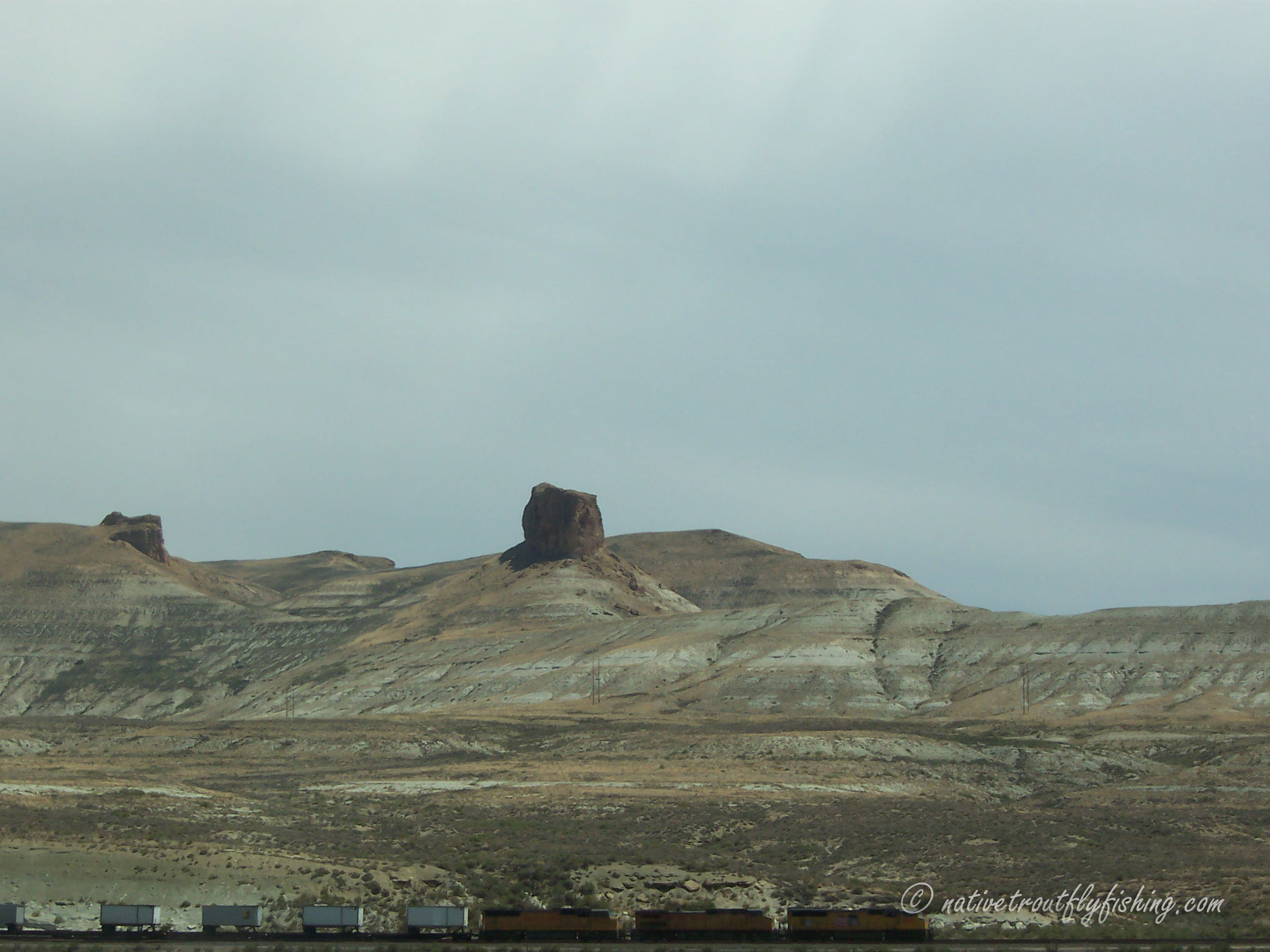
We continued down the road with hopes of making it to Rocky Mountain National Park in Colorado by dark. The countryside quickly transitioned from forested mountains to sage brush desert. This desert portion of Wyoming had some very interesting and unique rock formations and had an incredibly high population of pronghorn antelope and a large concentration of natural gas wells. After several hours of driving through this terrain, the scenery became rather repetitive it didn't revert back to mountains until we were well into Colorado.
The Wyoming desert
Just outside Steamboat Springs Colorado we ran into a large thunderhead, which seemed to follow us all of the way to Rocky Mountain National Park, but finally tapered off and disappeared in time for us to set up our tent at Timber Creek campground in the park.
Day 5: Friday August 4th 2006: We awoke early in the morning to see Elk walking through the campground. My targets for the day were set on catching some Greenback Cutthroat (note from the future - based on genetics work, we known know the the fish used for "Greenback" Cutthroat recovery in RMNP were actually misidentified Colorado River Cutthroat), so we set out for a hike in stream on the eastside of the park. The drive to the stream was through some of the most beautiful country that I have ever seen, as the road wound its way along the tops of the 12,000 foot peaks and over the continental divide.
The Colorado high country
A herd of elk in Rocky Mountain National Park
We arrived at the trailhead for the Greenback stream and the parking lot was so crowded that we could barely find a spot. We hiked up the trail about a mile before we came to the creek and started fishing. After covering a few yards of good looking stream and only managing to rise one Cutthroat, I figured that most people would also start fishing as soon as they arrived at the creek, so I decided to head further upstream. I hiked up the trail another mile or so and this made all of the difference in the world.
The Greenback Cutthroat stream
When I got down to the creek I could see several Cutthroat holding in a nice deep slot, so I cast my Royal PMX and Copper John dropper out, but couldn't get any reaction from the fish. Given the lack of interest, I figured that they must be keying in on something, and after a little pocking around I noticed an unusually high number of Yellow Jackets on the banks and a few dead ones in the stream. The closest imitation that I had was a yellow bodied Tellico Nymph, so I switched out my dropper and gave it another try. The results were immediate, as a nice sized Greenback grabbed my nymph on the first cast. There are some fish that when you catch them you have a hard time turning them loose again simply because they are so beautiful, and every one of these Cutthroat feel into this category. Drop dead gorgeous.
A beautiful "Greenback" Cutthroat. Note: In 2012 it was discovered that this population was actually made up of Colorado River Cutthroat that had been mistaken for Greenbacks.
After the first Cutthroat, fishing stayed consistently good as I worked my way upstream and each likely looking pocket produced a decent fish. After covering about a half mile of water I ran into trail crossing and reluctantly pulled myself away from fishing and headed back down the trail to the car. I still had one more fish to pursue and the next stop was back at the campground for a quick lunch, than it was off to another stream for some Colorado River Cutthroat.
Rough weather coming in over the high country on the way back to the campground
When I arrived at the Colorado River Cutthroat stream, I found it to be much smaller than what I had been led to believe from the research I had done prior to leaving on the trip. However everything that I had read indicated that it held a pure population of Colorado River Cutthroat, so I headed upstream to see if I could find any. Not to far upstream the gradient of the creek increased and there started to be a bit of decent holding water. Before long I spotted a decent trout in a small run and the fish grabbed my dry on the first cast. However, when I got it to the net it ended up being a Brook Trout instead of a Cutthroat. It seems that these fish have a special talent for turning up where they aren't supposed to be...
Small stream fishing in the extreme: the Colorado River Cutthroat stream
Luckily the Brook Trout was not the norm and in the next pool upstream I caught my first Colorado River Cutthroat on the Royal PMX. Just above this point, I ran into a fish barrier, above which the only fish present were beautifully colored Colorado River Cutthroat. As I continued upstream, the gradient steadily increased and the creek flowed down the mountainside from one stairstep pool to another.
A small, but beautiful Colorado River Cutthroat
Above the barrier, most the pools and pockets held fish, and I spent the next couple hours catching fish in most of the likely spots using dries and nymphs. In such small conditions it was fun watching the reaction of the fish to different flies. I one pocket I tossed a stimulator in only to watch it be refused at the last minute by a Cutthroat. For the next cast I switched back to a Royal PMX and watched as the fish rose to it without any hint of hesitation. In one of the larger pools upstream I caught my biggest trout on the creek at right around 10". While beautiful, this fish had an odd little hole in one of its gill plates, no doubt a testament to the harsh conditions that these fish live in.
Having successfully caught some Colorado River Cutthroat I went back down to the campground to get some dinner, then my dad and I headed out to the Colorado River for some more fishing and to see if we couldn't find some more Cutthroat that had washed down from the creek. The mosquitoes on the river were terrible, and after only catching a few small Brook Trout we decided to call it quits.
The upper Colorado River
Day 6: Saturday August 5th 2006: We broke camp bright and early and headed out of Rocky Mountain National Park bound for New Mexico to so I could try my luck for some Rio Grande Cutthroat. The park was beautiful in the crisp morning air, and there was plenty of wildlife around as well.
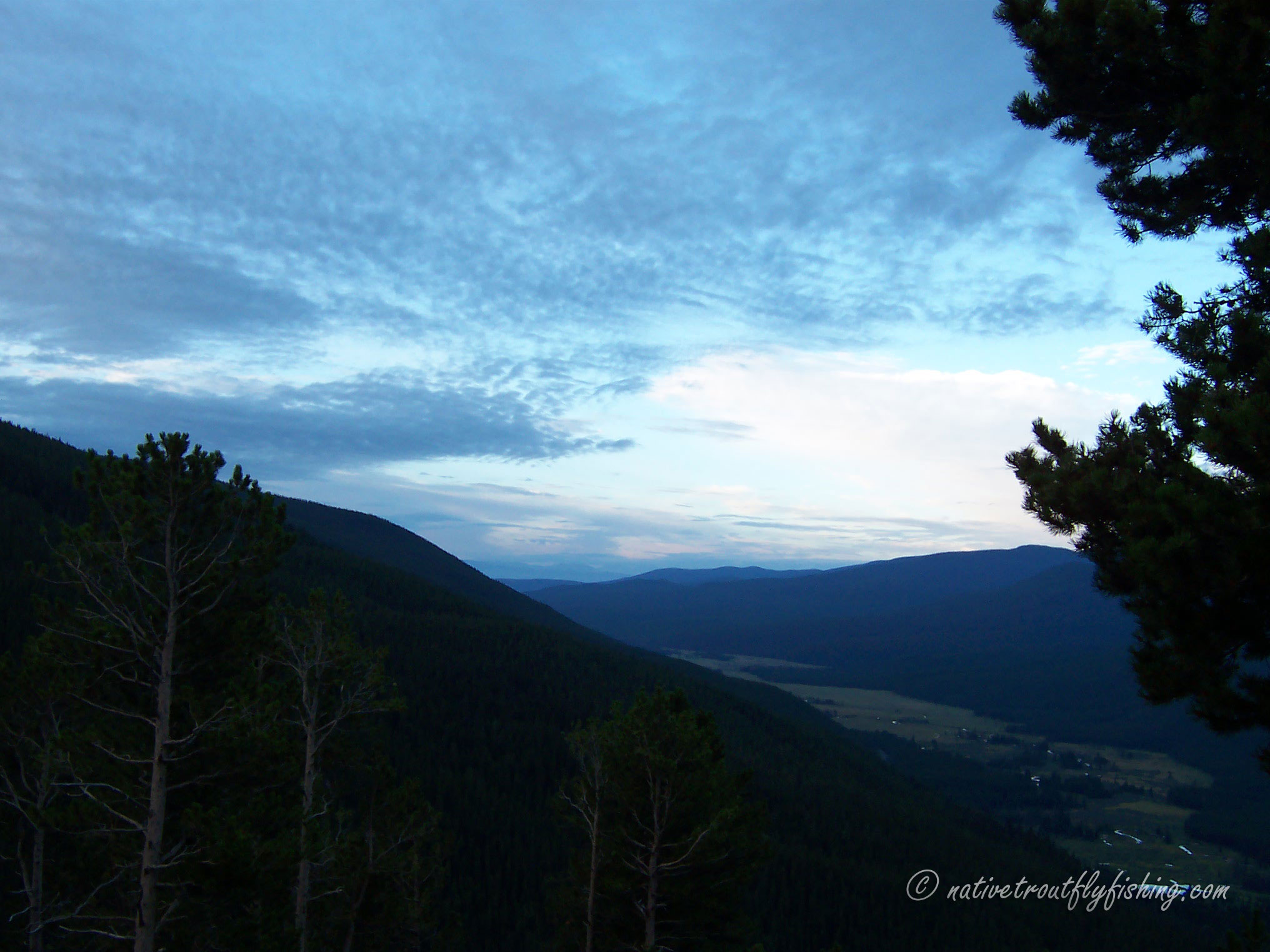
Looking down the Colorado River valley
A herd of elk in the alpine tundra
Looking down the east slope of the Rocky Mountains
After leaving the park we followed I-25 across the Frontrange prairies to just south of Colorado Springs where we headed back up into the Rockies. After that, we continued through southern Colorado where the terrain consisted of small groupings of mountains interspaced with desert. The desert extended into northern New Mexico and was a bit reminiscent of the scab lands of eastern Washington. Once into New Mexico, we almost immediately turned up into the mountains heading to the stream that I had chosen to fish for Rio Grande Cutthroat. As we gained elevation, the country rapidly changed from desert to high mountain forests with meadows and a picturesque stream flowing through the middle. Despite seeming to be in the middle of nowhere, it quickly became apparent that I was not going to have the place to myself, as there were fishermen in every pull off along the road. We continued upstream until we managed to find a section of the stream that was vacant of other anglers, and I got to work trying to catch some Cutthroat.
An abandoned adobe house in the valley leading up to the stream
The Rio Grande Cutthroat stream with an afternoon thunderstorm in the distance
Catching Cutthroat in this stream proved to be more challenging than expected as these fish were some extremely quick risers that often spit the hook before I had even realized that they had taken the fly. After a while I caught my first cutthroat, which was followed by several others as I got used to their lightning fast strikes.
A Rio Grande Cutthroat
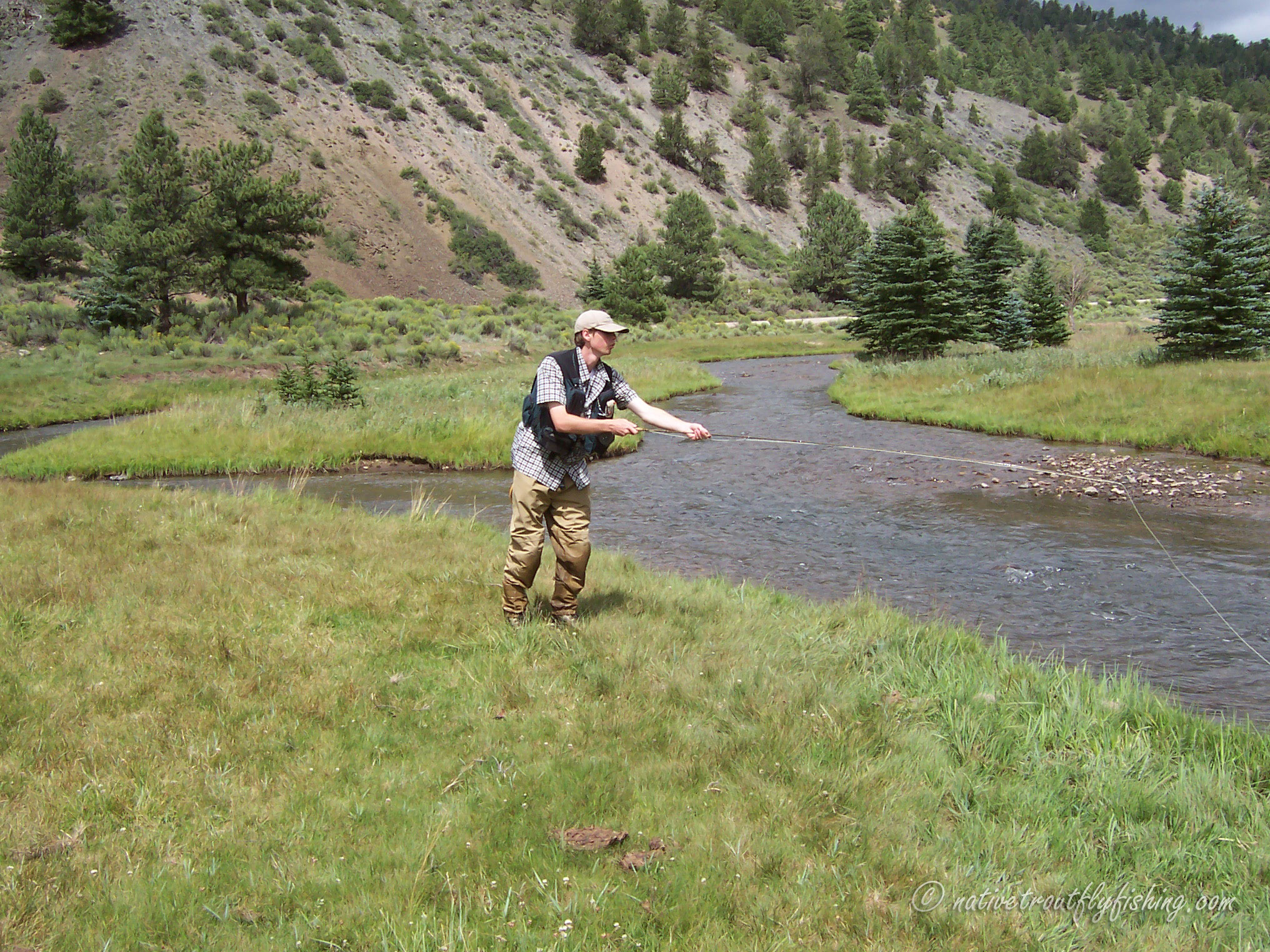
Me working a productive stretch of water
I continued fishing until we were driven from the stream by a thunderstorm, at which point we got back on the road and ended up finding a place to camp outside of Durango, Colorado.
Day 7: Sunday August 6th 2006: The combination a symphony of insects and thunderstorms made for a rough night of sleep, and when we finally got up it was back on the road for an uneventful day of driving. We drove through Colorado and Utah and along the way decided that we had time to try to go after one more type of fish - the Humboldt Cutthroat. With that our destination was clear and ended the day in the small casino town of Wendover, Nevada. While in Wendover, I finalized my plans for the next day's fishing and we took full advantage of the pool and buffet at the hotel where we stayed the night.
Breaking camp in Colorado for a long day on the road
Looking out toward Wendover, Nevada and the Bonneville salt flats
Day 8: Monday August 7th 2006: We got up in the morning and headed along I-80 through the desert, turning north at Elko to search for some Humboldt Cutthroat. We than followed the North Fork of the Humboldt River up to a forest service road leading to a small tributary that was said to hold healthy population of these Cutthroat. However, not to far up the road we ran into a group of ranchers that were driving to cattle up the road and had to wait for them to pass. While we waited, I rigged up my fly rod with the Royal PMX and Copper John step up that had already proved itself so effective on the rest of the trip.
The Humboldt National Forest
Once the cattle had passed I headed down to the creek and on my second cast hooked a Cutthroat, which unfortunately shook loose before I could get it in. A little further upstream I found a small hole and rose a 14" Cutthroat, but it too shook loose. Above this pool, the stream split into a number of side channels and was impossible to fish due to lack of water and a barrier of riparian vegetation. Blocked from continuing upstream I turned around and headed back the way I came. Just below where I had started out, I found an nice little channel with a Cutthroat sitting in the middle actively feeding on insects floating by. I made cast which landed well above the fish and slightly to his right and watched as he slowly cruised over to intercept my fly. There wasn't going to be any mistakes this time, and I landed my first Humboldt Cutthroat. Not far below where I caught this fish the stream once again flowed into an impenetrable wall of vegetation, so I decided to head back out the way I came to look for another way downstream.
A Humboldt Cutthroat
Once back where I had started, I found a little game trail leading downstream to an open section of the creek. This part of the stream had been absolutely ravaged by cattle, which had caved in the banks causing the creek to cut itself a small canyon. However, I found a nice pool that had been created by a bank cave in at the upstream end of the canyon and started fishing. The water in the pool was extremely off color, so I changed my tactics and switched to a heavy beadhead Zug Bug which I fished like a jig. The method proved to be very effective and within short order I had caught a couple more Cutthroat.
Erosion caused cattle on the Humboldt Cutthroat stream
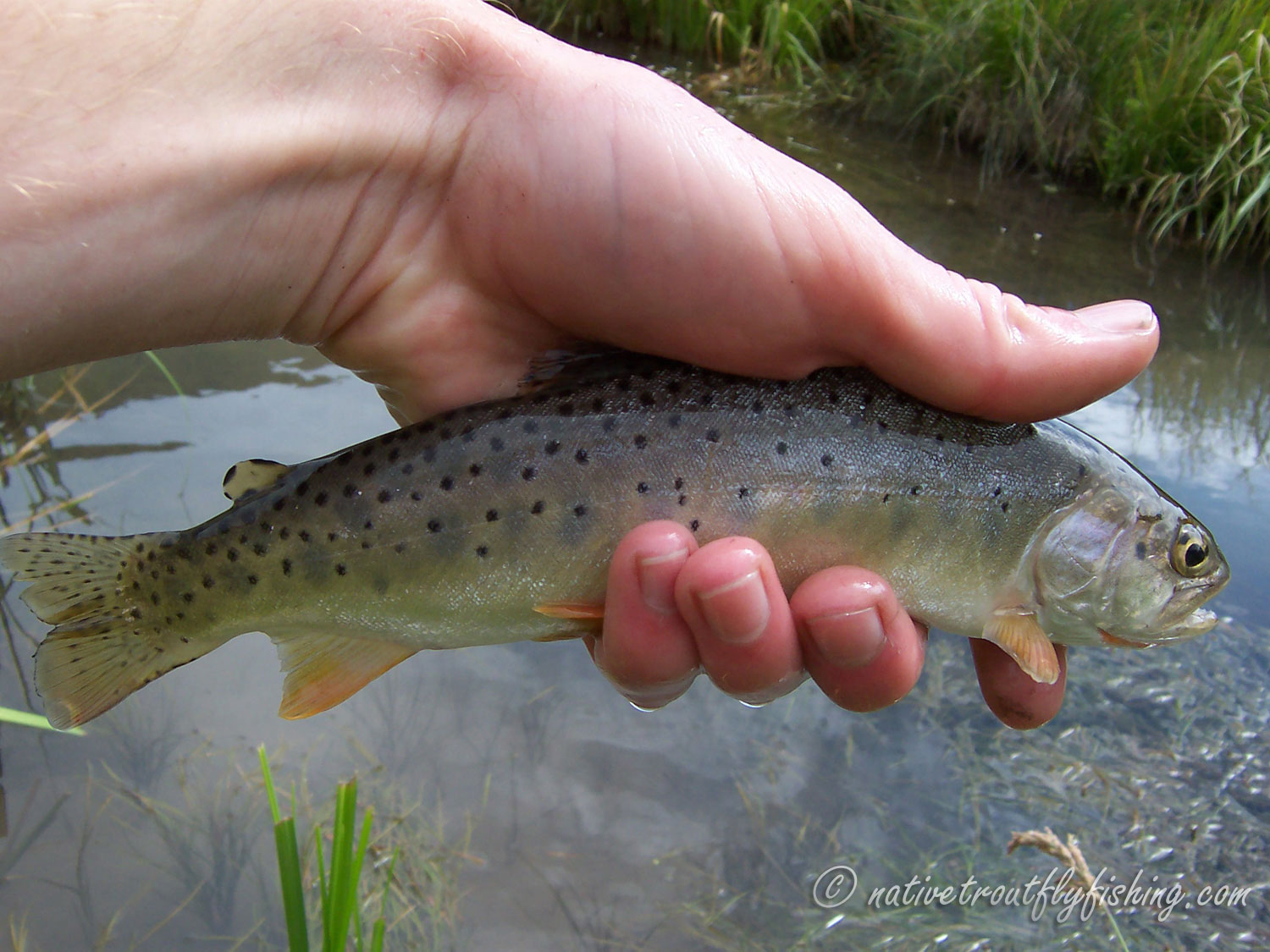
After a few Humboldts out of the hole, I decided to head back to the car so that we could me it home by the end of the day. The rest of the day was spent driving and we didn't get home until 10:30 PM after an extremely successful trip. All in all, I caught 10 types of trout on the trip, including five subspecies of Cutthroat that I hadn't caught before, making it an extremely rewarding once in a lifetime opportunity.
Day 1: Monday June 26th 2006: My dad and I left home bound for eastern Oregon around noon with the hopes that by the end of this trip I would manage to catch some Harney-Malheur Basin Redbands, Columbia Basin Redband and Whitehorse Basin Cutthroat. Other than some extremely high temperatures (109 degrees F in Gresham Oregon), the first day was rather uneventful and we ended up staying the night at my uncle's house in Bend Oregon.
The Three Sisters and Oregon Cascades from my uncle’s house in Bend
Day 2: Tuesday June 27th 2006: This was to be the day for me to do the majority of my fishing; we drove from Bend to the small town of Burns where we purchased our fishing licenses. The next stop was a river in the Harney-Malheur Basin to try to catch some Redbands. We arrived at the river in the mid-morning, set up camp and I got to fishing.
The river
To get away from the campground, I decided to hike upstream a ways. Upon entering the river, the water was a bit high and off colored from snow melt, but luckily that did not stop the fish from feeding. I decided to start with a dry/ dropper river and began to catch fish on a Royal PMX and Lightning Bug set up almost right away. These Redlands were some extremely hard fighting fish, and the first one I hooked jumped four times before finally coming to the net. With the high flows, it seemed that the majority of the fish were keyed in on nymphs, but I caught a few on dries as well. In a few hours of fishing, I managed to catch a fair number of fish, but lost far more including an 18" Redband that I hooked on a streamer in one of the deeper pools and almost had to the net before it tossed the fly.
A Harney-Malheur Basin Redband
Another view of the river
After finishing up fishing and returning to camp, a large thunderhead was moving in and with extremely bad mosquitoes, we made the choice to go ahead and skip camping here and continuing on to our next destination in the Whitehorse Basin to fish for some Cutthroat. Oregon south of the Steens Mountains is extremely sparsely populated and we drove for over an hour without seeing any oncoming traffic. The road to the stream that I planned on fishing in the Whitehorse basin lead us up Trout Creek in the Alvord Basin which was once home of the now extinct Alvord Cutthroat; a victim of hybridization with introduced Rainbow Trout.
An old homestead along Trout Creek, the former home of the Alvord Cutthroat Trout
We arrived at the creek and I started catching fish almost as soon as I started fishing. The first fish that I hooked was an impressive about 15" Cutthroat which managed to shake the size 18 nymph just before I could net it. Once I figured out that this creek was going actually to produce some fish, I took a quick break and we went ahead and set up camp and make some dinner. As I took in my surroundings, I was amazed by the amount of life found along the creek in this parched country, far from civilization. On the walk back to the creek I had a deer run across the road in front of me, and there were jack rabbits scurrying around in every direction.
A small waterfall on the creek
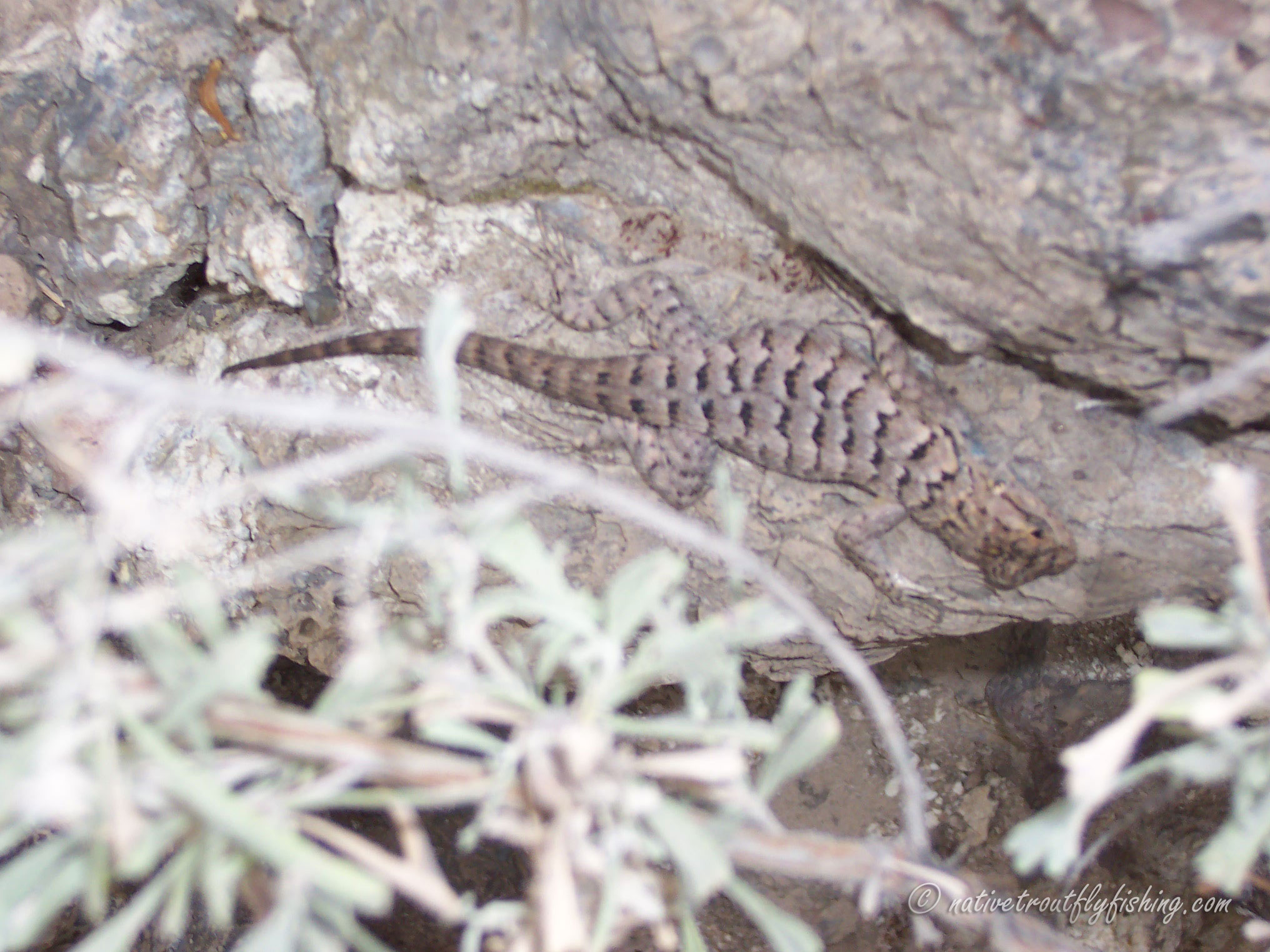
A streamside lizard
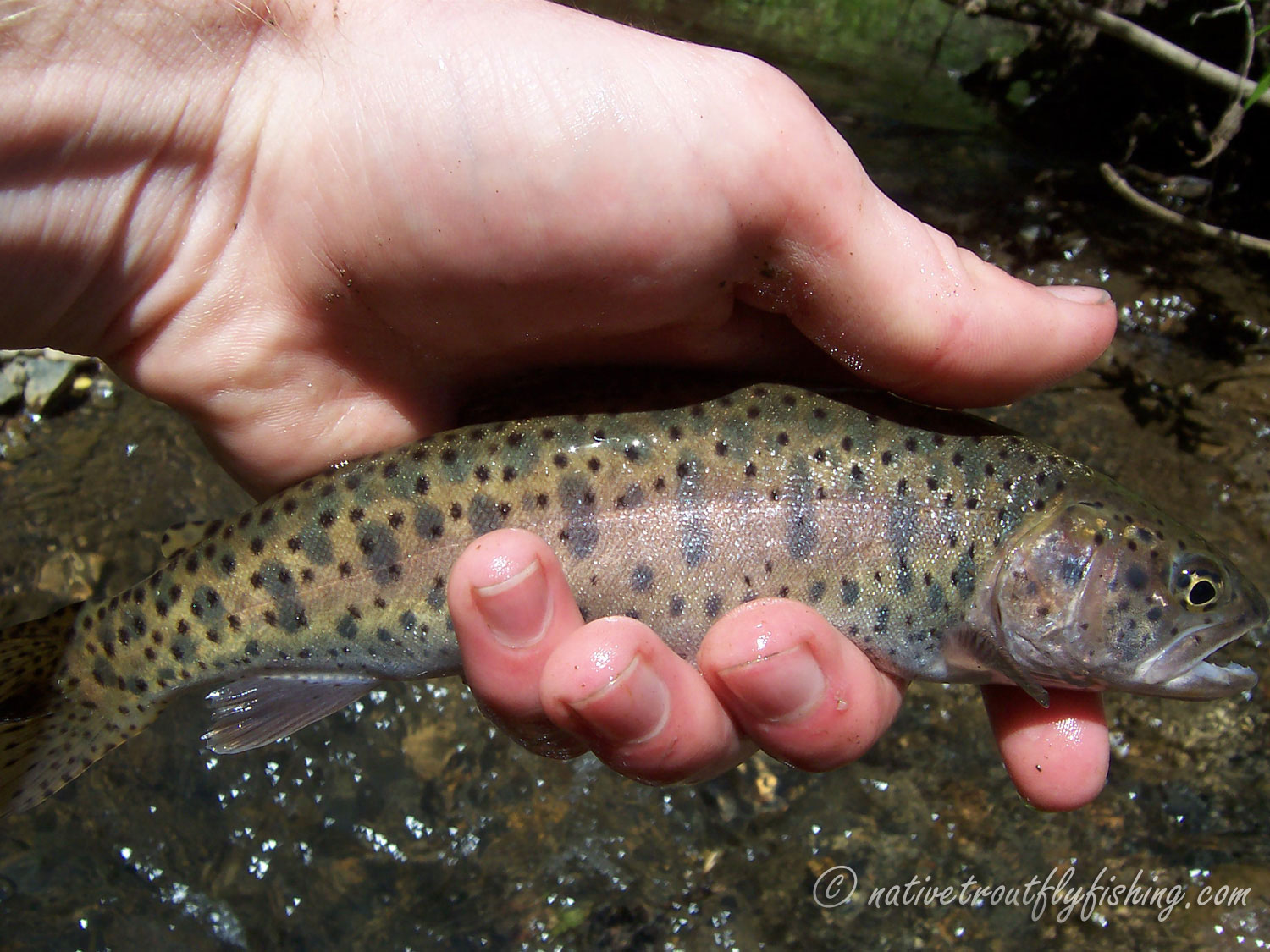
Once I got back to fishing, I found that the fish were especially susceptible to small black nymphs and most good pieces of holding water held a Cutthroat. I fished until dark and caught a good number of Whitehorse Basin Cutthroat, many of which seemed very resistant to letting me photograph them.
A Whitehorse Basin Cutthroat
Day 3: Wednesday June 28th 2006: After getting up, I went back to the creek to do a bit more fishing. However, overnight there had been some thunderstorms upstream, which had raised the flows and colored the creek up a bit and put the fish down. Despite this a little ways upstream I was able to find a series of beaver ponds, and using a Zug Bug nymph I was able to catch a few more fish.
Looking at the creek from the top of a ridge
Me at the Whitehorse Basin stream
After leaving the creek we headed to Winnemucca, Nevada and got hotel room for the night to rest and regroup for the drive home.
Day 4: Thursday June 29th 2006:We left Winnemucca and headed to northeastern Oregon to catch some Columbia Basin Redband, however this time luck was not with me as all of the rivers in this area were blown out from thunderstorms and snow melt. We decided to camp on the Lostine River, as it was one of the few areas that we found were it was not raining.
The Lostine River valley
Day 5: Friday June 30th 2006: When we got up in the morning, the rivers were still blown out and way to high to fish, so we cut our losses and headed home with an uneventful 6 hour drive home.
Day 1: Thursday June 23rd 2005:I planned this trip to try to catch three new species/ subspecies of salmonids; Arctic Grayling, Snake River Fine Spotted Cutthroat, and Lake Trout. I was also hoping to catch some repeat species, including Brown Trout, Yellowstone Cutthroat, and Brook Trout. My dad and I left home bright and early, bound for Yellowstone National Park and only made a brief stop in Missoula to refuel and grab some lunch.
The Upper Clark Fork valley in Montana
The weather was great all through Washington, Idaho and western Montana, until we turned off at the Madison River. After 11 hours of driving, there was an ugly looking thunderstorm hanging out over the Yellowstone area, completely putting the possibility of getting an hour of fishing in on the Madison River out of the question. We pulled into the Norris campground at 6:00 PM, in between rain showers and tried and failed to get our tent set up before the next front of rain came through. By the time the tent was set up, we were soaked and it was an easy decision to just call it a night.
A bull elk across the creek from our campsite.
Day 2: Friday June 24th 2005:We got up early the next morning after a cold Yellowstone night, that had the added bonus of sporadic thunderstorms. The goal for the day was to catch some Arctic Grayling and to do so, we decided to hike into one of the grayling lakes in the upper Gibbon River watershed. The trail to the lake passed through a patch of forest that had been charred in the fires of 1988, and provided little shade or scenic value until the lake.
The typical view on the trail into the lake
The Arctic Grayling lake
When we got to the lake, there were already several other fisherman there, but it appeared that the osprey were having much more luck than they were. We hiked a short distance along the south shore and found a nice point where some Callibaetis mayflies were coming off. I choose to use a double fly setup with a Callibaetis nymph trailed by a Tellico nymph and caught Rainbow Trout on the first cast. However, I had come here for Grayling and was a little worried that Rainbow Trout population would outweigh that of the Grayling. This was definitely not the case, and the first Rainbow Trout would also be the only one that we would see. Almost every cast after the Rainbow was rewarded with a Grayling, which averaged about 8 - 10" with a few larger and smaller ones thrown in. Although the Grayling were exceedingly beautiful, the best part of their fight was the hit after a couple hours of fishing we decided it was time to head back out.
An Arctic Grayling
After hiking out of the lake we went back to camp and got some lunch, then I headed off on my own to try out one the streams flowing through the meadow at Norris. I found plenty of small Brook Trout and lost a couple of decent Brown Trout on hopper patterns and returned to camp at about dinner time after a successful day of trout hunting.
Brook and Brown Trout water in the Norris area of the park
A beautiful, but nonnative Brook Trout
Day 3: Saturday June 25th 2005: The plan for the day was to hit Yellowstone Lake for some Yellowstone Cutthroat and possibly Lake Trout, which were illegally introduced to the lake in the 1980's and are said to congregate in the shallows around the West Thumb part of the lake during June. However, driving past some prime stretches on the Firehole River without fishing was just a bit more than I could handle, so we stopped for about an hour during which, we only picked up one Rainbow Trout.
Fly only water on the Firehole River
Yellowstone Lake
After the Firehole River we continued on to the lake, which provided me with a fishless and strikeless couple of hours, meaning that I would have to try again for a Lake Trout some other time. On the way back to Norris, we stopped at the Gibbon River below the falls where all I got was a few small Rainbow Trout, before returning to camp and calling it a day.
The Gbbon River
Day 4: Sunday June 26th 2005: When we got up in the morning, we decided to leave Yellowstone behind and try our luck fishing down south in the Tetons. However, we got a little side tracked on the way out of the park, as a herd of bison decided to walk down the middle of the road along the Firehole River, forcing our hand on fishing the river again. The stretch that we pulled off at was full of picky rising Browns and Rainbows, which did not want to treat us very well. I did manage to rise a few trout on caddis and baetis patterns, but couldn't actually bring anything to hand.
The bison herd once they finally left the road
Once we were clear of the Bison jam, we headed on for the Tetons and Jackson Hole area. Upon arriving though we were met by thunderstorms and rivers that were flowing far too high due to late spring run-off making the possibility of getting a Snake River Fine Spotted Cutthroat look rather bleak. We decided to stay in Jackson for the night so that I could gather some information at the local fly shops on were to look for some Fine Spotted Cutthroat as the original stream that I choose was blown out. The guys that we talked to at the Orvis shop suggested a stream that was fed by a lake in Grand Teton National Park should be flowing clear this time of the year. With my spot picked out, we went back to the hotel to get a good nights rest to be ready for a fresh start in the morning.
A thunderstorm over Jackson Lake
Day 5: Monday June 27th 2005: We got up in the morning and decide to grab a bite to eat a Bubba's BBQ, which had some awesome food. Our next stop was to set up camp in Grand Teton National Park at Signal Mountain Campground. Once camp all set up we headed out for the fishing spot that the folks at the fly shop had suggested the night before. When we got there the stream was indeed flowing at fishable levels and the water was crystal clear. It didn't take long before I caught my first few Snake River Fine Spotted Cutthroat.
A Snake River Fine Spotted Cutthroat
The Black Bear
We worked our way downstream, and saw a blond black bear along the way, then found a nice run which seemed oddly vacant of fish when compared to upstream. However, a few minutes later my dad's fly line went tight and with a large trout running downstream. The fight only lasted about 30 seconds before the estimated 4lb Cutthroat threw the fly and swam back to the depths. After thoroughly checking to make sure that there wasn't another fish hanging out in the area, we headed downstream and found a nice pool full of rising Cutthroat below a small set of falls. We spent the next couple hours hear catching Cutthroat after Cutthroat on small flying ant patterns and various attractors.
My dad with a nice Fine Spotted Cutthroat
Fishing a productive run
Day 6: Tuesday June 28th 2005: After getting up in the morning it was time to start heading towards home again we decided to head over to the Sun Valley area to see what it is like and more importantly how the fishing was. We arrived in Sun Valley in the middle of the day and went to the local fly shop to see how fishing in the area was. It sounded like the Wood River was out of the question due to high flows, but Silver Creek had been fishing reasonably well lately so we decided to go there.
Silver Creek, Idaho
I started fishing for some picky lipped trout with no success, there were no hatches coming off, and due to that the fish really didn't seem to interested in what anyone was offering them. I stayed for a couple hours during which I only saw one fish landed, and didn't have any hits, so it was back on the road again. We decided that we would try to make the Blue Mountains in Oregon by nightfall and camp there in hopes that the flows in that area would better. We ended up setting up camp on Phillips Lake, Oregon and called it a night.
Day 7: Wednesday June 29th 2005: After all of the driving that we had been doing, we figured that we would just take it easy in this area for the day. Once we got our Oregon fishing licenses we went to the Powder River, and spent a few hours catching put-and-take Rainbows on attractor patterns. Then we went back to camp and took it easy for the rest of the day.
The River
A Rainbow Trout
Day 8: Wednesday June 30th 2005: From what research I had done on the area, there was a nice stream to the south of where we were camping that held pure Columbia Basin Redbands, so I figure it would be fun to check it out. We arrived at the stream, which was flowing at a perfectly fishable level about mid-morning and started fishing in a nice meadow section. The fishing on this stream was amazing, almost every cast in a likely looking spot resulted in a beautiful Redband. The average fish weren't huge, but there were some fish up to 15" around that made things a little more interesting.
Hooked into a Redband
A Columbia Basin Redband Trout
Day 9: Thursday June 31st 2005: At this point, it was time to head home, and we spent the day driving across Oregon and Washington. Even though I didn't get all of the fish that I went after, this was a fairly successful trip. I managed to catch three fish native to the western US; Arctic Grayling, Snake River Fine Spotted Cutthroat and Columbia Basin Redband, along with a number of Brookies and Rainbows.
This blog is all about fly fishing for native salmonids everywhere. It has been my quest to catch and photograph every species and subspecies of salmonids native to North America.
















 Posts
Posts


