About this blog

This blog is all about fly fishing for native trout. On it I cover trip reports, fishing tactics, conservation, the latest news about native trout species and much more. This site provides a companion to my web page Nativetroutflyfishing.com.

Gary

Sunday, August 14, 2011

Eastslope Westslopes

This past weekend the drive over the Cascade Mountains on my way home from work was too much to take without a quick stop for a little fishing. As I hadn't caught any Westslope Cutthroat yet this season, I decided to try a small stream on the east slope of the mountains that I have been meaning to check out for some time. The stream was only about 10 to 15 feet across in most spots, but had a nice amount of holding water so it looked promising. With the water looking good, I rigged up with a dry-dropper set-up and started looking for trout.

Good looking water at the first pool

Good looking water doesn't always mean there will be fish around, but in this case it didn't take long to find the Cutthroat as within a couple of casts I had my first small Westslope to hand.

My first Westslope of the summer

From there the pace remained fairly quick and each good looking pool or pocket would yield two or three of these beautiful trout. The fish were quite eager to rise to a dry fly too and before long I took the dropper off due to their willingness to rise. While the stream was beautiful, it looked like about 15 years ago there were some very poor logging practices in effect and much of the watershed had been clear-cut up to the stream banks and at one time. Luckily the area appeared to be recovering nicely, but when compared with other streams in the area the water temps were noticeably warmer. This warmer water also seemed to have the effect of making the stream slightly more fertile than other mountain streams in the area and all of the Cutthroat seemed to be exceptionally chunky for their size.

A stream-side friend

In an exceptionally nice looking pool for the creek, I rose a fish that was slightly larger than most and after a quick battle I brought what is likely the most beautiful trout I have caught all year in. I must have said "wow" to myself at least ten times as I admired this gorgeous trout and watched it swim back into the depths.

Pictures don't do justice for this one

After covering about a mile of the stream and catching more than my fair share of trout, my desire to get home after a week away finally won out and I reluctantly left this gem of a stream.

A great place to spend any evening!

Tuesday, August 9, 2011

After work wanderings

My last work assignment had me back down in South-Central Washington tagging Coho Salmon. However, working with fish all day, sometimes just isn't enough so after my shift I made a point of exploring some new waters. My first place to explore was a beautiful little meandering meadow stream that I had driven by day in and day out when I was down here last time tagging Chinook Salmon, but it had been closed then. Now I finally had my chance to check it out.

The meadow stream

It didn't take long to hook into something, but the first fish which was a brook trout by the looks of it threw the hook mid jump. However, shortly after I hooked into a decent sized trout and brought what was clearly a stocked Rainbow to the net.

A chunky hatchery Rainbow Trout

Apparently this stream is managed as a put and take fishery and all of the fish that I encountered were cookie-cutter Rainbows, that even my 1wt seemed to quite easily out match. These fish were a bit reluctant to rise to a dry fly, but were suckers for a sunken dry stripped back in at the end of a the drift. The beautiful surroundings kept me fishing for a while, but before long the lack luster nonnative Rainbows lost their appeal and a long day of work finally caught up with me.

The next day I decided to explore some bigger water and headed for the local river, which is well noted for its robust summer-run Steelhead population. I picked a canyon stretch that I had been eye-balling on my last trip over and found a few decent pieces of water to fish.

The road into the canyon

I did a combination of nymphing and swinging, but the water was still a bit high and off color and all that I was able to coax out of the first spot were a few smolts. However, on the way out a I got a bit more excitement then the smolts had to offer, in the form of a rattlesnake that decided to cruise right past me on my way up the trail.

A stream-side visitor

As is more common then not when fishing for Steelhead, I wasn't able to find any fish, but fishing beautiful water was still quite rewarding for me.

Vacant Steelhead water

I fished my last spot of the trip on the way home. This smaller piece of water is known to have a healthy population of native Columbia Basin Redbands as well as a few Westslope Cutthroat in its upper reaches. Time didn't allow for a visit to the headwaters of the stream, but it didn't take long to find some nice Redbands in the stretch that I picked.

A spunky Redband caught on a Royal PMX

This was one of those streams where every fishy looking spot seemed to hold several decent trout, all of which appeared to be keen on the dry fly that I was offering them.

Redband waters

I worked my way upstream wet-wading and casting dries into every likely pocket. While their size was nothing special, being between 6-8" on average, all of the fish were brilliantly colored and hard fighting, with some of the larger ones actually managing to take a little bit of line.

A beautiful and vividly colored native Columbia Basin Redband

Given that I had a long drive ahead of me and had already spent most of the day at work though, I had to limit my exploration of this stream to about a mile of great water before I was forced to head back to my car and hit the road.

Monday, July 11, 2011

Summer time sea-runs

If I had the rank my top ten favorite places to fish, I am really not sure what all I would put on the list. However, I am sure that one of my sea-run Cutthroat haunts at a local estuary would make it. This fishery is not going to be listed among any "famous" waters, but that is the beauty of it, as it offers solitude, beautiful surroundings and native fish. Like other saltwater Cutthroat fisheries, things are driven by the tides and a such it requires time to figure the fishery out. Luckily over the years I have paid some dues at this spot and have learned a few of its secrets. As the general rule with this and other estuaries goes, the fish are most active once the tide starts moving and the bulk of the fish tend to follow the incoming tide in, then ride the outgoing tide back out again.

Low water at the estuary

With tides ideal for the day, my buddy Jonathan and I arrived at the estuary about an hour and a half after low tide and started looking for fish. With the low water, this didn't take too long and I spotted a few smaller Cutthroat and one really nice one that was having fun harassing some spawning Shiner Perch. With the fish spotted I moved into position and on my second cast over a bit of deep water I felt a tug, set, and fish on. The Cutthroat put its all into the battle, jumping five or six times and even brought spectator along that seemed set on following its buddy right up to the net.

Not bad for two casts into the day

Next it was Jonathan's turn and a few casts later, he got a good tug but no hook up before things slowed a bit. Before long I went to some high ground and tried sighting the fish for him. After a minute I spotted a school of 8" to 14" Cutthroat for him to cast to, but they didn't seem to like his offerings and spooked before long. After that Jonathan switched flies and we headed to another spot.

Calm water at high tide

We spotted some fish at the next spot upstream, and but they were a bit spooky with the low water and it wasn't until the tide really started flowing in that they let their guard down. Jonathan was the next one to hook into a fish and got a scrappy little Cutthroat that was probably about 12", but it still put up a good fight and a bend in the rod. Fishing never really got super productive, as the Cutthroat seemed to more finicky than normal, showing selectivity and spooking rather easy.

A beautiful native sea-run Cutthroat

We did get a few more Cutthroat as we worked our way up the estuary with the tide. However, as the tide slacked off the fishing slowed to a halt and as we both had places to be in the evening so we decided to call an end to a beautiful day on the water.

A great day on the water

Friday, July 8, 2011

Back to the beach

So I have to say that for about the last year I have been a bit at odds with the Puget Sound fishery. Yes I have had some good outings, but I haven't had any of those days where you feel like the stars had lined up or anything. In fact, the last time that I fished the saltwater I did pick up a few sea-run cutthroat, but thanks to the persistent wind and a bad cast I also picked up a nice inch long slit in my nearly brand new waders... All complements of a wayward Clouser Minnow. I can definitely say that I have needed a good day on the water for far to long.

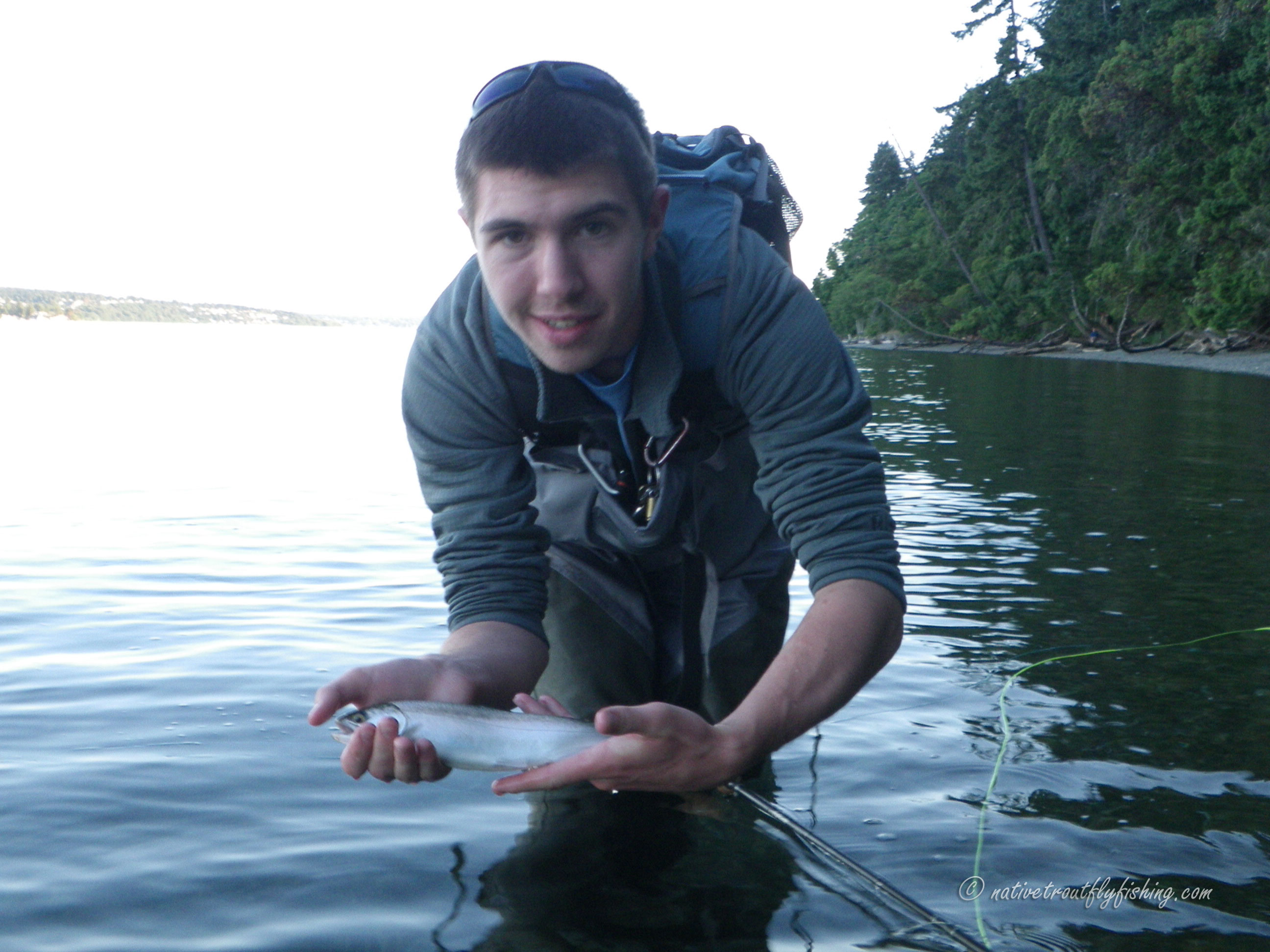
So between some unusually nice weather and catching a whiff of salty sea air on my way home from a long day at work, I just had to get out. I got a hold of my buddy Colton and we decided to hit the beach for the last bit of an incoming tide before dark. When we got to the beach, the first signs of a beautiful sunset were already underway over the glassy calm water. My mind was set on intercepting one of the 2-5lb adult resident Coho, which frequent the beaches of the South Sound this time of the year. So I started things off with a larger herring pattern, whereas Colton went with a smaller attractor pattern that tends to be deadly for just about anything with fins. For the first 20 minutes or so the only signs of life were a lone seal and some small baitfish breaking the surface, however before long Colton found a nice 12" resident Coho on his attractor pattern.

Colton with a nice resident Coho Salmon

A few casts later he got a second one and since I had yet to see an adult jump yet, my resolve crumbled and I switched over to a prawn pattern. This choice was immediately rewarded with one of the little resident salmon as well. This spunky little fish chased to fly right up to the rod tip, before getting hooked and then going for a few good runs.
A resident Coho Salmon for me

I seemed like a school had moved in and fishing stayed good like this for a while, with enough activity between casts to keep things interesting. However, as the evening wore on the rising tide forced us to leave our a spot and look for somewhere with a more favorable back cast. We relocated to a point that is generally rather productive, but the fish seemed to be much more scattered then our previous spot so we had to work a bit harder for them. However persistence pays off...
Yet another resident Coho Salmon

With the tide slowing down and the last rays of light casting a pink glow to the horizon, it was time to go and while the big fish didn't show this evening, it had been just what I had been looking for!
Twilight over the Puget Sound

Thursday, June 30, 2011

June on the Olympic Peninsula - Part 2

The second leg of my work trip put me on the other side of the Peninsula and limited my fishing options by a fair bit. While the flows on the west-end streams had ranged from ideal to low, the stream in this part of the Peninsula were still swollen with snowmelt and some major spring run-off. However, the draw of the mountains was to great for me to ignore and even though I figured I would probably just be going on a hiking trip I made for one of my favorite streams. The flows on the stream were double what they should be this time of the year, even with run-off but sometimes nymphing the soft spots can still produce a fish or two even in these conditions.

The snow swollen river

I rigged up my rod at the trailhead with a heavy soft hackled stonefly and a sink tip and started my search for fishable water. The river was definitely higher than I had ever seen it was carrying a heavy load of silt, however I still found a couple nice pockets at the first spot that I came to. Dead drifting didn't seem to get a lot of results, but as soon as I tried swinging my fly I got some results. The fish hit hard and with the aid of the current put up a hard fight, although it seemed quite unwilling to jump. When I got it in I saw that I had a char and not trout on my fly, in fact likely the rarest of char in the lower 48 a stream resident Southern Dolly Varden.

No bull about it, a beautiful native Dolly Varden

From fisheries reports I know that this stream holds Dolly Varden and no Bull Trout due to a barrier waterfall, external differences do make it possible to discern the two similar species but require a trained eye. The Dolly's heads tend to be less predatory looking and their mouths are much smaller for instance.
Dolly water

I let my next cast drift downstream into another good pocket and my fly was nabbed by another Dolly. With the gray hew to the silty water it these little char seem perfectly adapted to this stream, the way that native trout often seem to perfectly blend into their surroundings.

Another beautiful Dolly Varden

With my early success, I decided to hit the trail and head downstream in search of some more water. However, after covering a solid mile and a half of river and fishing every slow spot I could find, there was no sign of fish anywhere. Since the fish I got right off the bat were more than I expected in the first place and the fresh mountain air and a good hike were hard to beat, I wasn't going to be complaining.

The forest of the northern Olympic Mountains

The forest in the part of the Peninsula are much less luxuriant than those of the coastal rainforests, but they are still very beautiful with moss covered slopes and giant Douglas Firs. Add the the blooming rhododendron, salmonberries and trillium and views of the mountains and it is a great place for an evening hike.

Trillium

While it was peaceful wandering the woods and searching the river for slow pockets, daylight only lasts so long and light fades fast in the forest, so I found myself racing back to the trailhead before I would have liked. Catching a few rare native char and hiking a few miles in some of the finest forest in the state after work is about as good of a way to spend an evening as I can imagine. Although I didn't manage to sneak out again during the week, the two char and the stunning views of the mountains on the drive out were enough to keep me happy until next time.

Sunset over the Olympic Mountains

Tuesday, June 28, 2011

June on the Olympic Peninsula - Part 1

My last job assignment was a three week stint on the Olympic Peninsula and despite the long hours, I was able to find a bit of time to get out after work and do a bit of exploring and fishing. My first two weeks of this assignment were spent out in Forks, WA, a place that I have spent plenty of time in the winter, but seldom make it too in the summer. My first place to explore was a small and exceptionally beautiful coastal stream that I have fished several times for winter Steelhead but have never gotten to try once the weather warms and the flows drop. Although as fishing goes my timing was off by a fair bit as most Cutthroat are out to sea during summer and don't return till the first fall rains. However, being able to see the stream at low water will pay dividends once the winter storms roll in and the Steelhead with them.

The stream

Just because my timing wasn't ideal, didn't mean that the stream was vacant of fish, it just meant that those that were there were a bit on the small side. Most of these were native Coastal Cutthroat, but there were a few Steelhead smolts hanging around too. Dries and nymphs got the attention of the trout, but it seemed like these fish really wanted something that was moving and a basic soft hackle fly fit that bill. Each pool or log jam would produce a Cutthroat or two for a couple of hours before the sun started falling towards the Pacific. Although I wasn't able to find anything over 8", the fish were all beautiful, native and very feisty making for a great first outing of the trip.

A small native Coastal Cutthroat

My next venture to the river was for something slightly larger, with summer-run Steelhead in mind. Armed with my switch rod and a spey-style fly that I came up with I headed one of the many rivers in the Fork area. With the heavy snow pack in the mountains the flows were still a bit high, but the clarity was good. However, as is typical with Steelhead and especially with swinging flies for Steelhead the stars often need to align get one.

Great swinging water

The stars almost aligned for me as about half-way down the run an unseen force intercepted my fly and attempted to rip my rod out of my hand before vanishing into nothingness. This incident resulted in several more fruitless outings on the same stretch of river before I finally decided to trying something different.

For my last fishing outing on the west-end of the Peninsula, I headed down the rainforest to swing some flies. So armed with my switch rod and an articulated leech I headed for one of the wettest places on the west coast.

The Olympic rainforest

While this place receives over 80" of rain a year, I caught it on of those rare sunny beautiful evenings and stunning surrounding made it difficult to pay much attention to fishing.

The river


The flows were great, the clarity was great, the weather was great, and the scenery was amazing, but the fish just didn't seem to be overly cooperative. I wandered a good mile of river and fished several extremely fishy looking runs, but in the end only came away with one bump. In other words it couldn't have been time better spent! However, when you only have a couple of hours to spend in such a beautiful place time seems to like to pick up the pace a bit too much and before I knew it I was enjoying a beautiful sunset and the end of the first leg of my work trip.

A great way to end any day

Wednesday, June 22, 2011

Home stream startup

Being home for the stream opener weekend this year, I decided to kick things off at a local Coastal Cutthroat stream. While this stream is close to home, it is it is very small and the last couple of winters have not been kind to what was once my favorite stretch. Last year blow-downs were the big issue, this year I found that the high flows of winter had all but eliminated all of the holding water in the section.

Brushy, but beautiful

While this stream is a lot of work, without a ton of reward, the fish beautiful and will rise to dries at times and an ten minute drive and an hour of fishing resulted in a handful of beautiful small native Cutthroat.

Native trout 10 min from home... Doesn't get much better...

This time of the year is always tough on this little creek, with only small resident or juvenile sea-run fish present. In the fall the anadromous cutthroat will be returning and if things go as the usually do I will be ending my stream season where I started it.

A spot to look forward to for fall...