About this blog

This blog is all about fly fishing for native trout. On it I cover trip reports, fishing tactics, conservation, the latest news about native trout species and much more. This site provides a companion to my web page Nativetroutflyfishing.com.

Gary

Wednesday, April 26, 2023

2023 Winter Steelhead Wanderings: Part 1 - Early Season

While winter time is when most native trout anglers hunker down, restock fly boxes and dream of summer, in Washington it marks the return of our state fish, the steelhead. While I had hoped to get out earlier in the season, a mix of bad weather, illness and just being busy meant that me first chance to get out wasn't until early February.  Like many steelhead trips the weather was going to make things challenging, but neighbor Dyllon also able to join me so we decided to go with it, what ever the weather through our way.

Upon checking flows first thing in the morning, we were surprised to see that our first choice for the day was still in shape and with that we loaded up the car and were on the road in short order. While flows were holding, the torrential rain on much of the drive out to the river indicated we were going to be dealing with a rising river. While we had hoped that the conditions would thin out the crowds a bit, when we got to the river, there were already two rigs at the first spot we wanted to fish despite the fact the sun still wasn’t fully up yet so we had to divert to another spot. This time we were in luck and had the spot to ourselves.

The river

After a short walk we made it to the river found that it was still in shape, but starting to show some color so we got straight to prospecting for steelhead. It was on of those days where it didn’t take long for the river to show some signs of life and Dyllon hooked into a powerful fish within the first half hour. One thing that I have noticed with big steelhead, is that their instinct when hooked is often to head upstream. Dyllon’s fish did just that and quickly moved over some rapids into the next run and headed straight for a log jam. While Dyllon and I both thought he was done for, somehow he was able to thread the needle and kept the fish from snagging up on the logjam and got it to come back down into our run. From there it was just a tug of war until I was able to net his fish, which was a beautiful bright wild hen.

Dyllon starting the day off with a beautiful native hen

As it turned out, Dyllon was on a roll, and in the next run upstream he hooked another fish. This time it was a much quicker fight and after a couple minutes he brought a wild jack (small male) steelhead to the net.

Dyllon's second fish a wild steelhead jack

Following Dyllon’s back to back fish, there was a long gap in the action as we covered nearly a mile of great looking but fruitless water. However, the last run before we ran out of bank access on our side of the river was an absolute fish trap (piece of water fish will only move through when flows are up) and although there was some tricky water on the inside to contend with, I was able to wade out and get into casting position. It took a few casts, but as my rig passed through the middle of the run I got a savage grab and hooked into a hefty fish. Initially the fish didn’t want to move out of the hole, but after a couple minutes of back and forth, it decided that it had had enough and rocketed downstream. By the time I navigated the tricky fast water and slick rocks back to shore the fish was already in the next run and well into my backing. Back on shore, I was able to give chase and quickly regained my backing and but I found myself two runs downstream by the time the fish was ready to be netted. It took a couple scoops, but we were finally able to net the fish and I was able to admire the beautiful buck.


My first fish of 2023 a beautiful native steelhead buck

Having caught my first steelhead of the year, we worked the area a little longer, but didn’t find anymore willing fish so we started heading back downstream. At this point the river was noticeably starting to rise, so we decided to try the two runs Dyllon caught his fish in earlier in the morning again to see if any fresh fish had moved in.  Dyllon took the spot that held the jack, while I took the other run. Luck was on my side again, and after make a cast that stretched my ability to its limit I was immediately rewarded with a solid take. Shortly after hooking into it, a beautiful steelhead shot into the air. Luckily I had a good hook set and while the steelhead made a few solid runs, it stayed in the hole and I was able to bring it to hand after a few minutes.


Steelhead number two for me - a native hen

After I got my second fish for the day, worked a little further downstream before deciding to relocate to another run further upstream. The water upstream proved to be more typical of steelheading and while I did get one more solid grab, after covering around a mile of river we didn’t hook up with anymore steelhead . On top of that the morning rain was starting to catch up with us and the river was rapidly rising and losing its clarity, so we decided to recognize our success and move onto another stream.

Our next spot was a small tannic coastal stream that has a robust Coastal Cutthroat population that should hold its flows and color despite the rain. The stream was absolutely gorgeous and meandered through lined alder meadows and stands of Sitka Spruce and Western Red Cedar. However, the air still had the strong scent of decaying salmon, signs of a strong run earlier in the season and hopefully there would still be some Cutthroat interested in eat egg imitations.

The Coastal Cutthroat stream

While it was running a bit high, the stream still had good clarity and we started working our way downstream to prospect for Coastal Cutthroat and some possible steelhead. The first few holes didn't produce anything, but at a log jam about an 1/8 mile downstream I finally hooked up with something and after a short fight I landed an beautiful Coastal Cutthroat (with some possible hybrid characteristics).

A beautiful Coastal Cutthroat

We fished downstream a couple more bends and Dyllon caught a twin of the Cutthroat that I had caught and we also got a few smaller Cutthroat parr as well. Despite the decent clarity about a 1/2 mile downstream we hit a section that looked to be challenging at best to cross and with that and rain starting to fall in earnest again, we decided it was time to hike back out and hit the road after an exceptional day on the water.

After my first success outing, I got in touch with my good friend Chris and I were able to find a day that worked for both of us in mid-February and started planning our trip. Like the last trip the weather was going to prove challenging with a big rain coming in the night before after a long dry stretch. Knowing conditions were less than ideal, we picked a couple streams that we knew would keep in shape despite the rain and were on the road at 5:00AM and hiking into the river in the pre-dawn half light.

Our hike in put us at the first hole just as full dawn hit and we got to fishing. After a fruitless first half hour, Chris decided to switch rigs and two casts later he was hooked into a solid fish. The fish was a nice buck of perhaps 10-12lbs that was starting to show some color and wasn’t afraid to put in a few jumps. When the fish seemed to be tiring, Chris brought it in to be tailed, and just as I grabbed it the hook popped out and the steelhead shot off back into the depths.

Chris working a likely looking seem

That single steelhead ended up being the only fish we would touch as we covered the next mile of river downstream. Despite plenty of beautiful water it just didn’t seem like many fish had pushed in yet so we decided to move on to the next stream. Chris had yet to fish our next stream so I decided to start us out at a spot that has been a consistent producer.  This spot is another of those fish traps, with the river coming over a rapid and dropping off along a cliff face to provide fish with a safe spot to hold in. The run also has a nice tailout well suited to swinging flies and as I had been wanting to dust off my Spey rod, Chris took the top of the run, while took the tailout. I had just finished covering the best part of the tailout, when Chris hooked into a nice fish on the inside seam. With that, I reeled in and ran upstream to help him land it. This time Chris had a good hook set and after a few more runs we are able to tail the beautiful chrome bright hen.

Chris' dime bright native hen

Even the tail was shinny

After taking a few more casts to make certain there wasn’t another willing fish in the hole, we hiked back to the car and head upstream to another spot. This spot didn't show any signs of life and the thought of getting home early and out of the cold, windy and wet weather was enough for us to call it on another good rainy day on the river.

Monday, March 13, 2023

New Subspecies of Redband Trout formally described - McCloud River Redband

The Redband Trout of the McCloud River upstream of the falls in populations such as Sheephaven Creek have been recognized as distinct for sometime, but have been classified as Oncorhynchus mykiss stonei with the other Redband Trout of the Sacramento basin. However, a new study on the genetics of these trout has shown that they are distinct enough from other populations of Redbands in the basin to warrant subspecies status under the scientific name Oncorhynchus mykiss calisulat. This subspecies status includes the Sheephaven Creek population, as well as fish in other nearby isolated tributaries such as Edson, Tate and Moosehead creeks among others, which are found to constitute a single genetic unit.

The McCloud River Redband Trout - now recognized as Oncorhynchus mykiss calisulat

Those familiar with McCloud River Redband might be slightly confused as the type specimens for O. mykiss stonei were collected from the McCloud River, however these type specimens were from the population found below the falls. Based on the results of this study, the type specimens from the lower McCloud River are more closely related to the fish found in the Pit River and Goose Lake basin than they are to the fish in the upper McCloud River. Additionally, while the upper McCloud River Redband Trout represent a single ancient lineage of Redband Trout isolated above the falls in the basin, the fish in the Pit River and lower McCloud River appear to have genetics of several lineages, including more than on strain of Redband Trout and Coastal Rainbow Trout.  

Interestingly, the Sacramento Redband Trout found in the the Pit River and North Fork Yuba River appear to be more closely related to Redbands found in the Warner Valley and Surprise Valley than they are to Goose Lake Redband Trout. The study also showed the uniqueness of the Golden Trout of the Kern River and support their recognition as a unique species of trout. As genetic methods continue to evolve more isolated populations of O. mykiss are sampled it is possible the additional subspecies will be formally recognized in the coming years. For example, there is some evidence of a unique population of Redband/ Rainbow Trout in the Upper Skagit drainage that may warrant subspecies status in the future, not to mention unique populations such as those in the White River or Fort Rock basins in Oregon.

A link to the study can be found here.

Campbell, M.A., E. Habibi, G. Aubringer, M. Stephens, J. Rodzen, K.W. Conway, A.J. Finger. 2023. Molecular systematics of redband trout from genome-wide DNA sequencing substantiates the description of a new taxon (Salmonidae: Oncorhynchus mykiss calisulat) from the McCloud River. Zootaxa 5254 (1): 000-029. https://doi.org/10.11646/zootaxa.5254.1.1

Friday, August 26, 2022

Evening Kayaking for Coastal Cutthroat

On a recent trip up to my parent's house up in Gig Harbor, I was able to sneak away for a couple of hours to do a little kayak fly fishing for sea-run Coastal Cutthroat on the Puget Sound. Back when I lived in Gig Harbor, most of my free time was spent fishing for sea-run Cutthroat and I was quite excited to revisit on of the more productive beaches in the area. I was able to launch the kayak around 4:30PM to catch the last couple of hours of the incoming tide. My original plan was to troll a fly until I either got a fish or located some good structure However, this approach was complicated by thick mats of seaweed that were rolling in on the tide. This meant that I had to stop every few minutes and clean my fly off before continuing on. 

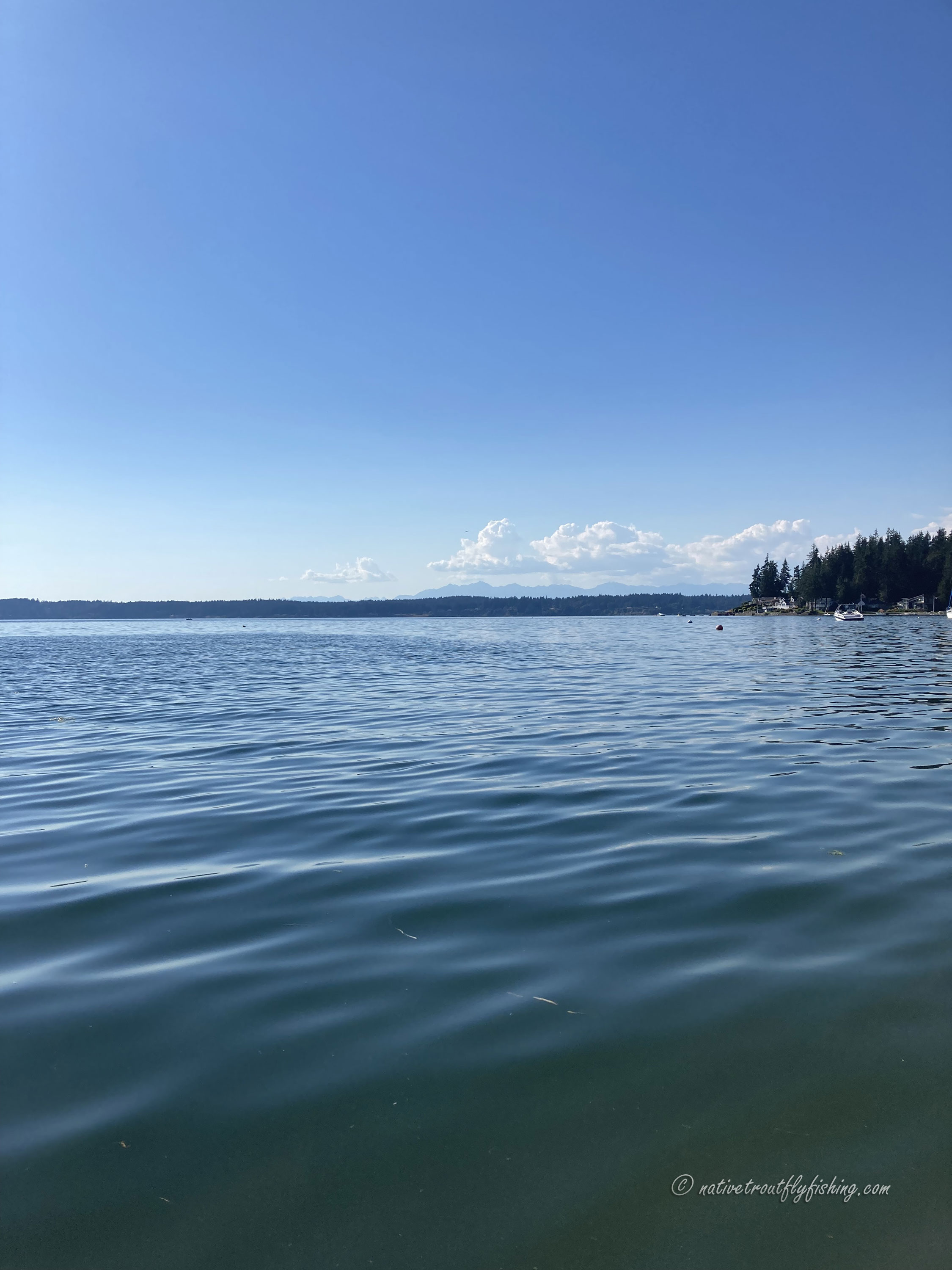
Looking out over the Puget Sound towards the Olympic Mountains

After covering about a mile I finally cleared the seaweed mats just as I started passing over some good looking structure of a nice point. I figured this would be a good spot to start to drift with the tide and I started retrieving my fly. When my fly was about half way in a fish absolutely crushed it and my 6WT doubled over. The fish started off coming right at me and left me scrambling to retrieve my line fast enough. Just as I caught up, the fish followed this up with several short runs. After a couple of minutes I was able to get my line on the reel, just in time to see the big Cutthroat which looked every bit of 20" come shooting out of the water.  A few minutes later I was finally able to get the Cutthroat along side the kayak and was very thankful for my long handled net as I finally scooped up the beautiful 20" native Coastal Cutthroat.

A beautiful 20" anadromous Coastal Cutthroat Trout

After catching my big sea-run, I started to drift and cast. As Coastal Cutthroat tend to travel in pods, I wasn't surprised when I immediately hooked another fish, which unfortunately popped off. This scenario repeated itself three more times before the bite seemed to die off and the seaweed floated in encouraging me to move on. I covered another mile of beach, but didn't get a single additional grab before the wind picked up and forced me to turn back towards my take out. It was at this point that I realized that my net, which I had been so thankful for an hour earlier had some how managed to fall out of the kayak. Making this my third net for fall in the line of duty over the years...

Choppy water as the wind picks up on the Sound

A greedy little Staghorn Sculpin

On the way back I stopped where I had caught the big Cutthroat, but all I managed to find were a couple of Staghorn Sculpin. With the no indication of Cutthroat, light fading and the wind still howling it was finally time to make may way back to the take out after a wonderful evening on the water.

Thursday, August 25, 2022

Westslope Cutthroat of the South Cascades

After my trip up to the Methow drainage after Westslope Cutthroat in the North Cascades in Washington, I wanted hunt down some Westslope Cutthroat in the Southern Cascades of Washington this summer as well. In particular, I was hoping to find some fluvial Westslopes. One thing I strive to do on my website is represent as much of the diversity as possible in each variety of trout, such as the different life history forms. The fluvial life history forms are also known as riverine migrants and are known for making concerted migrations throughout larger river systems as well as typically reaching much larger sizes than stream resident forms. The difference in the two life history trajectories also typically results in slightly different phenotypic traits, which is why I was hoping to document the fluvial life history.

After a bit of research, I landed on a moderate sized stream that I had fished way back in 2006, but at that point the stream was dominated by small Columbia Basin Redband Trout, with Westslopes only being a rarity. Since that point, catch and release regulations have been adopted in parts of the watershed and supposedly the Cutthroat population had responded very well to the new regulations. When I mentioned my plans to my neighbor Dyllon, he was interested in joining me, so set a date on the calendar and made plans for the trip.

The day of the trip we were on the road by 5:30 AM and made good time getting over to the east side of the Cascades. As we drove up the road once we hit the stream, we were both shocked with the number of anglers out already. I had specifically chosen a stretch as it appeared to have a good concentration of pools based on satellite imagery hoping that it might hold a few large Cutthroat and luckily it was still free of anglers. . While the morning was extremely chilly, we opted to wet wade as the clear skies promised that it would be quite hot by the afternoon. Dyllon opted for a streamer setup, while I brought, my 2WT with a dry/dropper and my 6wt with a double nymph rig. Once we were rigged up, it was time to get on the water.

Dyllon took to the river first and had a few good grabs in the first hole, but it wasn't until we got to the next riffle upstream that we landed any fish. I opted for the nymph rig and after a couple casts got a good take and after a quick battle landed a beautiful fluvial Westslope Cutthroat on my October Caddis nymph.

A beautiful orange-bellied Westslope Cutthroat Trout

After I got my Westslope, Dyllon got a nice Redband on his streamer and I picked up a couple small trout on my dry at the head of the riffle before we moved further upstream. The next stretch of the stream was a mix of riffle and pocket water habitat and turned out to be the most productive of the day. With the abundance of pocket water I grabbed my 2WT and started working up the run. The fishing was fast and furious with a fish on almost every casts and two Cutthroat (one on the dry and one on the dropper) on one of the casts. The recovery of the Westslope Cutthroat population was on full display in the section of river, as about 75% of the fish we encountered were Cutthroat. Despite the predominance of Cutthroat, it still was a mystery what would grab on each cast, and I was surprised by a couple of Chinook Salmon parr on dries in addition to the Redbands and Cutthroat.

A healthy wild Chinook Salmon parr

Dyllon managed to get a few decent fish up to 12" and continued upstream on ahead of me. Just as Dyllon was vanishing from sight I landed a nice cast along a boulder on the far bank and saw a big flash as a nice trout grabbed my dropper. I got a solid hookset and 2WT was completely doubled over by the powerful fish. The trout stayed deep and made a number of runs before I was finally able to net a beautiful 17" fluvial Westslope Cutthroat.

A beautiful fluvial Westslope Cutthroat Trout

The big Cutthroat managed to thoroughly put down the run, prompting me to continue moving upstream. The water for the next 1/4 mile was predominately pocket or shallow riffle water and most likely looking spots seem to produce a fish on my dry/ dropper rig.

The stream

I linked up with Dyllon at a series of deep pools, where it was time to switch back to my nymph set up. The most productive of these pools was quite deep and required a long drift to get to where the fish were holding. This resulted in a low take to hook up ratio, but by being persistent I was rewarded with some nice Cutthroat and a beautiful Columbia Basin Redband.

A beautiful native Columbia Basin Redband Trout

After the deep nymphing hole, we found one more productive run before we started to run into the afternoon innertube and swimmer hatch and decided to relocate. We headed downstream to where a few major tributaries came together to try our luck in some larger water. Right off the bat we found a nice run and I dredged up a beautiful 11" Westslope on my October Caddis nymph, which was definitely a good sign. After that first Cutthroat, the fishing slowed down considerably. 

The second river

We finally found some more good water about a 1/4 mile upstream, where both Dyllon and I managed to get into some more fish. For me it was another Columbia Basin Redband and a few smaller Cutthroat on my nymph rig, but Dyllon got the real surprise when he hooked into a nice fish on the streamer. I saw him hook into it from downstream and was able to reach him just in time to net a beautiful Bull Trout for him. Bull Trout are quite rare in this watershed making this a very special catch. We took extra care handling this beautiful fish and it was a joy to watch it glide back into the depths after being released.

Dyllon's surprise Bull Trout

We covered a bit more water, but didn't find much more in the way of fish and with temperatures reaching their peak for the day we both decided to call it a day. After encountering 4 native species and finding an amazing Westslope Cutthroat fishery I am already looking forward to my next trip to the east slope of the Cascade Mountains.

Monday, August 15, 2022

After work Coastal Cutthroat

Every now and again I find myself with an odd hour or two that would be the perfect time to sneak a little fishing in. When I lived in Gig Harbor, I had a handful of solid spots for native Coastal Cutthroat that were perfect for such outings. However, since moving a few years ago I have had a hard time finding a spot in my local area that has really fit the bill for the quick after work outing. Sure there are a couple beaches not to far away, but they have been inconsistent producers at best and dependence on the tides always makes fishing in the salt water less than straight forward. The other local waters I have found are just far enough from my place that they require a slightly longer block of time. What I have been really looking for is a quality small stream or pond and on my last outing with 2 hours to burn I found the stream I was looking for.

This actually was not my first time to this stream, as last year I had taken my buddy Steve here and he caught his first sea-run Coastal Cutthroat in the creek right at a road crossing. However, I played guide on that outing and this trip was my first time really exploring the creek with a fly rod in my hand.

I arrived at the creek at 5:30PM, with just enough time to explore the 1/4 mile stretch I had been meaning to check out. As I wasn't quite sure what to expect, I came equipped with my 1WT with a dry/dropper step up and my 2WT with a rust colored aggravator nymph, a fly that fishes well both dead drifted or twitched as a streamer. The first hole that I came to was several feet deep, with little flow so I opted for the streamer. After letting my aggravator nymph sink in next to a log, a bright 10" Cutthroat shot out and chased the fly but refused to grab. Subsequent casts failed to get even the slightest response from the trout, so I decided to continue downstream, at least feeling good that there were some sea-runs in the creek already.

The Creek

The next couple of bends of the creek were shallow and show no sign of life, but as I neared a deeper pool I spooked another 10" Cutthroat in 8" of water and halted my progress to see if there were any other fish about. It turned out that yes, there were several more fish about as I spotted five large Cutthroat in the 14" to 18" range sitting on the edge of the drop off into the hole. With little current or cover, I knew I was only going to get one shot at these fish, so I carefully lined up my cast and made a presentation. My aim was true and the cast landed just over the drop off, slightly upstream of the fish. Immediately a previously unseen fish came out of the depths and grabbed the fly, but failed to hook up. Luckily this did not spook the rest of the fish and with the fly still in play I was able to strip it right in front of the group of Cutthroat and sure enough one of the fish darted out and viciously attacked the fly. For a moment I thought that the stars had aligned as it felt like the hook had taken, but one big headshake later and my fly popped loose and the school completely spooked.
Hard to spot at first, but there are five Cutthroat holding right in front of the drop off.

In the hole just downstream, I spotted several more Cutthroat of a similar size, but just like the group upstream I only got one shot at each of them and despite several solid grabs, I just couldn't get a firm hookset on any of them. However, another bend downstream I was finally able to get the attention of a Cutthroat and this time got a solid hookset. This fish was fresh from the saltwater and full of spunk and quickly found its way into a logjam, but I was lucky enough to get my net under the logjam and come up with the the 12" Cutthroat. The fish was chrome bright. with no visible cutthroat markings and after snapping a few quick photos shot back into the depths. 
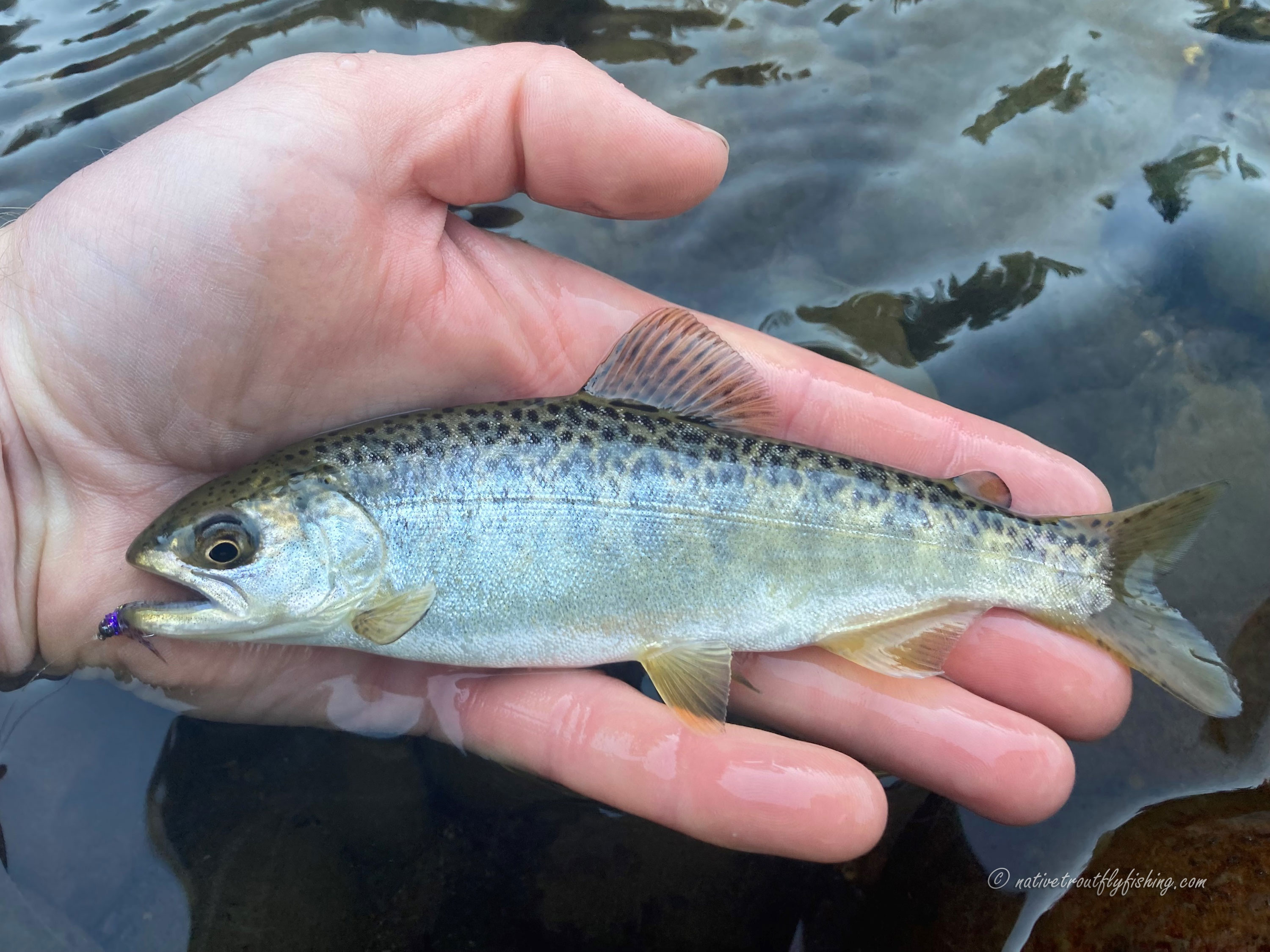
A beautiful bright sea-run Coastal Cutthroat

At this point I worked my way back upstream, but it appeared that either the fish I had encountered on the way downstream were still hunkered down or had moved on and I didn't have any additional luck. However, with a new close to home stream to fish and having caught a beautiful sea-run it was a great evening on the water.

Wednesday, August 10, 2022

Rainbow and Redband Trout Taxonomy - How do I count my trout?

Following up on the classification of Cutthroat Trout, I wanted to do my best to cover the classification of Rainbow/ Redband Trout. While Cutthroat taxonomy is a bit tricky and inconsistent, the classification of Rainbow and Redband Trout is in many ways even more challenging. As such, this post is going to be much longer than the one for Cutthroat. 

Just like Cutthroat Trout, there are multiple ways to interpret Rainbow and Redband Trout classification

Unlike most Cutthroat subspecies, that have clear delineations often associated with watershed boundaries, Rainbow Trout subspecies typically have zones of transition making clean classification systems challenging at best. Even where clear watershed boundaries do exist in the Northern Great Basin of Oregon, past connections to other watersheds complicate classification. In many cases this has resulted in secondary contact between forms of Rainbow and Redband Trout resulting in transitional forms. The lower Klamath River is a clear example of this, where the fish in the lower river represent a mixture of Coastal Rainbow Trout and Klamath Lakes Redband genetics. As with Cutthroat, I am going to present Rainbow Trout classification as three systems, the Behnke System, the Genetics based system that I use one my website and the Western Native Trout Challenge System. 

For the purpose of this post, I am not including any of the Rainbow Trout like trout of Mexico or Gila and Apache Trout. There are at least 12 distinct forms of Mexican Trout, all of which originated from the Rainbow /Redband Trout lineage, likely involving two to three distinct colonization events. Long isolation has resulted in significant differences from Rainbow/ Redband Trout further north and suggest that many of these trout could be considered distinct species. Similarly, Gila and Apache Trout both represent and ancient divergence from the Rainbow Trout lineage, occur long enough ago that they are distinct from Rainbow and Redband Trout as well as the Mexican Trout and represent their own lineage.

Behnke Classification: (Italics for "sub populations")

The classification system for Rainbow and Redband Trout developed by Robert Behnke is covered the  in the outstanding book Trout and Salmon of North America.  Behnke's system is based on traditional taxonomic methods that account for physical differences, such as phenotypic traits (spotting or coloration) scale counts, vertebrate counts etc. These methods were excellent for their time and are still useful, but often miss linkages that genetics work picks up. Based on taxonomic methods, Behnke recognized 9 subspecies of Rainbow /Redband Trout native to the United States, with two additional subspecies found outside the United States, the Kamchatkan Rainbow Trout and the Baja Rainbow Trout of Mexico. Both of these forms are closely related to the Coastal Rainbow Trout. 

Coastal Rainbow Trout account for a single subspecies that stretch from Alaska all the way to Southern California. The presence of sea-run Coastal Rainbow Trout (i.e. steelhead) has resulted in genetic exchange between populations of Coastal Rainbow resulting in the large continuous range of the subspecies. The next lineage is the Columbia Basin Redband Trout, which similar to Coastal Rainbow Trout have had significant genetic exchange between populations due to the steelhead life history. Columbia Basin Redband Trout are found east of the Cascade Mountains in the Columbia Basin, in the Fraser River basin upstream of Hells Gate and in the Athabasca River east of the continental divide.

The next group of Redband Trout Behnke lumps as a single subspecies known as the Great Basin Redband Trout. He acknowledged that there is significant diversity among these fish an that they likely derived from multiple sources, but his lumping differs significantly from the Genetic system. In the upper Sacramento watershed Behnke recognized two subspecies of trout, the Sheephaven Creek Redband Trout and McCloud River Redband Trout, which we will see also differs from the genetic method. The remaining Rainbow Trout subspecies are consistent between Behnke's classification system and the other two systems that were are discussing here. The Eagle Lake Rainbow Trout is a unique isolated lake adapted population likely deriving from a mixed Coastal Rainbow and Redband ancestry. Similarly the Kern River Rainbow Trout is thought to arise from a mixed ancestry of Golden Trout and Coastal Rainbow Trout. It is important to note that historically Golden Trout were considered a distinct species and there are still some that recognize them as such. 

  1. Coastal Rainbow Trout
  2. Columbia Basin Redband Trout
  3. Great Basin Redband Trout
    1. Fort Rock Redband Trout
    2. Harney-Malheur Basin Redband
    3. Catlow Valley Redband Trout
    4. Klamath Basin Redband Trout
    5. Chewaucan Redband Trout
    6. Warner Lakes Redband Trout
    7. Goose Lake Redband Trout
  4. McCloud River Redband Trout (also associated with fish found in the Pit and Feather Rivers)
  5. Sheephaven Creek Redband Trout
  6. Eagle Lake Rainbow Trout
  7. Kern River Rainbow Trout
  8. Little Kern Golden Trout
  9. California Golden Trout
Subspecies outside the United States

  1. Kamchatkan Rainbow Trout 
  2. Nelson's Trout or Baja Rainbow Trout

Genetics Based System: (Italics for "sub populations")

The Behnke system did a good job of classifying Rainbow and Redband Trout, but evidence has suggested some changes to the classification of several of the Redband Trout forms. While there is still significant work to be done with the genetics of Rainbow and Redband Trout a few recent studies have provided significant clarity regarding the relationships of these fish. Genetics work suggests that Behnke's classification of Coastal Rainbow Trout and Columbia Basin Redband Trout may not be as straightforward as originally thought. With a 2000 study (here) suggesting the core of the Rainbow and Redband Trout lineage originated in California and northern populations predominately originated from glacial refuges in the Columbia Basin (Redband Trout) and on Queen Charlotte Island (Coastal Rainbow Trout). The genetics work also suggests that mixing of these two lineages appears to be more extensive than suggested by traditional taxonomic methods, however a more recent study (here) supports the subspecies divide at the Cascade crest. Like Behnke genetics work does not subspecies level distinction for the Athabascan Rainbow Trout (here) and has indicated that the Athabascan Rainbow Trout is very closely related to Redbands in the upper Fraser River. Additionally, studies show that both the Kamchatchka Rainbow Trout (here) and the Baja Rainbow Trout (here) are genetically very closely related to Coastal Rainbow Trout. 

A notable study that deviates from the Behnke system was conducted by Ken Currens, Carl Schreck and Hiram Li, titled the Evolutionary Ecology of Redband Trout. Based on the results of this study the Northern Great Basin Redband Trout should be broken out into multiple lineages. First the Redband Trout of the Harney-Malheur Basin and Catlow Valley (determined in this study) group with the Columbia Basin Redband Trout. Next the Goose Lake, Chewaucan Basin and Warner Lakes Redband Trout all group with the McCloud River and other Redband Trout of the Northern Sacramento Basin. A major difference comes up with the Klamath Basin Redband Trout, which appear to have two to three separate forms. There are two groups with subspecies level differences in the basin, one in the headwaters of the Williams, Sprague and Sycan Rivers (Klamath Headwaters Redband Trout) and another group associated with Klamath Lake. A third group in select tributaries of the upper basin aligns with the steelhead populations in the lower river, which appear to be a mix of Redband and Coastal Rainbow trout as mentioned in the Behnke section. The other major difference is the distinctiveness of the Fort Rock and White River Redband Trout. Both of these groups align most closely with the Columbia Basin Redband Trout, but have diverged enough due to long isolation and possible past contact with the Klamath Redband Trout that they should be consider distinct subspecies. Additionally, the Sheephaven Redband Trout are now recognized to just be a population of McCloud River Redband Trout that have experienced significant a genetic bottleneck, but are very closely related to other McCloud River Redband populations (see here).

  1. Coastal Rainbow Trout
  2. Columbia Basin Redband Trout
    1. Harney-Malheur Basin Redband
    2. Catlow Valley Redband Trout
  3. White River Redband Trout
  4. Fort Rock Redband Trout
  5. Klamath Lakes Redband Trout
  6. Klamath Headwaters Redband Trout
  7. McCloud River/ Sacramento Redband Trout
    1. Pit River Redband Trout
    2. Goose Lake Redband Trout
    3. Chewaucan Basin Redband Trout
    4. Warner Lakes Redband Trout
  8. Eagle Lake Rainbow Trout
  9. Kern River Rainbow Trout
  10. Little Kern Golden Trout
  11. California Golden Trout

Western Native Trout Challenge System

The Western Native Trout Challenge classification system is by far the most simplified of the classification systems with significant lumping. In fact, the 9 to 11 subspecies recognized by the other two classification systems are reduced to just 6. The most notable changes off the bat is that only a component of the Coastal Rainbow Trout subspecies are included, as the Alaskan Rainbow Trout. The classification of Alaskan Rainbow Trout as a distinct subspecies is not recognized by the science but instead is a categorization strictly for the challenge. The most significant lumping is with the Redband lineages, where all of the forms are lumped into a single Interior Redband classification. 
  1. Alaskan Rainbow Trout
  2. Interior Redband Trout
  3. Eagle Lake Rainbow Trout
  4. Kern River Rainbow Trout
  5. Little Kern Golden Trout
  6. California Golden Trout

Sunday, July 31, 2022

Westslope Cutthroat of the North Cascades

I recently had to make a work trip over to Washington's Methow Valley and managed to find a few hours to do some exploring for native Westslope Cutthroat. While I have caught plenty of Westslope Cutthroat in Washington State, I had never had a chance to fish for them in the northern part the state. My preference has always been to catch native trout from a variety of streams across their native range so I was particularly excited to look for some Cutthroat in the Methow basin.
The upper Methow Valley

The stream I selected, had a barrier in the lower watershed and was supposed to have a healthy population of Cutthroat upstream. Upon arriving at the stream, there were two were two things working against me. The first was that the creek had been caught up in one of the many wildfires that had torn through the Methow basin and much of it had burned. The second was that the cold wet June resulted in a prolonged runoff season and the creek was still high and off color. 
The stream

Given the off color water, I rigged up with a flash body PMX and a Lightning Bug dropper set deep to get the attention of the fish. It turned out that neither the burn nor the off colored water appeared to be hindering the trout and within a few casts a small Cutthroat eagerly rose to my dry fly. The fast water and my 2WT  made the 8” Cutthroat feel more formidable than it should, but it still didn’t take long to bring it to hand. 
A beautiful native Methow Basin Westslope Cutthroat

The Cutthroat in this stream were a stunning beautiful mix of bronze-yellow and vibrant orange with a classic Westslope spotting pattern. Continuing upstream, the fishing was fast paced with most pockets producing a gem of Cutthroat, but I was surprised by a Brook Trout on my dropper as well. While Brook Trout are typically the bane of Westslope Cutthroat, luckily this population seemed to holding its own with about 80% of the fish I caught being Cutthroat. 
A beautiful, but invasive Brook Trout

With the sun slipping behind the peaks, I decided to end my day a a particularly productive pool. I switched out my Lighting Bug for a Blow Torch nymph and the trout couldn’t resist it. After a couple smallish fish, I hooked into a fish that that had a bit more weight behind it. I nearly lost the trout when it tried to dive into some woody debris but I was able to pull the 11” Cutthroat  free and bring it to the net.
The big Cutthroat of the day

After catching the biggest Cutthroat of the outing I decided to call it an evening. Despite how many times I have caught Westslope Cutthroat, the beauty of these fish never ceases to impress. 
The canyon on the way out

Then again the beauty of the places these Cutthroat are found is pretty hard to beat too. While in the area, I was also able to get out for a short hike to an alpine lake and I have to say that the scenery did not disappoint. 
Washington truly is a beautiful state!